

Every Monday, I share my first take on 3 interesting opportunities.
If you want me to dig deeper into an idea, vote for it. Use the poll at the end of this email.
A quick review
Thursday 6 August, I highlighted the potential for more capital returns at Nexon: 11% FCF Yield, Zero Debt, and a Potential Tencent Takeover.
Good news: Last Thursday 13 August, the Korean video game maker declared a big special dividend. This brings total dividends in 2026 to ~20% yield.
Nexon’s share price jumped > +25%.
But this is not a happy story. I have not bought any shares because I was still completing my thesis. This is a repeat of PayPal (PYPL US).
Sad!
What do I do? I’ll need to make my process even more efficient.
At the same time, as I shared with a reader, a big risk is I turn greedy and take shortcuts. I’ve seen someone blow up like that.
Finally, what’s the potential technical lesson here?
When new management takes over a cash-rich company, watch for changes in the company’s attitude towards cash.
When I shortlisted Nexon, I shared my observation from their 2026 capital markets day:
The tone from the new management seems to be moving from “hoarding cash just in case we see an attractive acquisition” to “let’s optimise our capital structure”.
Enough talk. Let’s move on to the 3 interesting opportunities.
Genting Malaysia Berhad (GENM MK)
About (14 Aug 2026)
Share price: MYR 1.77
Market capitalisation: MYR 10,032 mn (USD 2,455 mn)
Enterprise value (EV): MYR 21,936 mn (USD 5,369 mn)
Average daily volume (ADV): MYR 3 mn (USD 1 mn)
NTM P/E: 19x
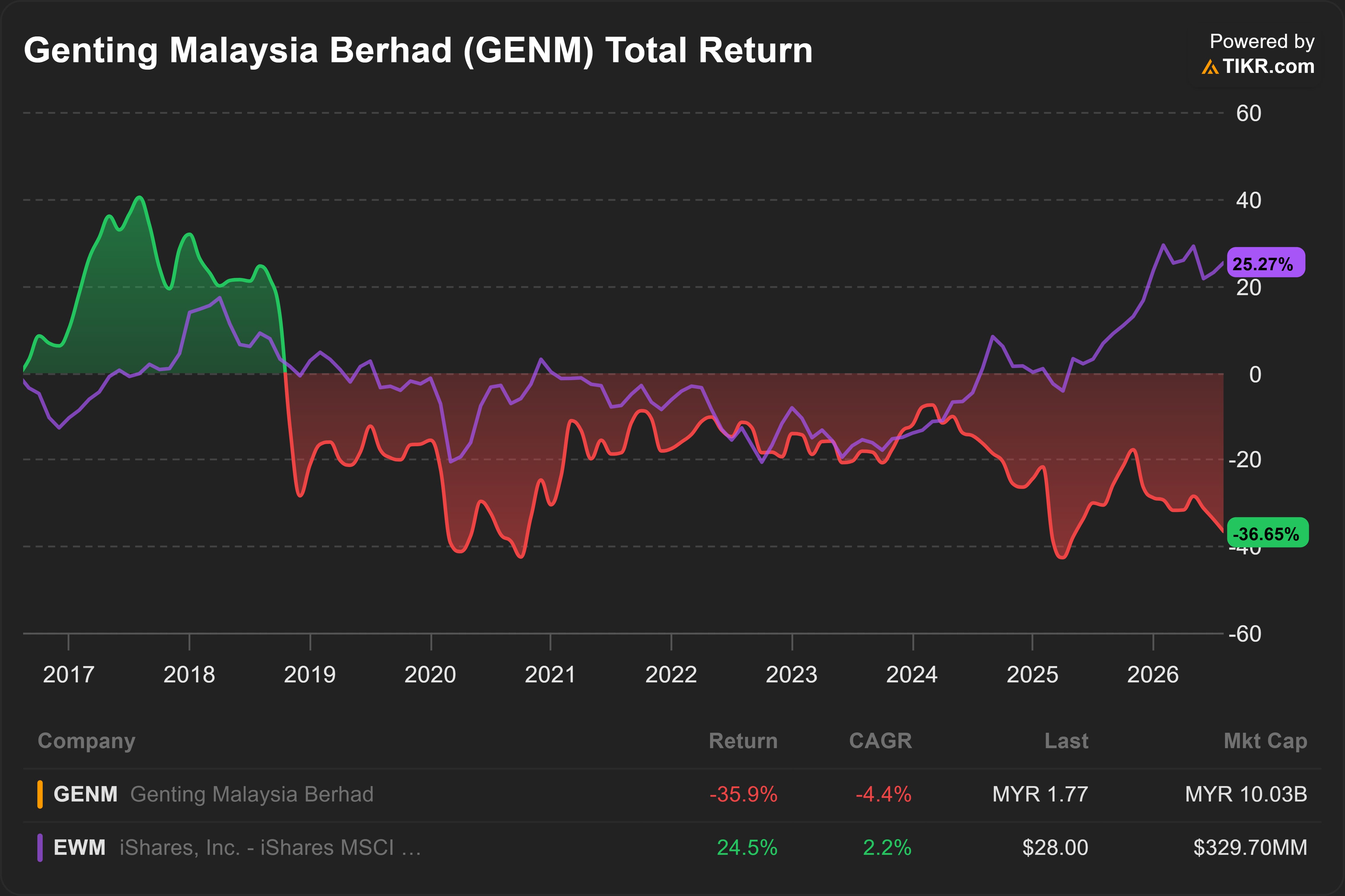
GENM owns a casino monopoly in Malaysia (63% of revenue). It also operates casinos in the US & Bahamas (19%) and the UK (18%).
My initial estimate suggests at least ~ 8% free cash flow yield on EV.
Considering its above-average growth potential, this is an attractive premium of ~ 4% over Malaysia 10y government bond.
Under-recognised growth?
In December 2025, GENM won one of the only three New York full commercial casino licenses.
Because it already has a racino in New York, GENM was able to quickly introduce live table games and commercial slots by April 2026. The other two licensees have to build their casinos from scratch.
GENM will effectively have a casino monopoly in New York City until around 2030. Fitch estimates that by 2028, New York will increase EBITDA by more than 50%.1
However, consensus seems to have not fully recognised this growth potential. Sell-side forecasts EBITDA in 2028 will only be ~ 12% higher.
Privatisation?
In October 2025, parent Genting Berhad (GENT MK), offered MYR 2.35 per share to acquire all remaining shares it did not already own.
Independent advisor Kenanga Group deemed the offer not fair and not reasonable. It did not account for the potential upside of the New York license bid. They assessed fair value between MYR 3.48 and MYR 3.77.2
While GENT successfully increased its stake from approximately 49.3% to 73.8%, it did not receive enough acceptances from shareholders to reach the regulatory thresholds required for delisting (75%) and compulsory acquisition (90%).3
There are signs that GENT may try again later this year.
“It is a time to pause and rethink what can be done next,” CEO Tan said. “We have the capability to advance the plan to the next stage within a year.”4
If there’s another attempt, it can only happen from December 2026.
Malaysia’s law prohibits GENM from making another attempt within 12 months from the date the offer failed (1 December 2025).5
Factors to focus on
More details on the growth potential in New York?
How much financial headroom does GENT have for another privatisation attempt?
Empire Resorts controversy?
How big is the potential exposure from RAV Bahamas litigation?
Tuas Limited (TUA AU)
About (14 Aug 2026)
Share price: AUD 2.22
Market capitalisation: AUD 1,217 mn (USD 862 mn)
Enterprise value (EV): AUD 680 mn (USD 482 mn)
Average daily volume (ADV): AUD 8 mn (USD 5 mn)
NTM P/E: 55x
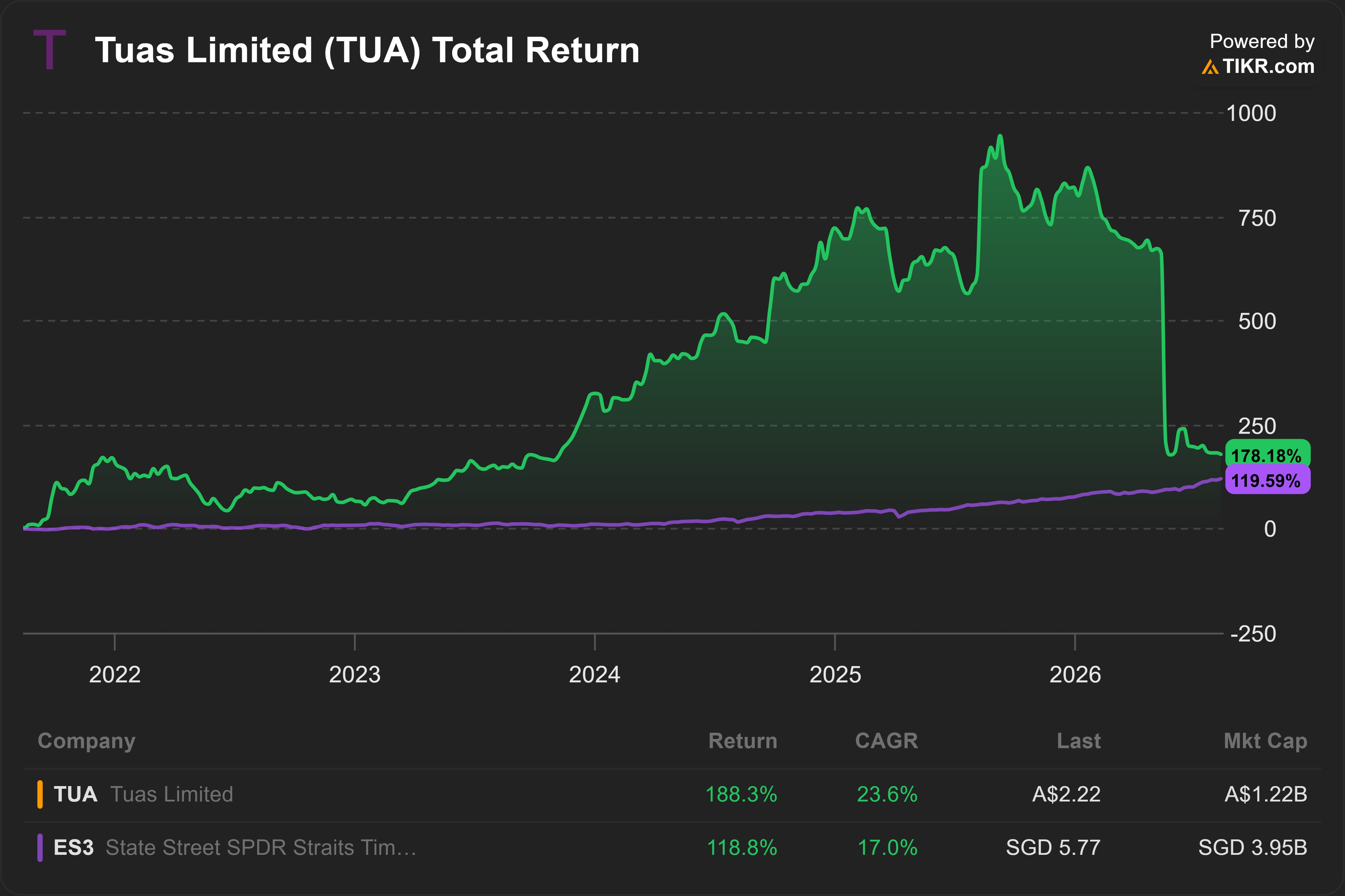
TUA owns Simba Telecom, Singapore’s 4th telco.
Its share price had a good run. Investors were anticipating big gains from its proposed acquisition of M1, Singapore’s third largest telco.
That all fell apart in May 2026.
IMDA, Singapore’s telco regulator, launched an investigation into Simba Telecom over alleged unauthorised use of spectrum bands. The acquisition fell through. Share price plunged -60% in a day.
Good business, temporary headwinds?
IMDA’s investigation is still ongoing.
We don’t have any precedent to work with. In Singapore, there had been no previous cases of telcos using spectrum that had not been assigned to them.6
But I will be surprised if IMDA revokes Simba’s license.
That would defeat the regulator’s goal of introducing more competition. If there is indeed unauthorised use, I suspect the more likely outcome is a fine.
Under the Telecommunications Act 1999, IMDA can impose a financial penalty of SGD 1 mn or up to 10 per cent of Simba’s annual turnover, whichever is higher.7
This means we could be looking at a fine of up to SGD 17 mn. This will wipe out a year’s profits, but is only 4% of TUA’s cash.
In any case, all these worries overshadow TUA’s good business.
Compared to StarHub Ltd (CC3, STH SP), Singapore’s 2nd largest telco, TUA has much smaller market share.
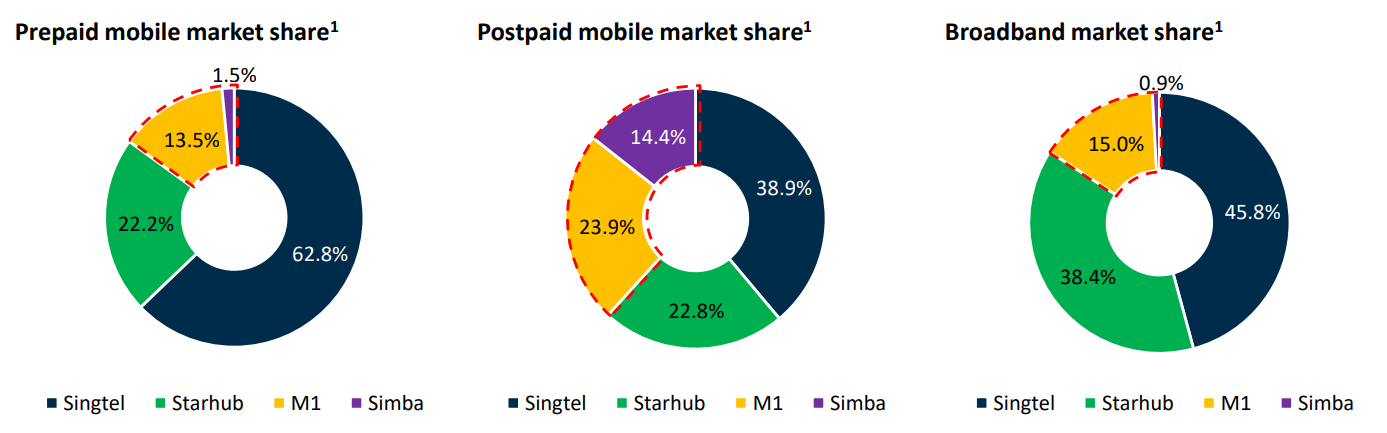
Source: TUA (2026)
Despite that, TUA’s operating profit margins (OPM) far exceed StarHub’s. In the last twelve months (LTM), it reported 10% OPM vs. StarHub’s 5%.
TUA is the low-cost producer.
Under-recognised growth?
TUA earns almost all its revenue from consumers. It wanted M1 because it’ll give Simba instant access to enterprise customers.
With the deal now scrapped, TUA will have to build its enterprise revenue from scratch. This will take time. But the fact remains that TUA, being the low cost producer, has significant growth potential in enterprise.
M1 earns ~13% of its revenue from enterprise customers, across both mobile and broadband.8
If TUA’s revenue profile eventually converges towards M1’s, I estimate enterprise will contribute an incremental revenue of SGD 25 mn. This will increase total revenue by ~15%.
Factors to focus on
Growth potential from broadband and enterprise customers?
How much more market share can TUA take?
Reviews indicate Simba’s network still suffers from some dead zones, making some consumers reluctant to switch despite the steep discount to incumbents.
However, recent reviews suggest Simba is aggressively addressing these coverage gaps. Anecdotally, a family member uses the network and seems satisfied.
How much more capex will TUA need?
DBS estimates spectrum constraints combined with higher cybersecurity compliance capex might turn Simba’s free cash flow negative9
CAB Payments Holdings plc (CABP LN)
About (14 Aug 2026)
Share price: GBP 0.81
Market capitalisation: GBP 206 mn (USD 278 mn)
Enterprise value (EV): Not meaningful for a bank
Average daily volume (ADV): GBP 0.2 mn (USD 0.2 mn)
NTM P/E: 9x
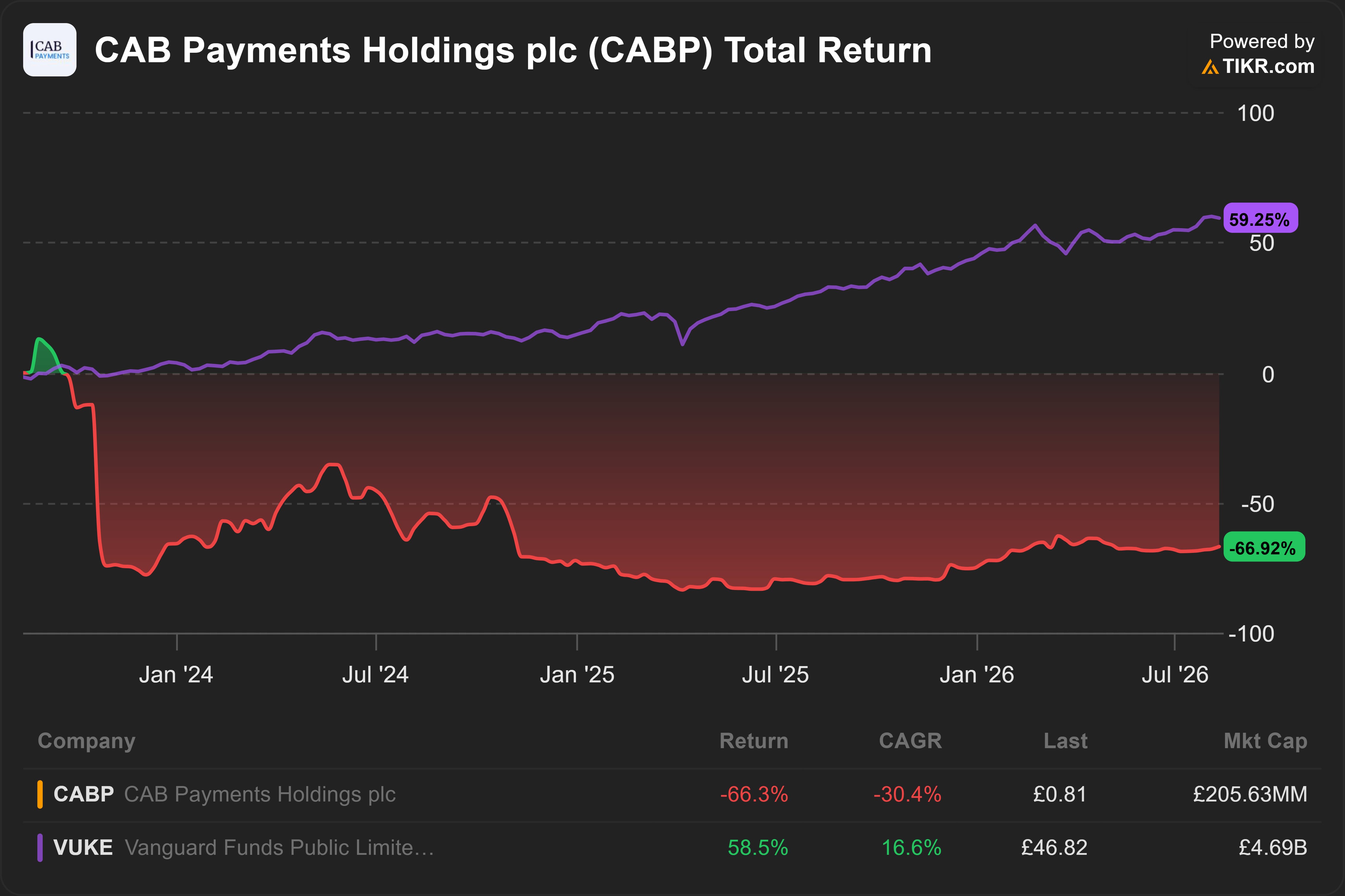
CABP specialises in business-to-business (B2B) cross-border payments and foreign exchange (~ 70% of revenue).
Capital returns?
On 6 Aug 2026, CABP announced its first interim dividend at ~40% of adjusted profit after tax during H1’26.
There is potential for more capital returns.
CET1 ratio in H1’26 reached 21.7%. This significantly exceeds CABP’s medium term target of between 16.5% and 17.5%.10
The board has committed to returning remaining surplus above the target CET1 range, through share buybacks and /or special dividends.
Potential sale at a higher price?
On 9 April 2026, StoneX Group Inc. (SNEX 0.00%↑ US) offered GBP 1.10 per share to acquire CABP.
However, the deal collapsed after Helios refused to back the bid. Helios is a private equity fund holding ~ 45% stake in CABP.
Helios likely saw the SNEX bid as an undervaluation. Yet, having held CABP for nearly a decade, the fund is well past the typical private equity holding period and has a strong incentive to exit.
If a suitor emerges with a better offer, I suspect Helios will be highly motivated to sell.
Factors to focus on
Helios offered USD 1.15 per share (~GBP 0.85) to take CABP private. For now, the independent board has rejected this.11
Is there a risk that CABP is taken private at an unreasonably low valuation?
Estimate how much more capital returns CABP can make before its CET1 ratio reaches its medium-term target
Vote for the best idea
If you want me to dig deeper into an idea, vote for it.
Coming up next
I will look deeper into NICE Information Service Co., Ltd. (030190 KS) this week. This was the idea you voted the most interesting in my previous email.
NICE is the largest credit bureau in South Korea. It has ~ 70% market share in the country’s consumer credit scoring market.
At 9x NTM P/E and 10% FCF yield, the market seems to be ignoring its growth potential, especially in advertising and Vietnam.
Subscribe to get the analysis when I publish.
Subscribe for 2 to 3 analyses of global SMID equities every week.
Discover overlooked ideas and rethink familiar names.
Published by Andrew Wong, ACA, CFA
In case you missed it
Last week, I highlighted the opportunity I am seeing in CTOS Digital: 7% FCF Yield, Potential 2x Buyout Target, Insider Buying.
CTOS Digital: Malaysia's Top Credit Bureau, a Potential Double Bagger

Last week, you highlighted a potential opportunity in CTOS Digital Berhad (CTOS MK). What have you learnt since then?
I also highlighted 3 red flags many bulls miss in Shift4 (FOUR 0.00%↑ US):
Shift4: 20% growth. 7x PE. But 27% short interest

20% revenue growth over the next 2 years. Only 7x P/E.
Disclaimer
This publication is for informational, educational, and entertainment purposes only and does not constitute financial, investment, legal, or tax advice. The content herein is a record of my personal research and investment process, and all analysis, forecasts, and opinions expressed are solely my own.
I make no representation or warranty, express or implied, as to the accuracy, completeness, or timeliness of the information provided. The stock market is highly volatile, and my forecasts, estimates, and assumptions may prove incorrect.
I am not acting as your financial advisor or fiduciary. You should not rely on any information in this publication to make investment decisions. Under no circumstances will I be held liable for any direct, indirect, or consequential losses or damages arising from your reliance on the content of this publication.
At the time of publication, I do not hold any positions in GENM MK, TUA AU and CABP LN, either long or short. I may change my views, predictions, or personal portfolio positioning at any time without notice.
Really interesting opportunities, thanks for sharing