

Every Monday, I share my first take on 3 interesting opportunities.
If you want me to dig deeper into an idea, vote for it. Use the poll at the end of this email.
NICE Information Service Co., Ltd. (030190 KS)
About (7 Aug 2026)
Share price: KRW 15,100
Market capitalisation: KRW 883 bn (USD 627 mn)
Enterprise value (EV): KRW 751 bn (USD 534 mn)
Average daily volume (ADV): KRW 2 bn (USD 1 mn)
NTM P/E: 9x
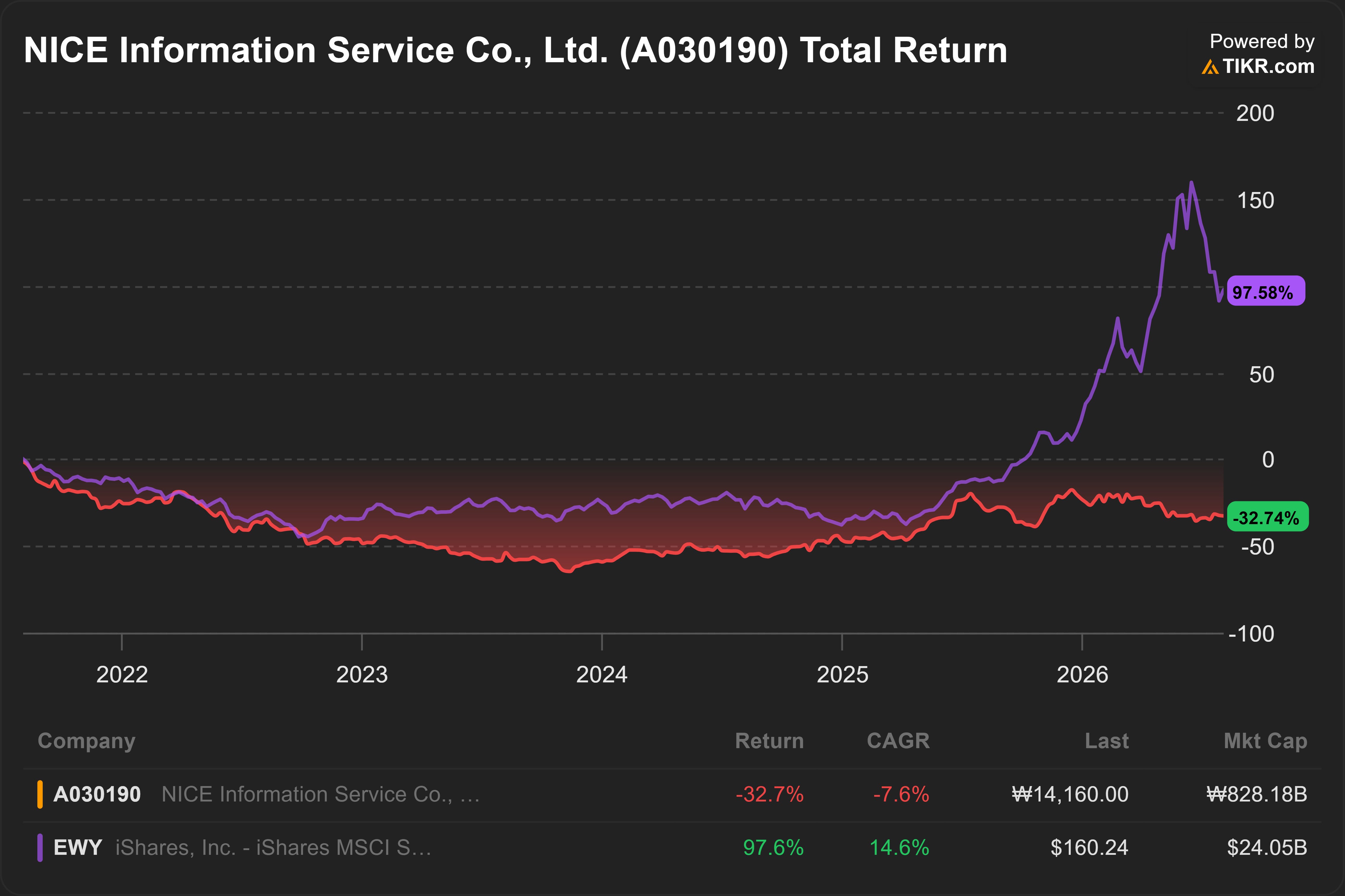
NICE is the largest credit bureau in South Korea. It has ~ 70% market share in the country’s consumer credit scoring market.
Main customers include banks that use the credit scores for both personal and corporate lending.
My initial estimate suggests ~ 10% free cash flow yield on EV, an attractive premium of ~ 6% over South Korea 10y government bond.
Under-recognised growth?
At 9x NTM P/E and 10% FCF yield, the market seems to be pricing zero growth.
At least MSD growth possible. However, it seems like NICE will continue growing revenue by at least mid-single digit (MSD).
Revenue is tied to loan growth in South Korea. NICE’s revenue growth accelerated significantly during 2019 and 2020, driven by a boom in lending.
Even though loan growth has now decelerated, it still remains between MSD and high-single digit (HSD). The Bank of Korea reported 0.7% YoY growth in private sector lending in May 2026.1 This works out to be ~ 9% annualised YoY growth.
Advertising. South Korea passed the Data 3 Act in early 2020.
Essentially, this new law allows NICE to sell its credit data to advertisers, so long the data is pseudonymised.
Instead of selling this raw data to third-party marketers, NICE acquired advertising agencies so it could capture the value itself.
Vietnam. Vietnam could contribute to stronger-than-expected growth. In May 2026, the State Bank of Vietnam issued a license for credit information service to NICE.2
Vietnam is Korea’s top destination for foreign direct investment (FDI), the second most popular country for Korean tourists, and the third largest trading partner.
Factors to focus on
What is the downside risk to loan growth in South Korea?
It seems like household lending is facing some weakness due to high indebtedness, but this is being offset by corporate lending.3
Growth potential in advertising and Vietnam? Timeline?
Potential for more capital returns?
Business is capital light, but payout ratio is only ~35%
LONGi Green Energy Technology Co., Ltd. (601012 CH)
About (7 Aug 2026)
Share price: CNY 12.93
Market capitalisation: CNY 97,723 mn (USD 14,480 mn)
Enterprise value (EV): CNY 83,135 mn (USD 12,319 mn)
Average daily volume (ADV): CNY 1,853 mn (USD 275 mn)
LTM P/B: 2x
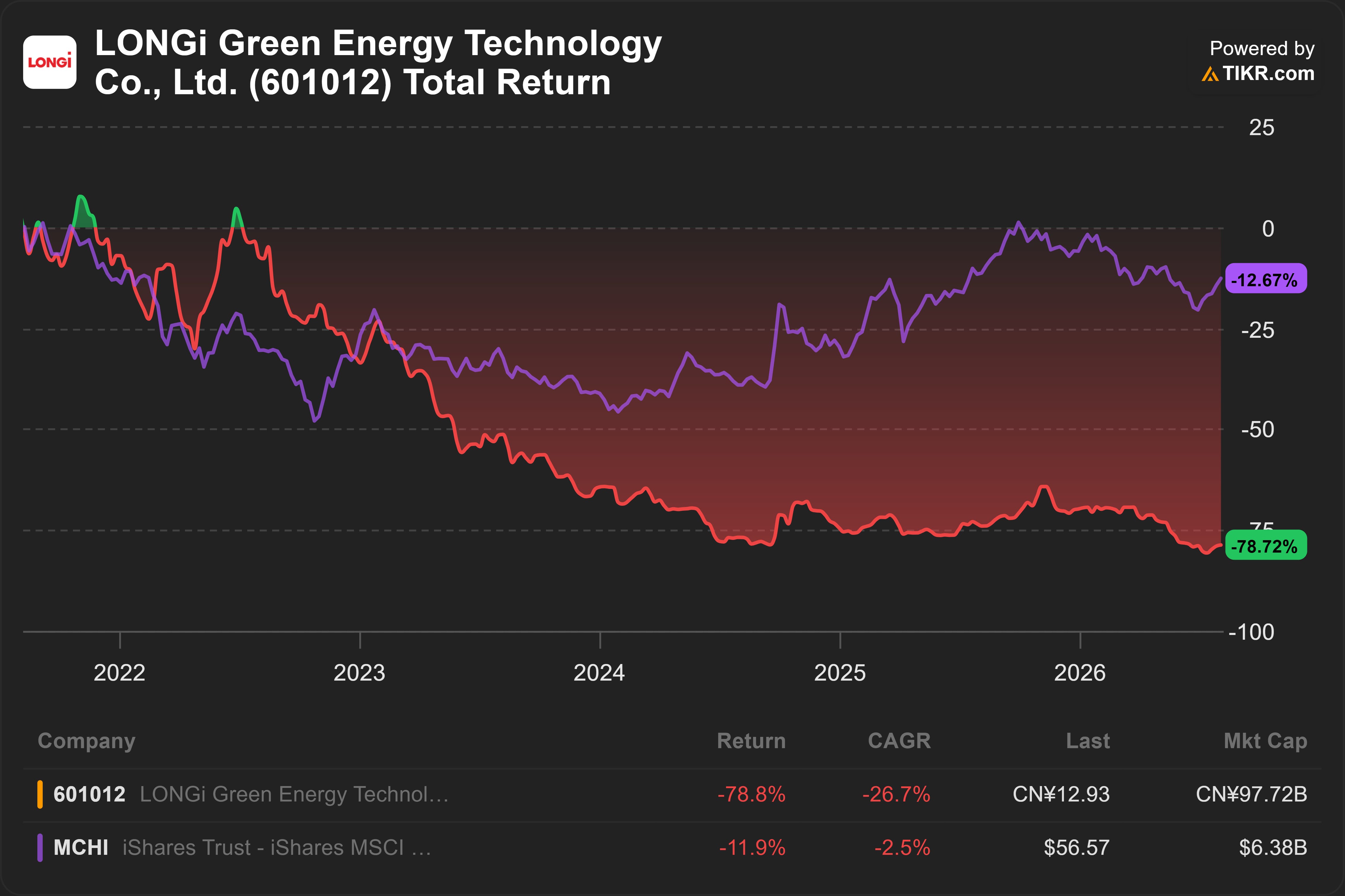
LONGi is the world’s largest maker of solar wafers and the second largest maker of solar panels.
Cyclical inflection?
It is no secret that the solar industry is in a severe oversupply.4
The media likes to quote the International Energy Agency (IEA)’s report that “In 2024, there was sufficient manufacturing capacity to have produced more than twice as many solar PV modules as were actually deployed.”
However, the consensus often underestimates demand growth. The orange hairy lines below show this:
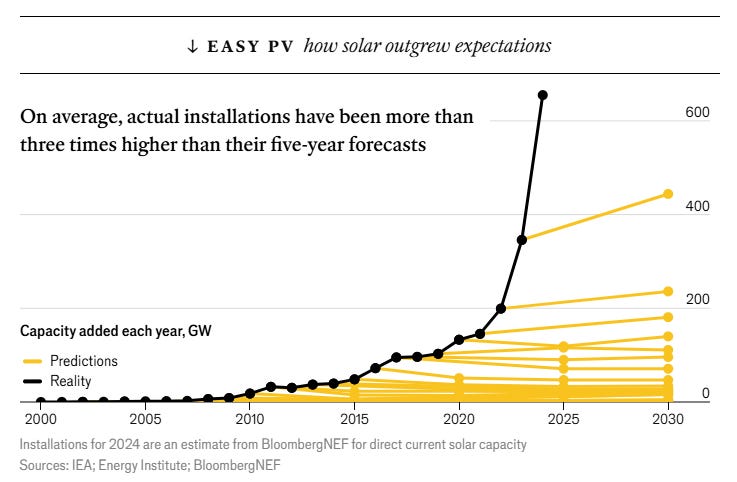
Source: The Economist (2024)
There are two reasons why demand growth will likely re-accelerate:
Higher-than-expected oil prices
Declining cost of battery energy storage systems (ESS)
I discussed them in detail here.
Second point: falling supply.
Cash capex of top 5 solar companies has declined from the peak in 2023.
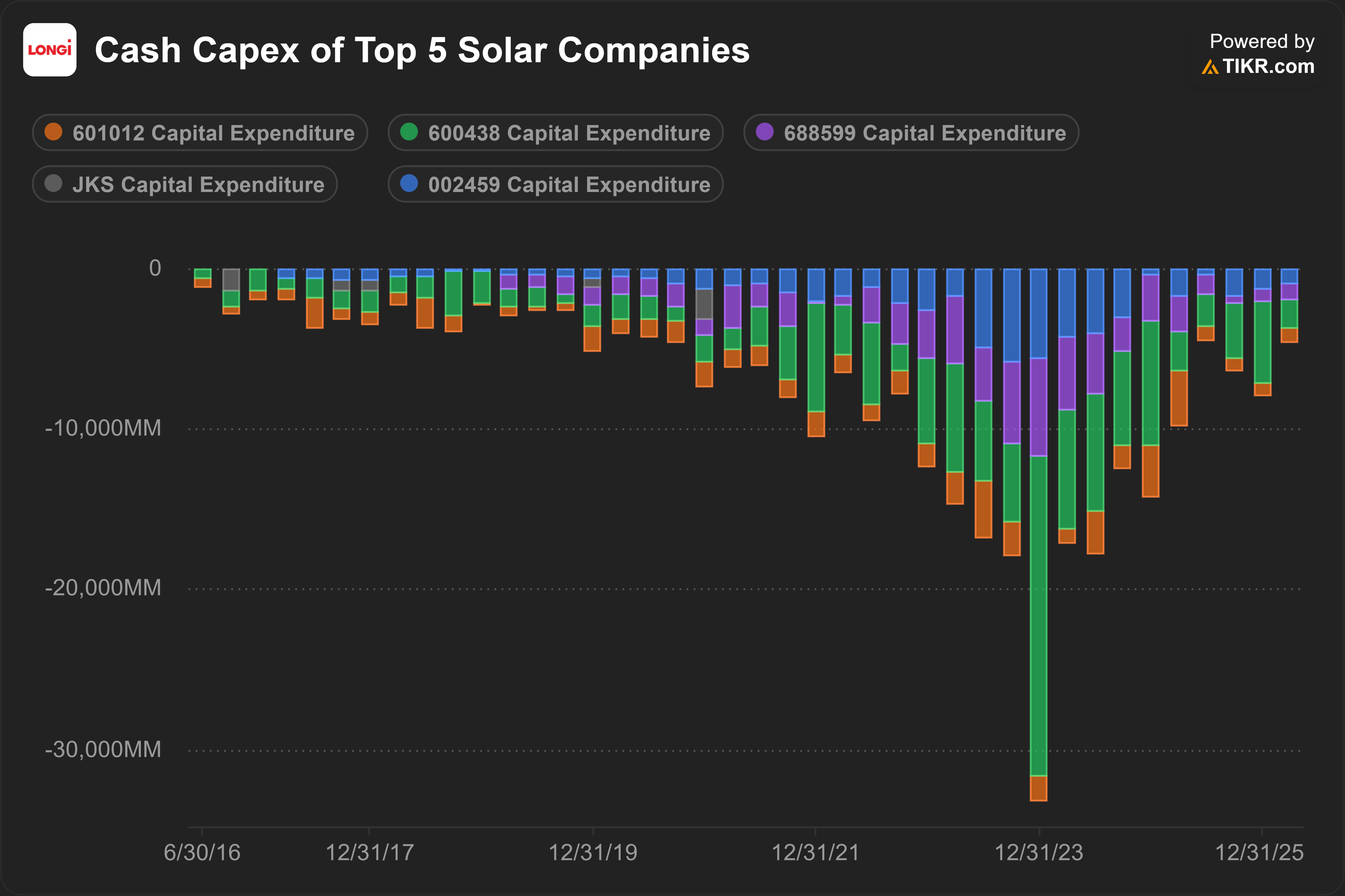
Supply seems to be finally contracting.
LONGi’s cash capex finally fell below depreciation in 2025. In the last twelve months, the company’s cash capex is less than 50% of depreciation.
LONGi’s gross margins have been negative since 2024.
What cannot go on forever must eventually stop. Either the solar industry will collapse, or enough supply gets removed and profits restored.
The second scenario is more likely. Solar is here to stay. In many parts of the world, solar has become the cheapest source of energy.
The best opportunities in cyclical industries tend to come when the leading players slip into losses and you can see signs of contracting supply.
All that’s left is to work out the timing of the next shortage and choose the companies with strong balance sheets.
LONGi reminds me of SK Hynix in Q1’23.
As you may recall, SK Hynix’s gross margins turned negative that quarter. Sentiment turned very negative. Many (wrongly) extrapolated the losses.
The shares then went on to 30x.
Factors to focus on
When will demand catch up to supply?
Find reliable leading indicators of the solar cycle (e.g. working capital). Where are we in the solar cycle?
LKQ Corporation (LKQ US)
About (7 Aug 2026)
Share price: USD 24.86
Market capitalisation: USD 6,290 mn
Enterprise value (EV): USD 11,326 mn
Average daily volume (ADV): USD 80 mn
NTM P/E: 9x
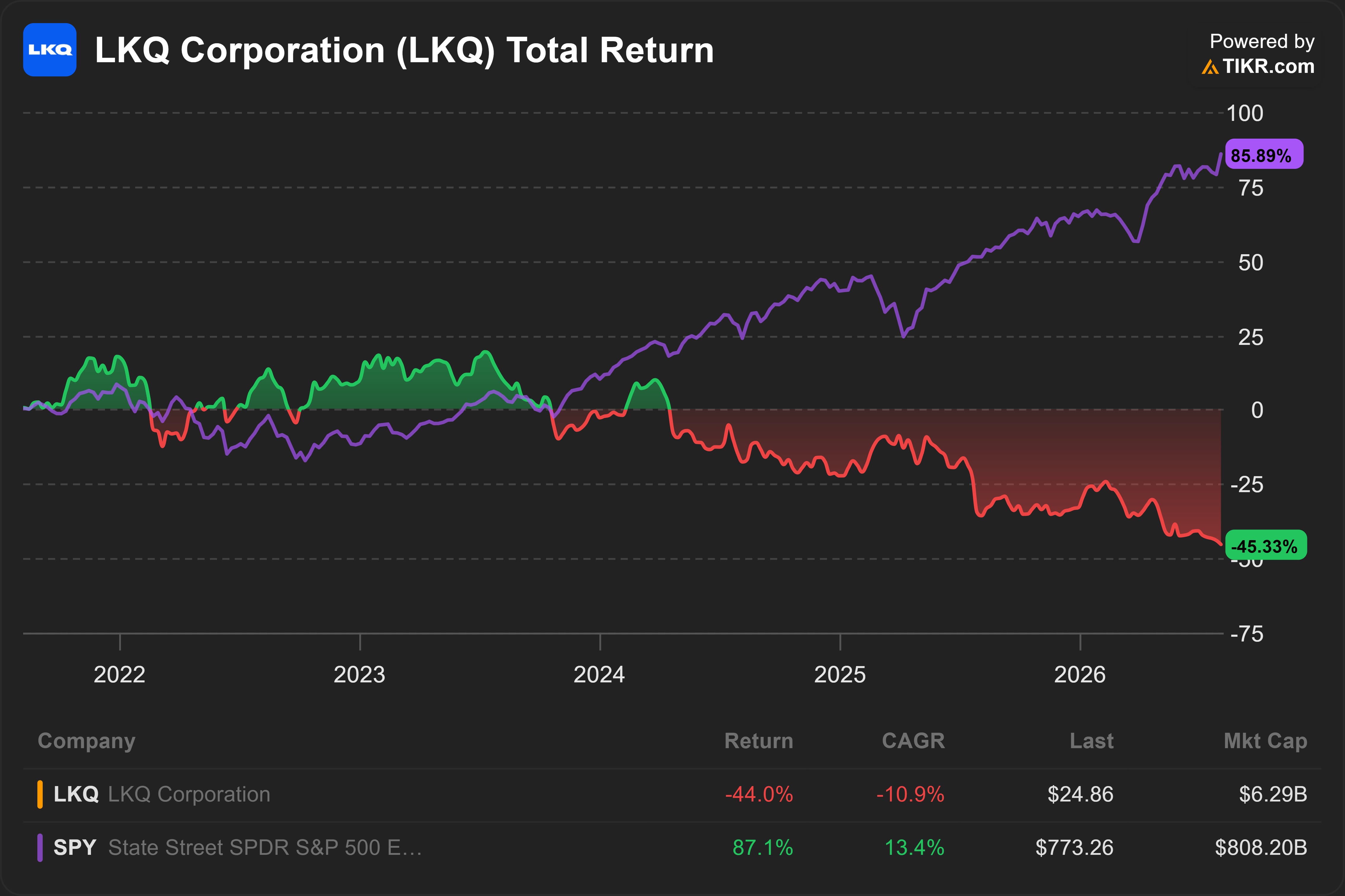
LKQ is one of the world’s largest distributors of car parts.
While its North American segment is a leader in metal "crash parts" like doors, hoods, and fenders, LKQ’s European segment mainly sells mechanical components such as brake pads, clutches and filters.
My initial estimate suggests ~ 9% free cash flow yield on EV. This is an attractive ~ 4% premium over the US 10y Treasury bond.
Good business, temporary headwinds?
LKQ’s shares diverged from the S&P 500 starting in 2024 mainly due to a sustained decline in North American repairable claims.
In North America, car insurance premiums started increasing rapidly from 2023.
Consumers became highly sensitive to anything that might trigger another premium hike. This means drivers become increasingly hesitant to file insurance claims for minor, cosmetic, or drivable damage.
Many drivers simply choose to live with the damage or delay the repair. Fewer cars entering repair shops translates directly to lower demand for the aftermarket and recycled parts that LKQ sells.
However, this headwind seems to be easing.
The US Consumer Price Index (CPI) for motor vehicle insurance dropped by -4% YoY in June 2026, and decreased -2% MoM.5
Activists pushing for sale
In January 2026, LKQ announced its board is reviewing strategic alternatives, including a potential sale of the company, to enhance shareholder value.6
Since October 2025, Ananym Capital, an activist fund, has been pushing LKQ to sell its European business.
“Instead of trying to integrate 20 ERP software systems across 900 locations in 18 different countries in Europe, management should talk to potential buyers who could handle the integration and free up LKQ executives to concentrate on running its crown jewel NAB (North America) collision business.”7
On 30 July 2026, LKQ reported “Europe fell short of expectations, with results affected by the ERP implementation in Germany.”8
All the more reason to sell its European business or even the whole company.
Indeed, there are signs that the board is preparing LKQ for a sale.
In September 2025, LKQ sold its Self Service segment to Pacific Avenue Capital Partners, a PE firm. The company also initiated a process to explore the potential sale of its Specialty segment.
Factors to focus on
Probability and timing of recovery in North America segment
How much can LKQ receive from selling its European business?
Polish distributers like Auto Partner SA (APR PW) and Inter Cars S.A. (CAR PW) seem to be doing very well.
Is LKQ’s Europe problems really just due to ERP issues?
Vote for the best idea
If you want me to dig deeper into an idea, vote for it.
Coming up next
I will look deeper into CTOS Digital Berhad (CTOS MK) this week. This was the idea you voted the most interesting in my previous email.
CTOS is Malaysia’s top credit bureau. Since IPO, its shares have sold off heavily. Investors are scared off by its decelerating growth and falling margins.
However, these seem to be investments in technology and marketing to re-accelerate growth and margins.
There seem to be early signs of recovery.
Subscribe to get the analysis when I publish.
Subscribe for 2 to 3 analyses of global SMID equities every week.
Discover overlooked ideas and rethink familiar names.
Published by Andrew Wong, ACA, CFA
In case you missed it
Last week, I highlighted the opportunity I am seeing in Nexon, Korea’s largest video game maker responsible for MapleStory and Dungeon & Fighter.
Nexon: 11% FCF Yield, Zero Debt, and a Potential Tencent Takeover

Why are you shortlisting NEXON Co., Ltd. (3659 JP)?
Investors often see telcos as a safe haven. So, why did Starhub’s share price fall -75%?
I highlight a very important detail that many investors miss:
StarHub: How to lose money investing in telcos

"Buy telco shares! Safe, stable, predictable. Can’t go bankrupt."
Disclaimer
This publication is for informational, educational, and entertainment purposes only and does not constitute financial, investment, legal, or tax advice. The content herein is a record of my personal research and investment process, and all analysis, forecasts, and opinions expressed are solely my own.
I make no representation or warranty, express or implied, as to the accuracy, completeness, or timeliness of the information provided. The stock market is highly volatile, and my forecasts, estimates, and assumptions may prove incorrect.
I am not acting as your financial advisor or fiduciary. You should not rely on any information in this publication to make investment decisions. Under no circumstances will I be held liable for any direct, indirect, or consequential losses or damages arising from your reliance on the content of this publication.
At the time of publication, I do not hold any positions in 601012 CH, 030190 KS and LKQ US, either long or short. I may change my views, predictions, or personal portfolio positioning at any time without notice.