

20% revenue growth over the next 2 years. Only 7x P/E.
What a bargain!
But why are so many investors betting against Shift4 Payments, Inc. ( FOUR 0.00%↑ US)?
27% of float shorted!
FOUR’s 10-K reveals 3 critical questions the bulls missed.
Why is FOUR acquiring its distributors so aggressively?
FOUR paid USD 318 mn to acquire intangible assets in 2022. This was more than 10x in 2021.
My eyes widened. Whenever there are big movements in capitalisation or acquisition of intangible assets, it’s worth investigating.
The bulk of it, USD 276 mn, was spent on residual commission buyouts.
What’s that?
Turns out, Blue Orca has already beaten me to it. I won’t repeat the details of their report, but will simply highlight the key point here.
Oversimplified: FOUR pays its distributors a lump sum today to avoid paying recurring commission expense in the future. FOUR records this lump sum today as an intangible asset: residual commission buyouts.
What’s the financial impact?
Essentially, FOUR transformed cost of sales expense (recurring commission expense) into amortisation expense. This boosts its adjusted EBITDA, a key performance indicator (KPI).
Blue Orca estimated:
On the accounting benefit of these deals alone, Shift4, we estimate, was able to turn what would have been a $5.8 million Adj. EBITDA miss into a $12.5 million Adj. EBITDA beat.1
Why is FOUR capitalising more costs?
Cash paid for intangible assets jumped again, in 2025.
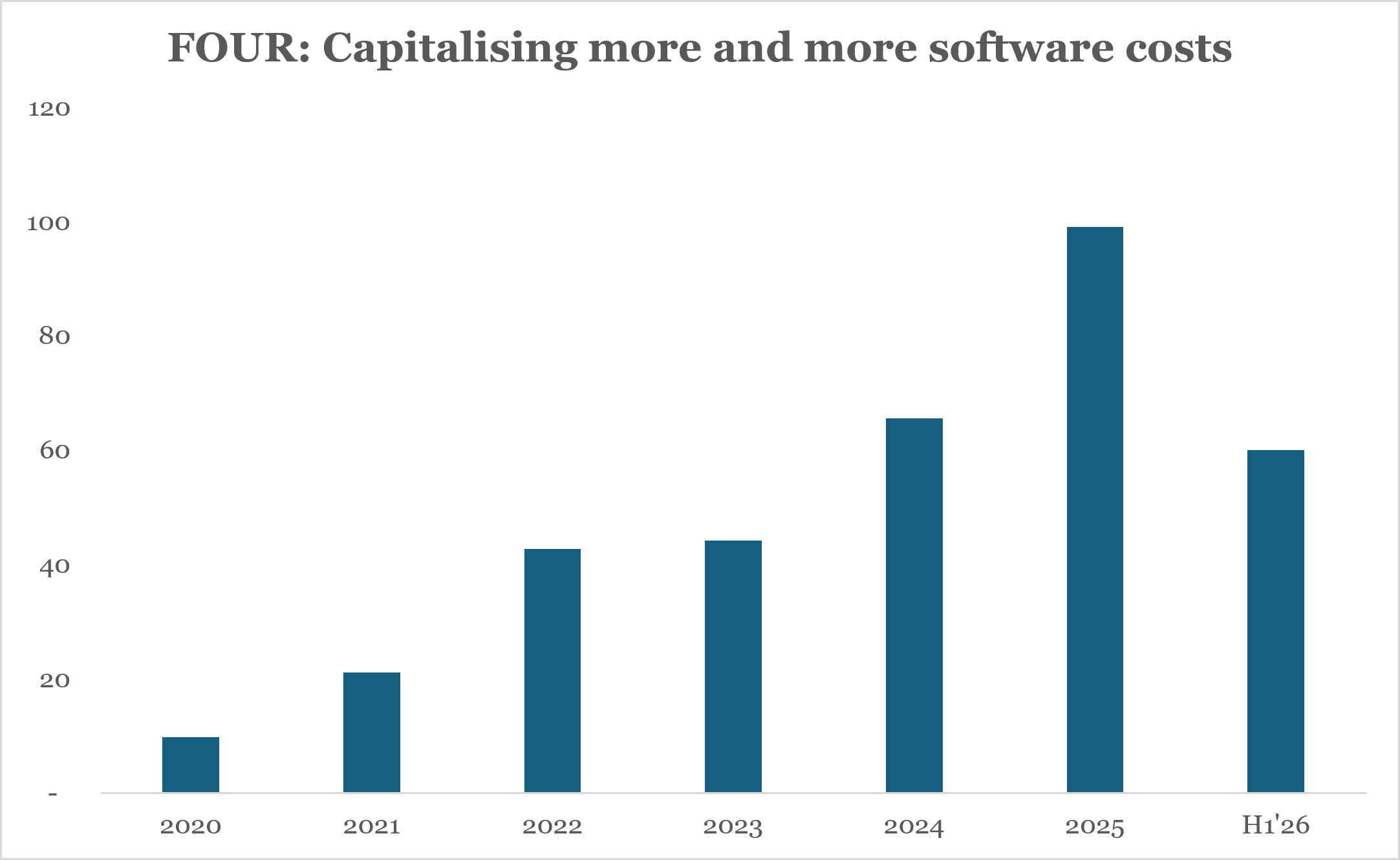
The bulk of it, USD 99 mn, relates to capitalised software development costs. This represents cash paid to software engineers for the development of internal software. Instead of expensing their salaries, FOUR capitalised them as an intangible asset.
Capitalised software development costs are surging.
Source: FOUR 10-K
Capitalisation during the first half of 2026 almost exceeds the amount in the whole of 2024.
Yet, I could not find details of any major internal software projects.
If anyone knows the business reason behind this surge, let me know in the comments.
Why are customer advance payments falling?
FOUR charges customers in advance for “various post-contract license support and service fees”. The company’s accountants call this “deferred revenue”.
Like biologists, accountants are terrible at naming things (Parastratiosphecomyia stratiosphecomyioides is a tiny, wasp-mimicking soldier fly found in Southeast Asia).
Instead of deferred revenue, let’s just call this advance payment from customers or customer advance payments.
Customer advance payments are small. Only 0.20% of total assets.
That makes sense. The bulk of FOUR’s revenue comes not from post-contract license support and service fees, but from payment processing fees charged as a percentage of the customers’ transaction volume.
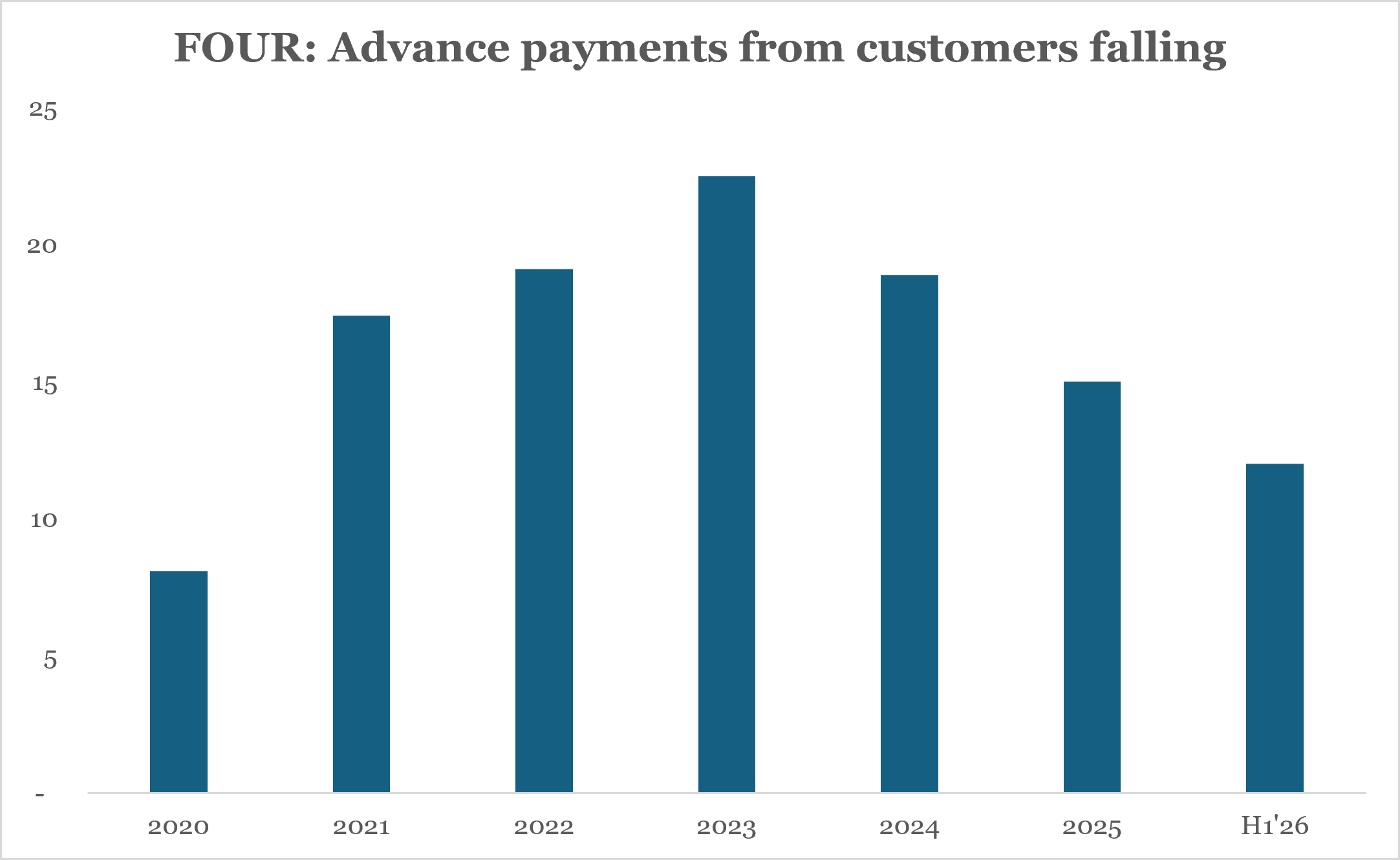
But it is the trend in customer advance payment that I am more interested in.
Fewer contracts → lower post-contract license support and service fees → falling customer advance payments
Source: FOUR 10-K
This clashes with sell-side forecasts. They expect revenue growth of 23% this year, +14% in 2027 and +12% in 2028.
Of course, mergers and acquisitions (M&A) is part of FOUR’s growth story. But with a BB credit rating2, I wonder how much more M&A capacity they have, without diluting shareholders.
Why not short?
I am not making a short pitch here.
I initially approached this as a potential long, but found important questions missed by many investors and “deep dives” on Substack.
I thought sharing these questions would be helpful. If you have important information that can help change my mind, let me know.
I would be scared to short
27% of float shorted. This suggests many investors believe FOUR is a good short. But this also makes it a less attractive short. Higher risk of short squeeze, higher borrowing costs, etc.
Finally, there’s also the risk of a potential takeover or sale.
In February 2026, founder Jared Isaacman waived his tax receivable agreement (TRA) rights. In exchange, he received cash and preferred stock.
Without going too much into the technicalities, the TRA is essentially a debt that FOUR has to repay to its pre-IPO owners (Isaacman and Searchlight Capital) when it starts earning taxable profits.
TRA waiver usually happens when the company is preparing to sell itself. Without a waiver, buyers will balk at the high TRA payments.
We saw that with Bumble (BMBL US).
In Nov 2025, Blackstone and BMBL founder Whitney waived all their TRA in return for a significantly smaller cash payment upfront. In Jun 2026, Reuters reported BMBL is exploring a sale.3
Note: Searchlight Capital has not yet waived its TRA rights.
TLDR
FOUR looks like a bargain: 20% revenue growth. 7x P/E.
But 27% of float is shorted.
Unless I can resolve these questions, I prefer to watch on the sidelines:
Why is FOUR acquiring its distributors so aggressively?
Why is FOUR capitalising more costs?
Why are customer advance payments falling?
Coming up next
Next week, I’ll be back with 3 more interesting ideas.
I’ll then analyse the most voted idea from my last post.
Right now, that’s NICE Information Service Co., Ltd. (030190 KS).
LKQ Corporation (LKQ US) is the close runner up. Only 1 vote behind NICE.
Haven’t voted yet? Check out my last post: 3 interesting opportunities
Thanks for reading! If you found this helpful, hit the “like” button.
If you’re not already a subscriber, sign up for weekly analysis on global SMID equities.
Disclaimer
This publication is for informational, educational, and entertainment purposes only and does not constitute financial, investment, legal, or tax advice. The content herein is a record of my personal research and investment process, and all analysis, forecasts, and opinions expressed are solely my own.
I make no representation or warranty, express or implied, as to the accuracy, completeness, or timeliness of the information provided. The stock market is highly volatile, and my forecasts, estimates, and assumptions may prove incorrect.
I am not acting as your financial advisor or fiduciary. You should not rely on any information in this publication to make investment decisions. Under no circumstances will I be held liable for any direct, indirect, or consequential losses or damages arising from your reliance on the content of this publication.
At the time of publication, I do not hold any positions in FOUR US, either long or short. I may change my views, predictions, or personal portfolio positioning at any time without notice.