

"Buy telco shares! Safe, stable, predictable. Can’t go bankrupt."
February 2016.
Urged on by your “portfolio manager” friend, you went all in on StarHub, Singapore’s second-largest telco.
The shares have fallen almost -20% from its peak in 2015. So cheap!
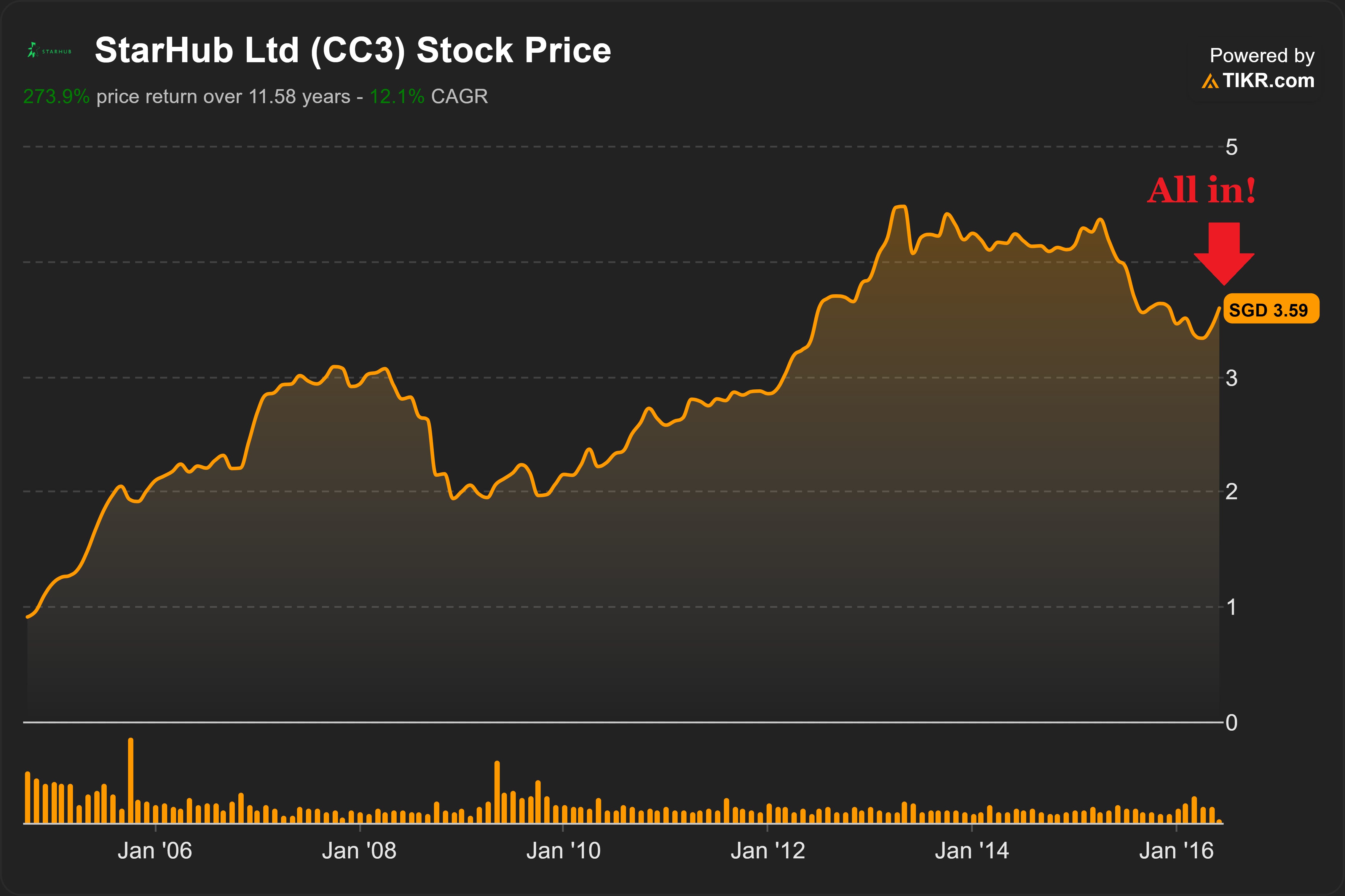
Right after you bought, the share price started to decline.
Never mind, you are a conservative long-term investor. You only buy and hold.
The “portfolio manager” urges you to stay the course: “It is a necessity to accept short-term volatility in pursuit of higher returns”
August 2026.
More than 10 years have passed. You watched your shares drop more than -70%, from SGD 3.59 to SGD 1.05.
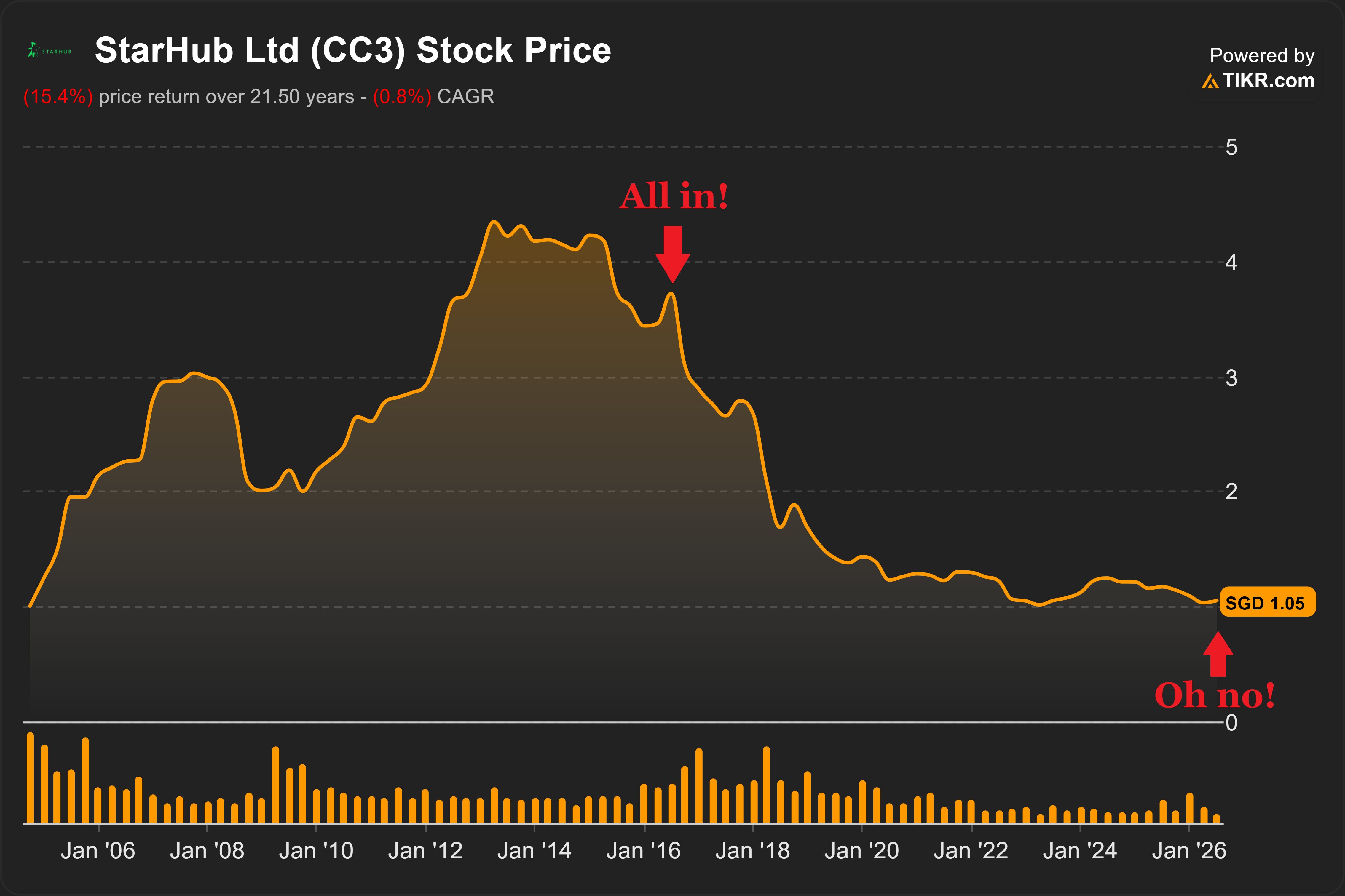
What went wrong? Aren’t telcos supposed to be safe, stable, predictable investments?
That’s what we will explore today:
Why do telco shares blow up?
How can investors avoid telco blow ups?
Can telcos do anything to stop the blow up?
Why do telco shares blow up?
StarHub is not alone.
Since 2021, shares in Proximus PLC (PROX BB) have collapsed -63%. Between 2015 and 2024, Telecom Italia S.p.A. (TIT IM) fell -80%.
What was the common factor?
New competiton.
In 2016, Italy’s fourth mobile network operator (MNO), Iliad Italia was founded. It launched mobile services in 2018.
Digi became Belgium’s fourth MNO after it acquired new spectrum in 2022. Its mobile plans start from as low as EUR 5 month, severely undercutting the EUR 16 plans charged by Proximus.
StarHub’s kryptonite came in the form of Circles.Life and SIMBA.
Circles.Life became Singapore’s first full-service postpaid MVNO in 2016. Being a mobile virtual network operator (MVNO), Circles.Life does not own a physical network. Instead, it leases network capacity from a MNO (M1) at wholesale rates and resells cellular plans under its own brand.
SIMBA became Singapore’s fourth MNO after winning a mobile spectrum auction in 2016. It launched services in 2020.
Just as kryptonite drains Superman’s powers and causes severe pain, SIMBA and Circles.Life drained StarHub’s pricing power and caused severe pain to shareholders.
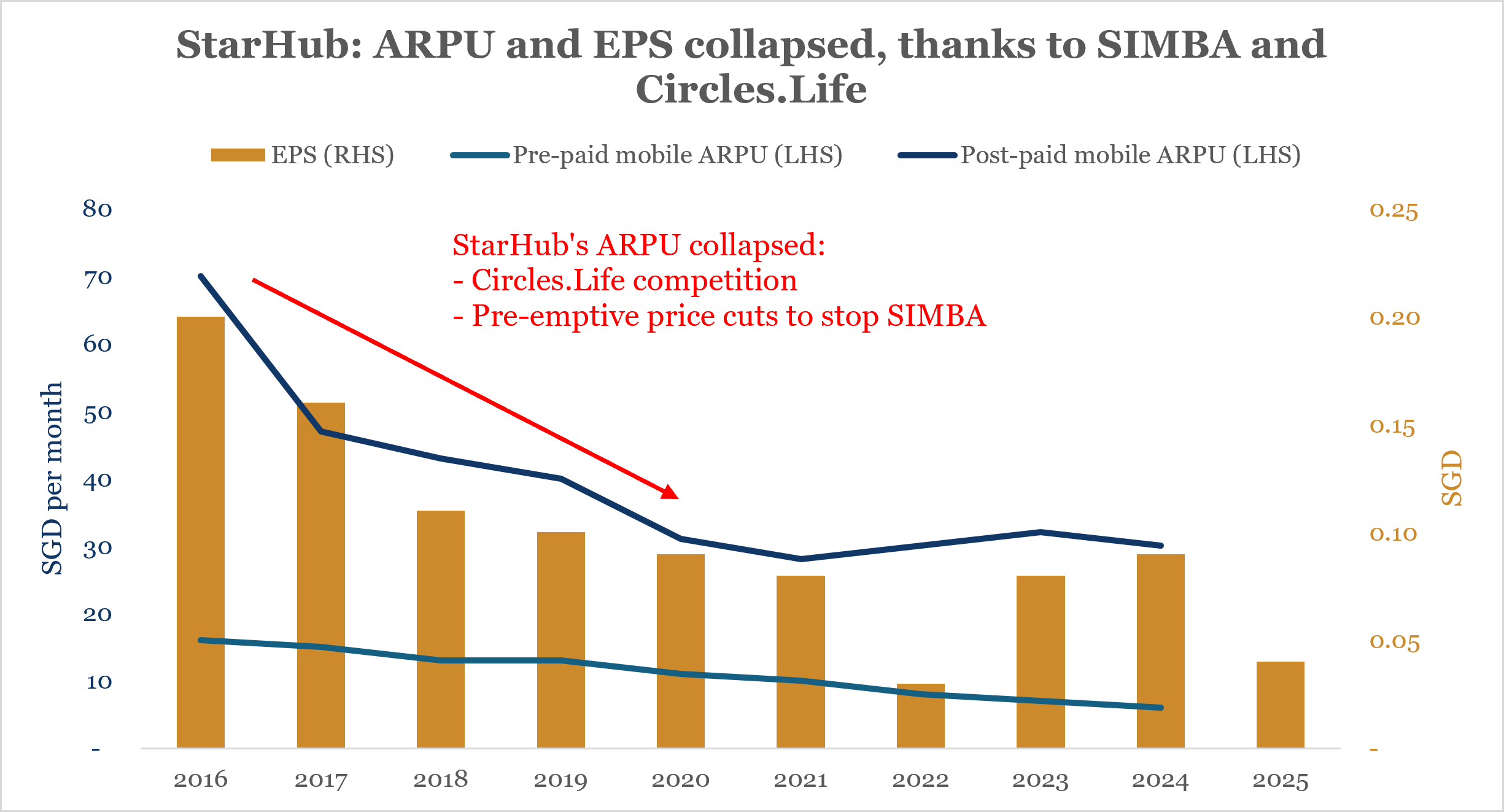
Source: StarHub’s annual reports.
From 2025, StarHub stopped showing ARPU breakdown. It showed combined ARPU instead.
But the trend remains. Combined ARPU declined -9% in 2025.
How can investors avoid telco blow ups?
New competitors enter, telcos blow up.
That’s the rule of thumb.
But new competitors cannot simply enter as they please. They need permission from regulators.
What will drive regulators to let in new competitors?
High prices
In 2012, all three MNOs in Singapore removed their popular 12GB mobile data plan. SingTel effectively cut its customers’ data allowance to as low as 2GB. For StarHub, it went as low as 1GB.1
StarHub’s operating margins, already high among global peers, surged to new highs:
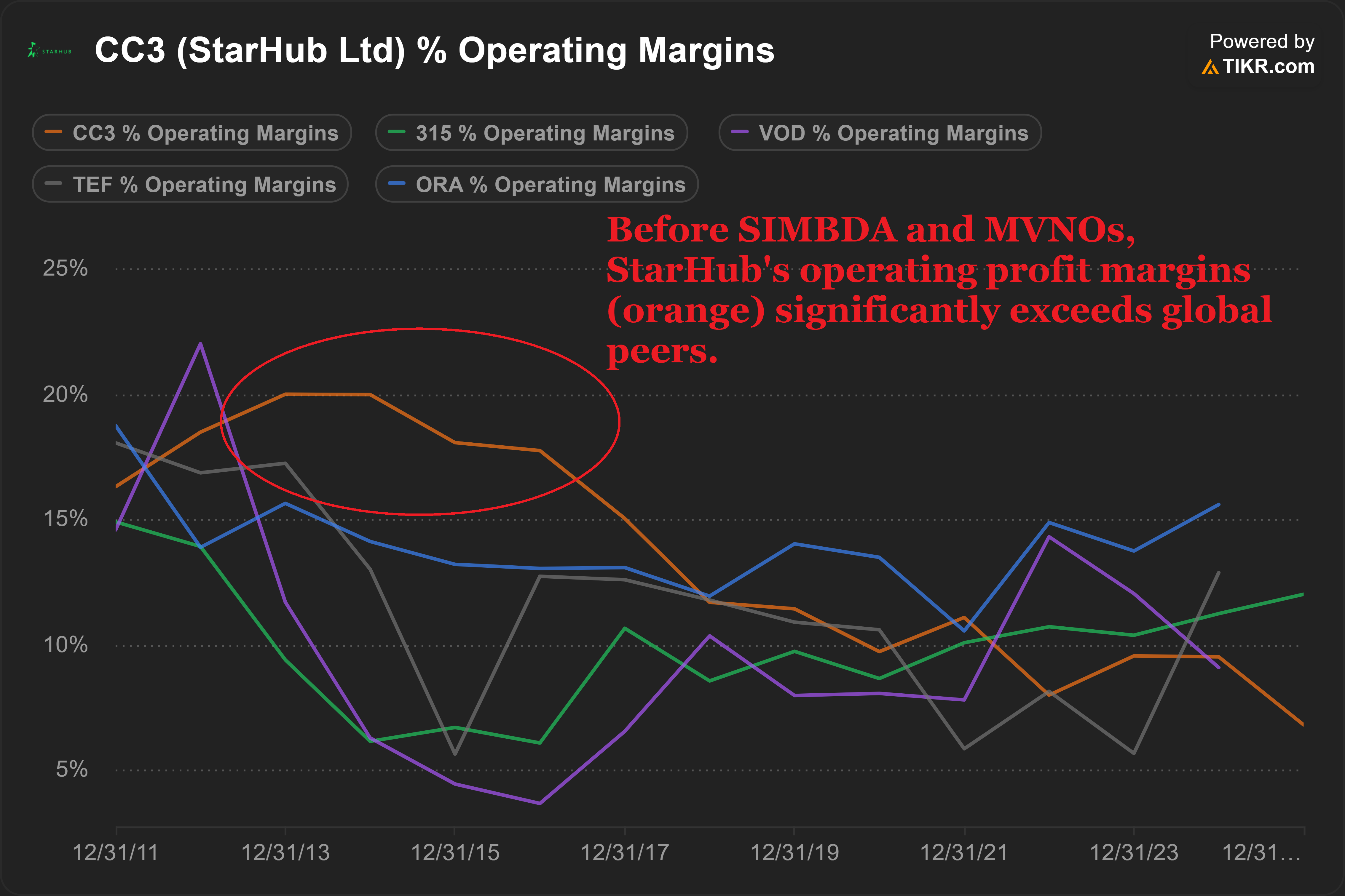
Singapore’s telco regulator must have seen this, and felt very unhappy.
In explaining its decision to let in a fourth MNO, IDA revealed a strong desire for lower consumer prices:
“IDA has observed that the entry of new players in other jurisdictions has brought about lower priced and/or more innovative mobile plans for the benefit of consumers.
For example, some jurisdictions with new MNO entry have experienced decreases in average mobile price plans by up to 40%…”2
There is indeed a lot of room to cut prices. Damodaran’s data showed, on average, global telcos earned ~12% operating profit margin (OPM).3
The same number for StarHub?
A whopping 18%!
Room for one more MNO
If more competition benefits consumers, why not have 10 MNOs?
The answer is simple.
Too much competition destroys all profits. No profits → no investment in network. → network falls apart.
So, the regulator needs to balance its desire for low consumer prices against leaving enough profits for telcos to invest.
In 2016, IDA concluded that Singapore’s 3 MNO market still has room for 1 more MNO:
On the concerns that new MNO entry will impact mobile network investments, IDA found no clear or direct correlation between new MNO entry and a fall in mobile network investments by incumbent MNOs in other jurisdictions.
IDA also notes that globally, some mobile markets have been supporting a 4-MNO structure, such as in Spain and Sweden.
Further, IDA has observed that the entry of a new MNO may also incentivise the MNOs to invest in their mobile networks to maintain their competitive advantage.4
Can telcos do anything to stop the blow up?
During its Q1’16 earnings call, management reassured investors:
“We're always prepared for competition whether it's the fourth, fifth or the current competitor.
But bear in mind that StarHub will still have more than just good service coverage, we also have the Hubbing strategy.”5
10 years later, profits collapsed -75%.
Why didn’t the Hubbing strategy stop the drubbing?
The Hubbing strategy involves bundling mobile, pay TV, broadband and fixed network services. In industry speak, this is called 'quadruple play’.
The idea sounded promising.
Customers get more value than if they paid for each service separately. They also enjoy the convenience of just one single bill.
In return, StarHub enjoys lower customer churn, higher ARPU and more cost efficiencies.
Sadly, technological advancement blunted the value proposition of the Hubbing strategy.
The arrival of Netflix and YouTube meant more and more customers are cutting their pay TV. Fixed landlines have become a relic.
More importantly, the huge savings from switching to MVNOs and SIMBA outweighed the slight inconvenience of multiple bills.
TLDR
More than anything else, regulation drives investment returns in telcos.
If the telcos are charging high prices and earning above-average returns in a two or three player market, the regulator has a huge incentive to let in a new competitor.
That’s usually how telco investors get blown up.
Coming up next
Next week, I’ll be back with 3 more interesting ideas.
I’ll then analyse the most voted idea from my last post: CTOS Digital Berhad (CTOS MK) or Samsonite Group S.A. (1910 HK).
Right now, the vote is exactly tied!
Haven’t voted yet? Check out my last post and break the tie: Yet another 3 interesting ideas.
Thanks for reading! If you found this helpful, hit the “like” button.
If you’re not already a subscriber, sign up for weekly analysis on global SMID equities.
Disclaimer
This publication is for informational, educational, and entertainment purposes only and does not constitute financial, investment, legal, or tax advice. The content herein is a record of my personal research and investment process, and all analysis, forecasts, and opinions expressed are solely my own.
I make no representation or warranty, express or implied, as to the accuracy, completeness, or timeliness of the information provided. The stock market is highly volatile, and my forecasts, estimates, and assumptions may prove incorrect.
I am not acting as your financial advisor or fiduciary. You should not rely on any information in this publication to make investment decisions. Under no circumstances will I be held liable for any direct, indirect, or consequential losses or damages arising from your reliance on the content of this publication.
At the time of publication, I do not hold any positions in STH SP, either long or short. I may change my views, predictions, or personal portfolio positioning at any time without notice.