

Why are you shortlisting NEXON Co., Ltd. (3659 JP)?
3 reasons:
Good business, temporary headwinds
Under-recognised growth
Attractive capital returns
Catalyst? Potential takeover target. There were reports of interest from private equity (PE) and/or Tencent.
I estimate ~ 11% free cash flow yield on enterprise value (EV). This is an attractive premium of ~ 7% over the South Korea 10y government bond.
Are the shares liquid enough?
4 Aug 2026
Share price: JPY 2,374
Market capitalisation: JPY 1,862 bn (USD 12 bn)
Enterprise value (EV): JPY 1,045 bn (USD 7 bn)
Average daily volume (ADV): JPY 6 bn (USD 40 mn)
NTM P/E: 17x
Ok. I am looking at the price chart now. Nexon’s share price (green) fell almost 50% from its peak in January this year.
What happened?
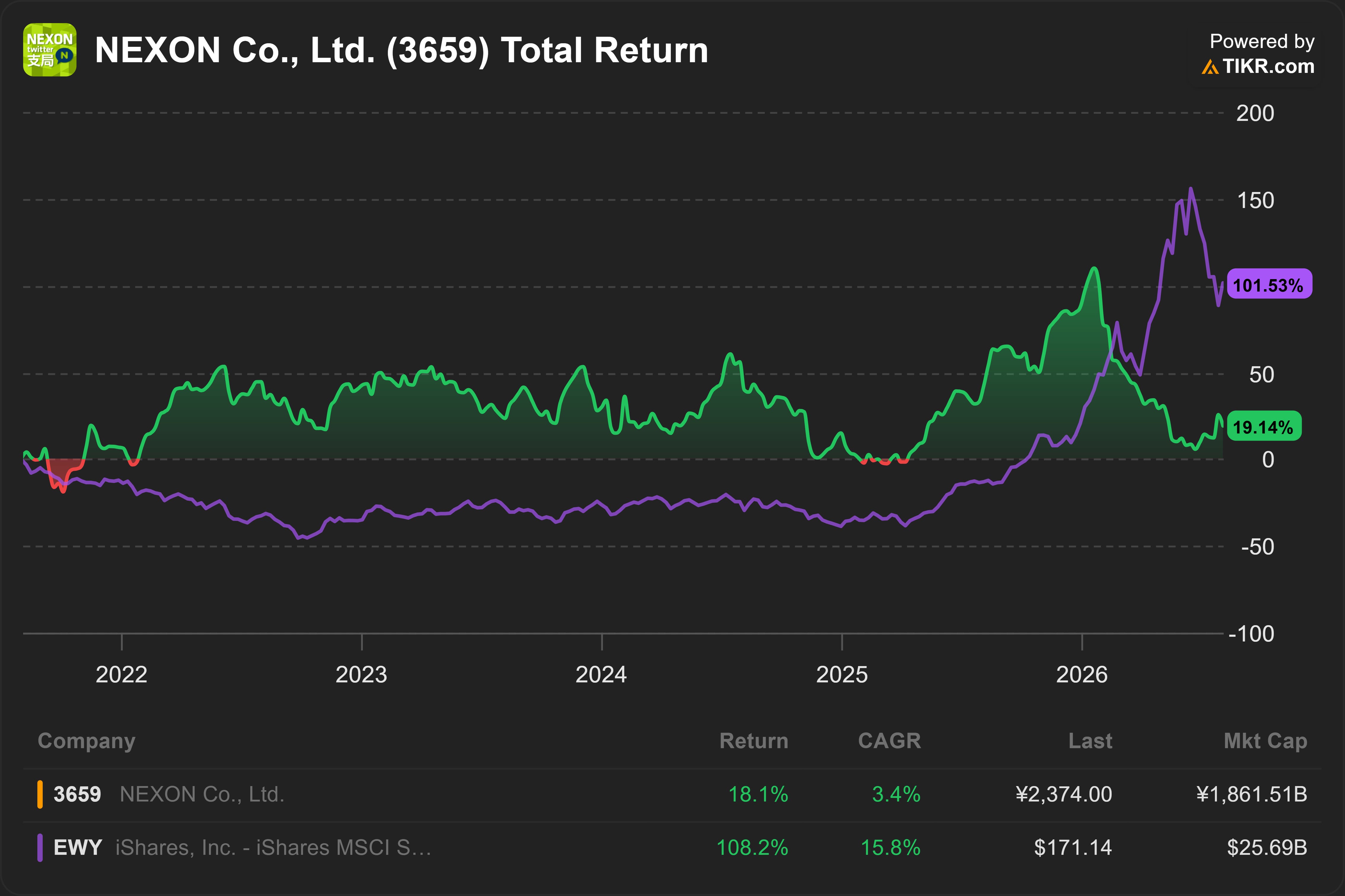
Investors were doubting whether Nexon can meet its 2027 revenue and operating profits targets. In March 2026, during its capital markets day, management admitted they will not hit the targets on time.
The sell-off accelerated.
Good business, temporary headwinds
Why do you see an opportunity in the sell-off?
Investors seem too fixated on the near-term operational headwinds in Dungeon & Fighter Mobile (DNF Mobile).
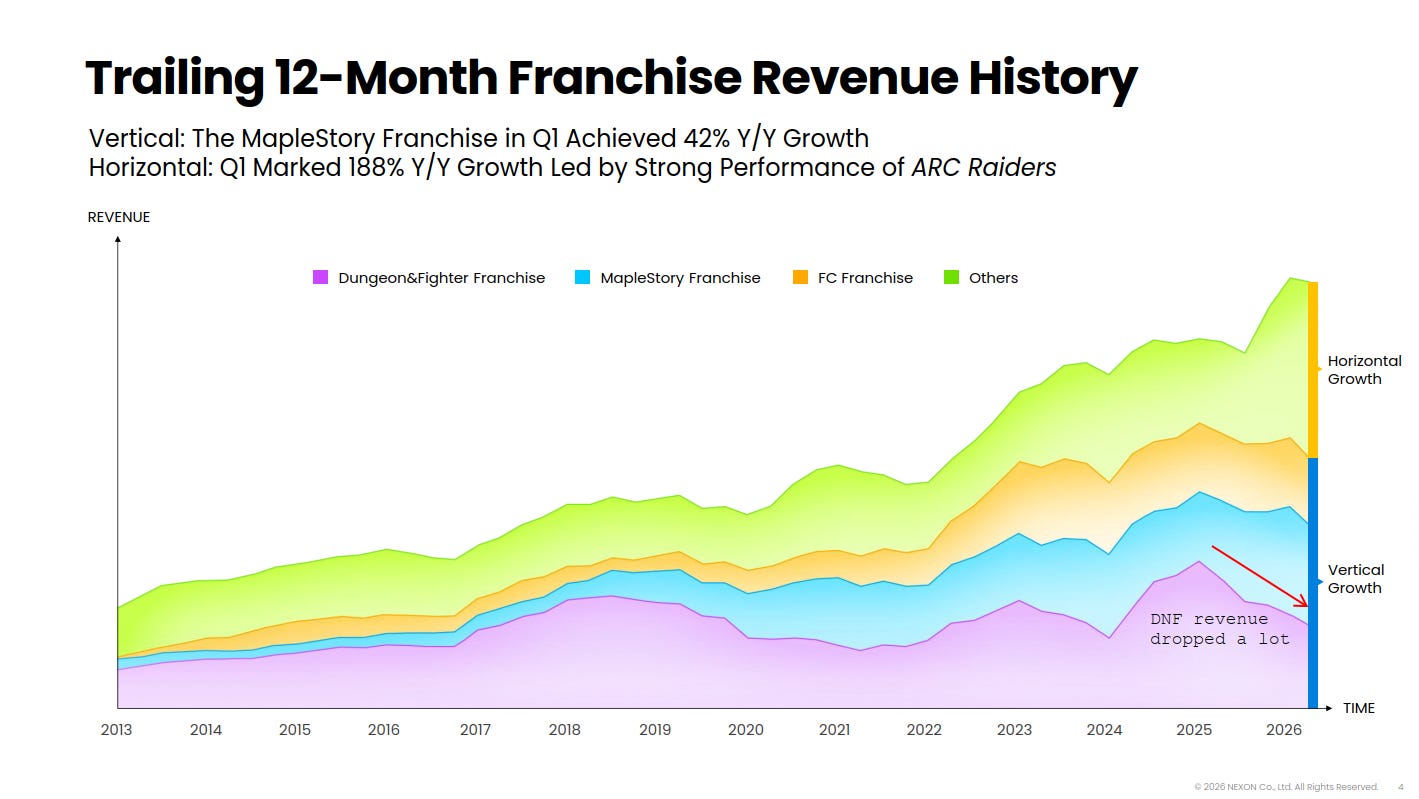
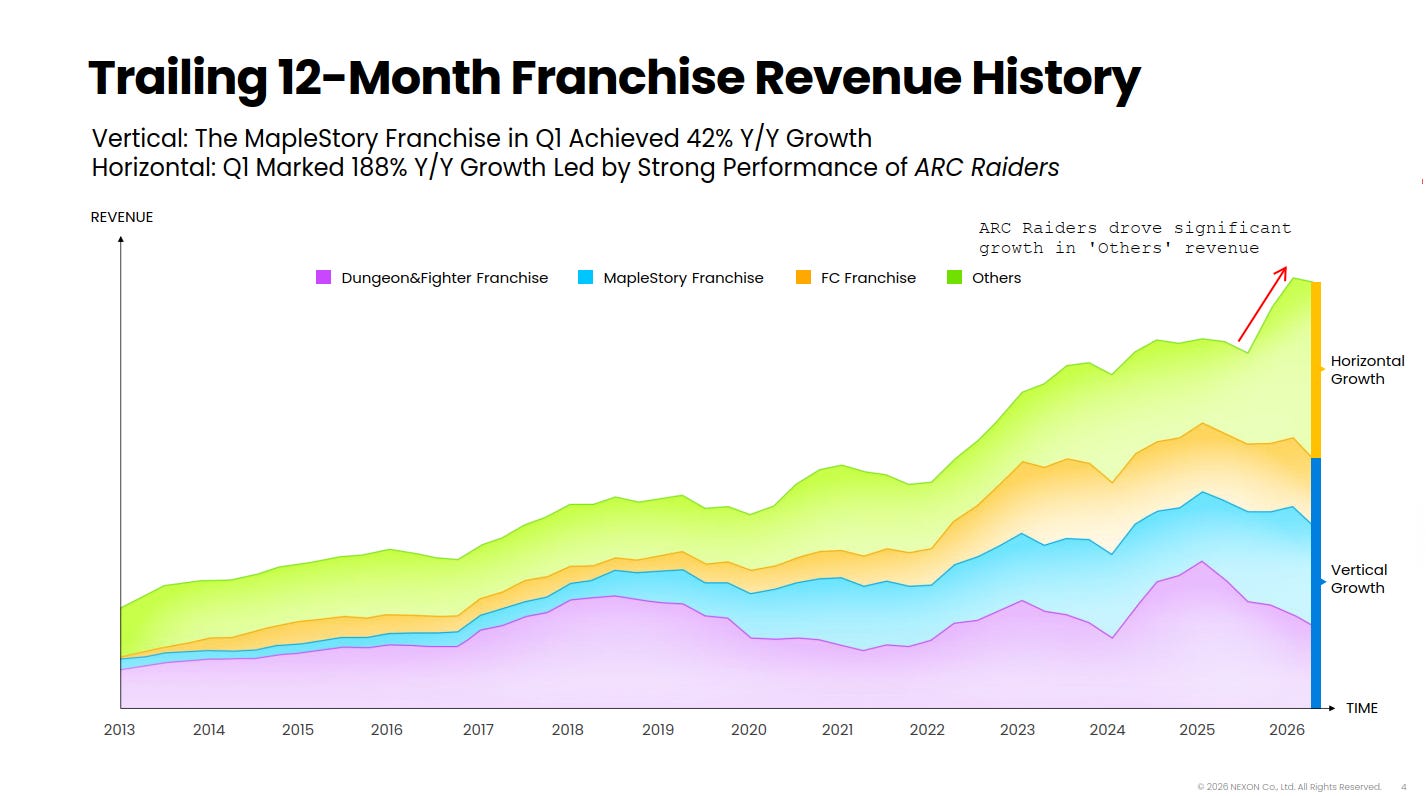
Nexon is South Korea’s largest video game maker. DNF is one of its three main game franchises. Together with MapleStory and FC, they contribute over 60% of revenue in Q1’26.
Chart 1: Trailing 12-Month Franchise Revenue History
Source: 2026 Q1 Nexon Presentation
During 2024, DNF revenue surged. It is now in decline. What happened?
The most significant driver behind the 2024 surge was the successful release of DNF Mobile in China in May that year.
However, DNF revenue peaked in early 2025. Content updates, specifically the New Year update in January 2025, failed to meet players’ expectations.
According to reviews on TapTap, a mobile game distribution platform in China, content production fell far behind consumption.1
Once players get the best gear in DNF Mobile, they lose motivation to play. New updates just don't come out fast enough to keep the game interesting.
What is Nexon doing about this?
In early 2025, Nexon signed a co-development agreement with Tencent.
Nexon retained control over creative content while Tencent focused on “hyperlocalisation”: adapting content specifically to Chinese tastes.
On 13 August 2026, they will relaunch DNF under “DNF Mobile 2.0” with higher level caps and new game zones. These are designed to enhance long-term progression motivation.
Do you think the fix will be successful?
I believe it is a question of ‘when’ rather than ‘if’ the fixes will succeed in drawing players back.
This is not the first time DNF revenue declined. In 2023, DNF PC revenue faced a similar decline, driven by an unexpected oversupply of in-game gold. Players started leaving the game as the prices of in-game items started to inflate.
Management started implementing fixes to get players to spend more gold, thereby reducing supply. By early 2025, the gold supply had stabilised. DNF PC revenue started recovering.
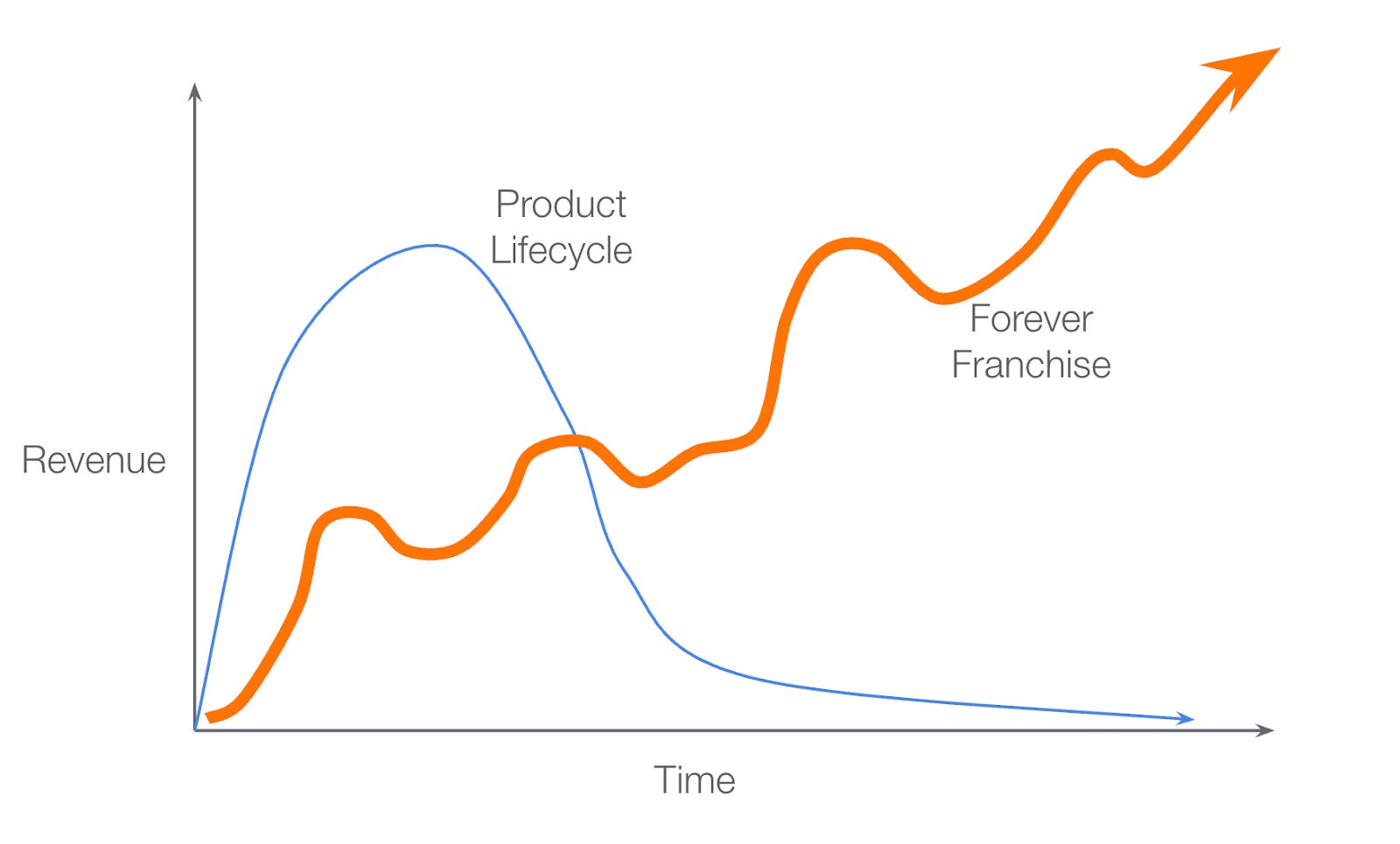
Looking at chart 1, for live service online games, the rise and fall of revenue is a feature, not a bug.
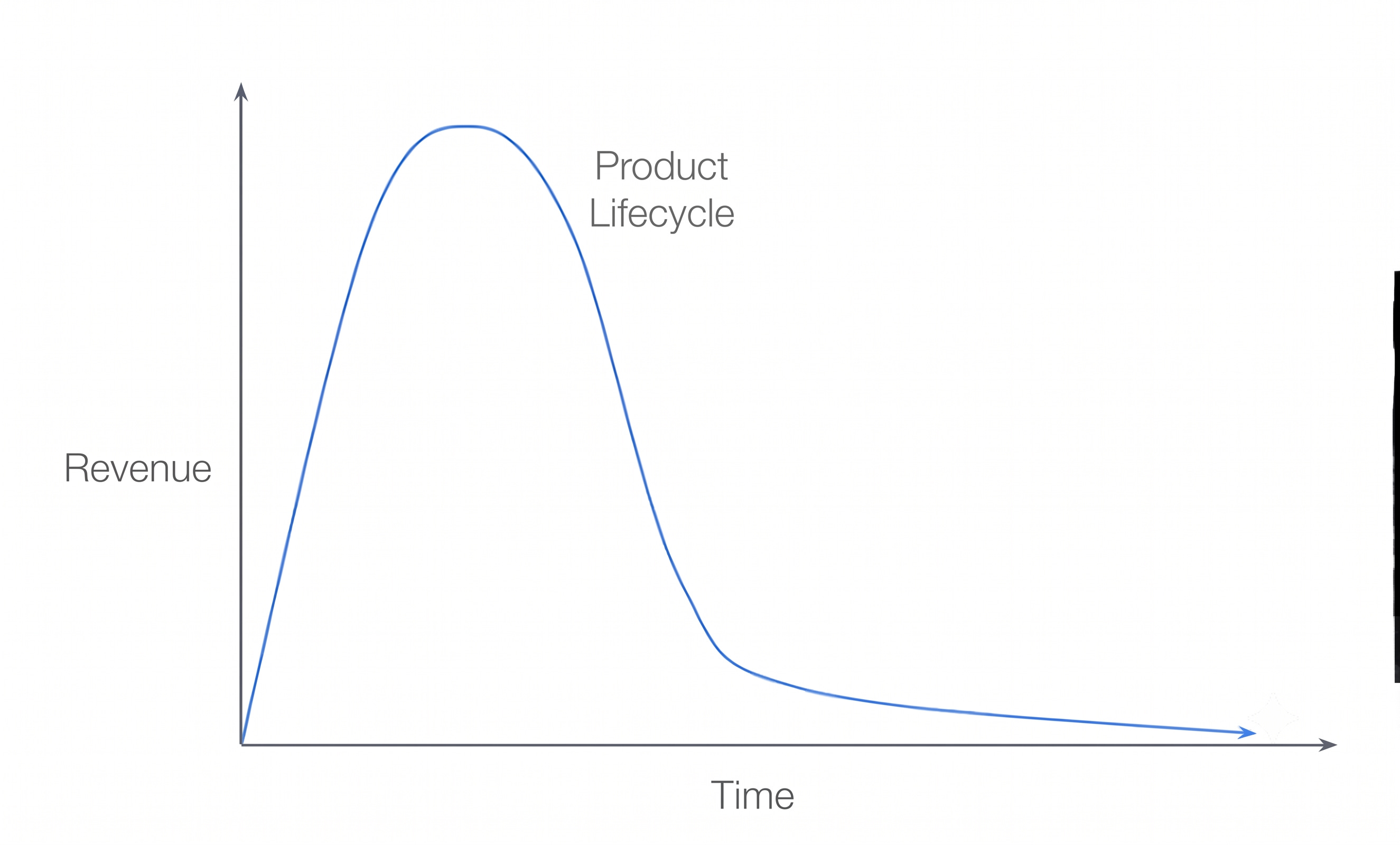
Are you sure? Another gaming analyst told me that revenue peaks soon after a game launches. It then steadily declines. Like the graph below.
Source: Owen Mahoney (2025)
Your graph is accurate, but only for hardcore offline games.
For successful live games like DNF and MapleStory, a more accurate graph looks like this:
Source: Owen Mahoney (2025)
Owen Mahoney, Nexon’s ex-CEO explains:
Live games are updated continuously.
Some updates are small fixes or tuning changes, others are major additions to the game world.
Not all of them succeed. Some introduce bugs or balance issues that temporarily harm the experience and drive players away.
In well-run games, those mistakes are identified and corrected, and the community returns.
Short-term volatility is not a sign of failure. It is the normal operating pattern of a healthy, evolving system.
He adds:
The wrong model makes analysts panic at the first dip, dump the stock, and miss the next wave. Investors with the right map see the dip for what it is: a buying opportunity.
That’s interesting. Nexon’s revenue in chart 1 does resemble the squiggly upward orange line. Good business, temporary headwinds.
Under-recognised growth
Despite DNF revenue declining -26% YoY in Q1’26, overall revenue still grew +34% YoY. ARC Raiders saved the day.
Is this the under-recognised growth you’re talking about?
Source: 2026 Q1 Nexon Presentation
Yes. Nexon released this third-person multiplayer extraction shooter game in October 2025. It was a success.
What’s more important than ARC Raiders is the creative talent that created it. After all, a game ‘factory’ is nothing more than a group of creative people making fun games.
Owen Mahoney explains:
If the key people leave, the rest usually follow, and you're left with an empty box, explaining to your board how an [acquisition] deal that looked smart last month became a management crisis this month.
It looks like Nexon scored a huge win when it acquired Embark Studios, the developer of ARC Raiders, in 2021. Patrick Söderlund, the CEO of Embark Studios, became a major shareholder and the Executive Board Chairman.
Yes, but investors seem to be ignoring this.
For many years, Nexon has been known as an Asian video game maker with limited pipeline. In 2024, Korea and China accounted for 44% and 37% of revenue, respectively. North America and Europe contributed only 10%.
With Embark Studios, Nexon can now reach into Western markets. In 2025, revenue contribution from North America and Europe jumped to 14%.
Embark Studios is preparing a significant "Frozen Trail" update for ARC Raiders in October 2026. This will introduce an expansive new map and a paid Premium Reward Pass.
The studio is also looking to launch the game in the Chinese market through a hyperlocalization partnership with Tencent Games.
Finally, Embark Studios also confirmed they have two projects already in early development.
Yet, investors seem to have not fully recognised this growth potential.
The sell-side expects revenue to grow 7% in 2026 (similar to 2025), before tapering down to +2% and +3% over the next two years.
Attractive capital returns
Why do you say capital returns look attractive?
Nexon looks like a value trap. Over the past 10 years, cash averaged ~170% of revenue.
This is changing.
In 2024, the new CEO took over and introduced a formal dividend policy of returning at least 33% of the previous year’s normalized operating income.
Dividend per share more than doubled from JPY 10 to JPY 23, then doubled again to JPY 45 in 2025. For 2026, Nexon plans to pay JPY 60 per share.
The company is also buying back more shares.
In total, for 2026, Nexon will return at least ~ 5% of its market capitalisation or ~ 8% of enterprise value. This level of capital return is more than 100% covered by its free cash flow.
If Nexon returns 100% of its free cash flow to shareholders, I estimate capital returns of ~6% of today’s market capitalisation and ~11% of enterprise value.
What makes you think 100% capital return is possible?
Nexon still has cash ~ 170% of revenue, no debt and a capital-light business.
The tone from the new management seems to be moving from “hoarding cash just in case we see an attractive acquisition” to “let’s optimise our capital structure”.
Potential takeover target
Why do you say Nexon is a potential takeover target?
The founding family explored a sale around 2019, attracting interest from Tencent and private equity (PE) firms like KKR and Hillhouse.2 However, they apparently failed to agree on price.
In June 2025, Tencent was reportedly trying to revive the deal.3 The Chinese tech company later clarified that the reports were not true.4
Even so, I expect the founding family would eventually want to sell and diversify their wealth. The founder himself passed away in 2022.5 His wife and daughters inherited his majority stake but are not involved in management.
Saudi Arabia’s Public Investment Fund (PIF) owns ~11% through a subsidiary (Ayar First Investment Company).
In 2025, PIF agreed to acquire Electronic Arts Inc. (EA US), another video game developer for USD 55 bn.6 PIF may look to acquire Nexon and merge it into EA.
Great. Go ahead and develop the full thesis for this.
Give me a sense of the competitive landscape. Compare Nexon to its peers like NC Corporation (036570 KS) and KRAFTON, Inc. (259960 KS).
I know you’ve done this, but go through more player reviews of DNF Mobile in Chinese. I want more data to support your hypothesis of temporary headwinds.
Also, try quantifying the growth opportunities for Embark Studios. Are there any good historical precedents?
Coming up next
“We're always prepared for competition whether it's the fourth, fifth or the current competitor.
But bear in mind that StarHub will still have more than just good service coverage, we also have the Hubbing strategy.” - StarHub’s earnings call (5 May 2016).7
This was how Singapore’s second largest telco allayed worries over a new competitor.
Since then, StarHub’s profits had taken a drubbing. Net profits fell almost -75%. Share price followed, falling more than -70%.
What happened? Why didn’t the Hubbing strategy stop the drubbing?
That’s what I will explore in my next analysis.
Subscribe for free to be notified immediately when I publish.
Subscribe for 2 to 3 analyses of global SMID equities every week.
Discover overlooked ideas and rethink familiar names.
Published by Andrew Wong, ACA, CFA
Disclaimer
This publication is for informational, educational, and entertainment purposes only and does not constitute financial, investment, legal, or tax advice. The content herein is a record of my personal research and investment process, and all analysis, forecasts, and opinions expressed are solely my own.
I make no representation or warranty, express or implied, as to the accuracy, completeness, or timeliness of the information provided. The stock market is highly volatile, and my forecasts, estimates, and assumptions may prove incorrect.
I am not acting as your financial advisor or fiduciary. You should not rely on any information in this publication to make investment decisions. Under no circumstances will I be held liable for any direct, indirect, or consequential losses or damages arising from your reliance on the content of this publication.
At the time of publication, I do not hold any positions in 3659, either long or short. I may change my views, predictions, or personal portfolio positioning at any time without notice.
Thanks for sharing the article by Owen Mahoney! I found it a very interesting read, this is the first time I've heard of the term "Forever Franchise". Immediately, Pokemon comes to mind.
You laid out a lot of potential positives in the turnaround process, but what are the chief risks you see to this investment?