

What’s a big problem for investors?
Great return can come from skill or taking on excessive risk and being lucky. It’s only during a bear market that we can tell those two apart.
Happily for me, I did not blow up in 2022 (fingers crossed).
I first started investing in 2021. Despite outperformance, looking back, I realised how naive I was.
If I could send a post back in time to 2021, what would I tell myself?
1. Stocks are businesses
A stock is a partial ownership of a business.
The value of a stock today is the sum of all cash the business throws off from now until the end of time.
That is the fundamental truth.
2. The stock market is a market
Think of the stock market as a fish market.
If the fishermen caught way more mackerel than expected => supply goes up => prices go down.
The same forces of demand and supply decide share prices in the short term.
If someone gets margin-called today, they dump their shares => supply goes up => share price falls.
That’s why, in the short-term, share prices can diverge from their true value.
Does that mean you should ignore short-term movements?
No.
3. Pay attention to the short-term
If the share price falls -10% in a day on huge volume, someone on the market is dumping.
You should find out why they’re selling.
Maybe there’s new information that disproves your thesis. You should get out.
Maybe there’s no fundamental changes. A 24-year old investor got margin-called on his other holdings, and needed to raise cash very fast. You should take advantage and buy more.
In either case, you shouldn’t ignore big short-term movements on huge volume.
It can save you from a disaster, or present you with a huge opportunity.
There’s another reason why long-term investors should pay attention to the short-term.
4. Most people are short-term, but they just haven’t realised it yet
There’s nothing wrong with being short-term. Plenty of short-term investors are rich.
But the problem comes when people think they are long-term, but are actually short-term.
This mismatch usually ends with the tragedy of buying high and selling low.
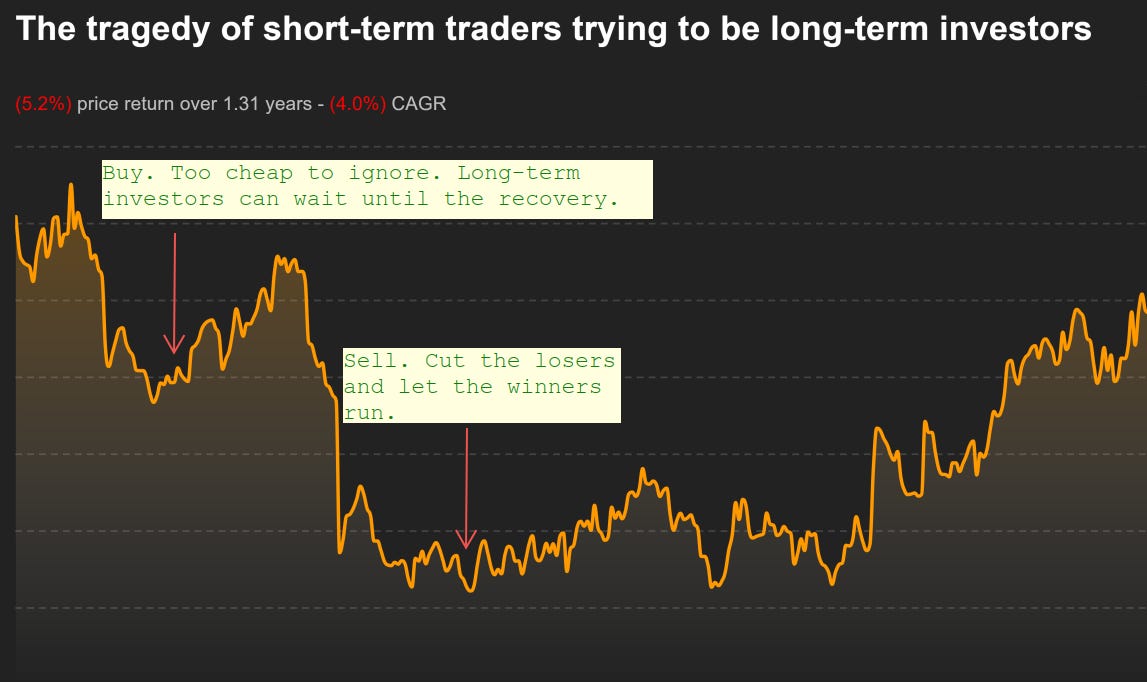
If you are investing money for other people, and you are not sure whether they are truly long-term, then you must pay attention to the short-term.
You need to weigh the trade-off between minimising short-term volatility and maximising long-term returns.
The corollary lesson is: Know yourself.
If you yourself cannot handle the short-term volatility that comes with long-term investing, don’t try to be Buffett or Greenblatt.
Many envy Greenblatt’s performance: 50% per year.1
But not many knew Greenblatt said:2
“Every couple of years, there are a few days where you lose 20% to 30% of your assets… That’s just part of the way it works.”
5. Variant perception
If you want to outperform other investors, you cannot just buy businesses that are cheap or good quality. Outperformance will be elusive.
To outperform, you need businesses that are cheaper or better quality than expected by other investors.
You need variant perception.
Focus on the under-appreciated changes in the business:
A new management took over a ‘cash-hoarding’ company. Their tone is changing from ‘hoarding cash’ to ‘efficient capital structure’ (e.g. 3659 JP)
A ‘cash-sucking’ business passing through the peak of its capex cycle, and poised to raise capital returns (e.g. GRG LN)
A ‘cyclical’ small-cap with hidden value in its investment property. Management is preparing to sell and unlock the value (e.g. PDS SP).
6. What is your edge?
“If you don’t know your edge, you don’t have one”
Jack D. Schwager
My 1st edge comes from my positioning. I focus on small to mid cap companies (SMID).
Because of their smaller sizes, they are not worth the time and effort of smarter investors. Thus, there tends to be more mispricing in SMIDs.
But the mispricing cuts both ways.
SMID stocks can be very overpriced or underpriced. Worse yet, because not many sophisticated investors are looking, red flags tend to be more prevalent and go unnoticed.
That’s where my 2nd edge comes in.
Having started my career in a Big 4 audit firm, I am much more sensitive to numbers than the average analyst.
From just the annual report, I can get a good sense of whether the business is deteriorating, whether management is questionable, etc.
I’ve seen so many red flags in SMIDs. The most memorable ones are:
My 3rd edge: I dig deeper into what’s important.
For example, investors are dumping Li Ning (2331 HK) over fears of another severe and long downturn. But my analysis strongly suggests the current downturn will be less severe than expected.
I dug into the footnotes. I discovered inventory and receivables are much healthier, reducing the need for the heavy discounts like those in the previous downturn. I will be discussing this in further detail next week.
For my 4th edge, I was tempted to list ‘passion and hard work’. When you are thinking about business and stocks for 12 hours every day, ‘obsession’ might be the better word.
But I decided against it.
Who isn’t obsessed in this game?
Afterword
This post is inspired by Charlie Huggins, a former fund manager in the UK:

Coming up next
Next week, I’ll be back with 2 to 3 more interesting ideas.
I’ll then analyse the most voted idea from my last post.
Right now, that’s Li Ning Company Limited (2331 HK). Dr. Martens plc (DOCS LN) is the runner-up.
Haven’t voted yet? Check out my last post: Yet Another 2 Attractive Ideas
Thanks for reading! If you found this helpful, hit the “like” button.
If you’re not already a subscriber, sign up for weekly analysis on global SMID equities.
Disclaimer
This publication is for informational, educational, and entertainment purposes only and does not constitute financial, investment, legal, or tax advice. The content herein is a record of my personal research and investment process, and all analysis, forecasts, and opinions expressed are solely my own.
I make no representation or warranty, express or implied, as to the accuracy, completeness, or timeliness of the information provided. The stock market is highly volatile, and my forecasts, estimates, and assumptions may prove incorrect.
I am not acting as your financial advisor or fiduciary. You should not rely on any information in this publication to make investment decisions. Under no circumstances will I be held liable for any direct, indirect, or consequential losses or damages arising from your reliance on the content of this publication.
At the time of publication, I do not hold any positions in the companies mentioned in this article, either long or short. I may change my views, predictions, or personal portfolio positioning at any time without notice.
Thanks for sharing this mate!