

“Lenders and analysts have said the risk of default or operational impact is relatively small for Evergrande...”1
This was in October 2020.
Just over a year later, Evergrande defaulted. Its founder later pleaded guilty to fraud and has been detained ever since.
In hindsight, Evergrande’s default looked inevitable.
But why did the lenders and analysts fail to see this? If we were in their shoes, could we have spotted the warning signs?
That’s what we will do today.
31 March 2020. You are an equity analyst. Evergrande just published their 2019 annual report. Your portfolio manager (PM) wants your recommendation. Should the fund sell everything at HKD 13?
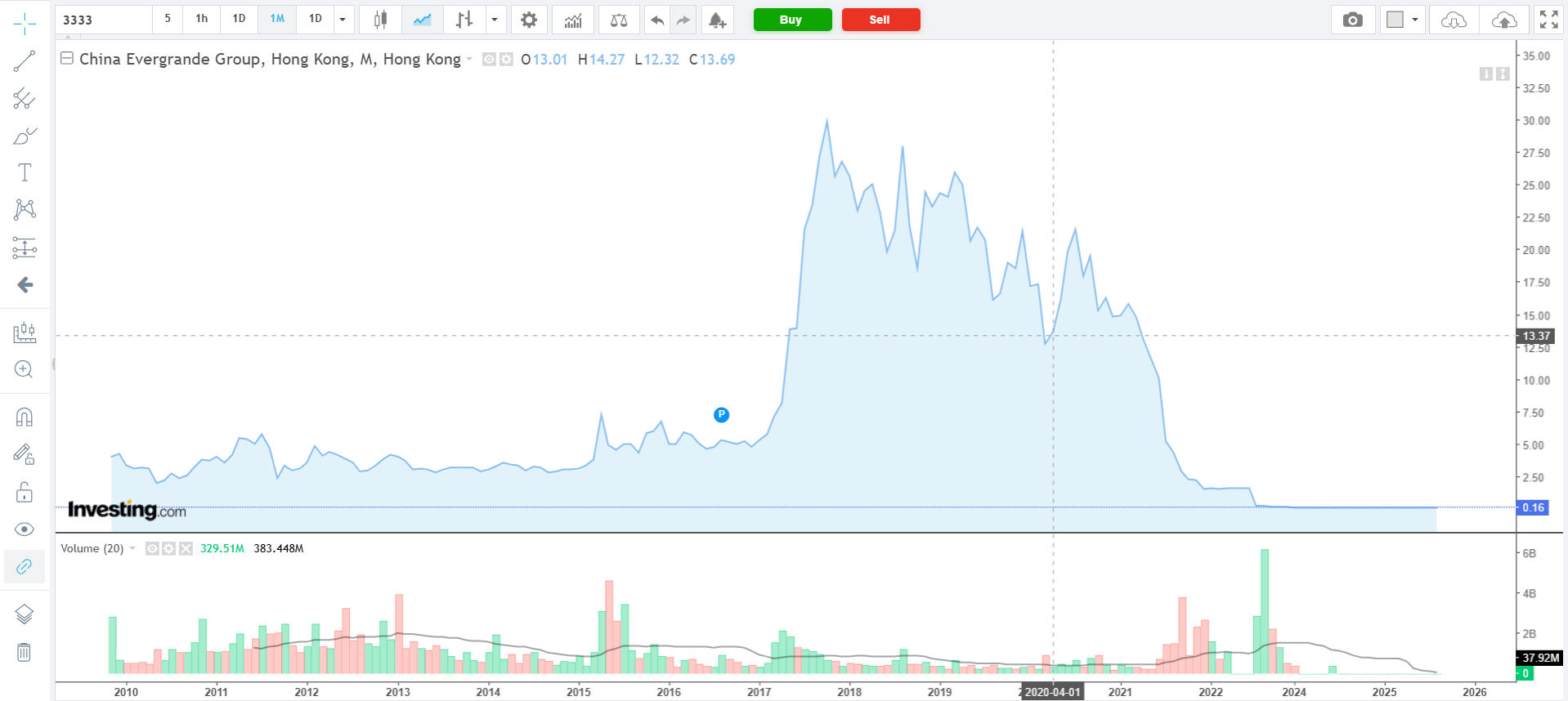
Evergrande’s share price (source: investing.com)
You start flipping through the annual report.
Aggressive capitalisation of interest expense
Property developers usually borrow money to build apartments. During the construction, they incur interest costs but are not yet earning revenue.2
To remove this timing mismatch between interest costs and revenue, property developers are allowed to capitalise the interest costs. Instead of recognising the interest costs as an immediate expense, they recognise them as an asset, usually as part of properties under development.
When the developers eventually sell the apartments, the capitalised interest costs will be recognised as cost of goods sold expense, thereby matching the interest expense with revenue.
Evergrande knew this. It pushed this to the extreme:
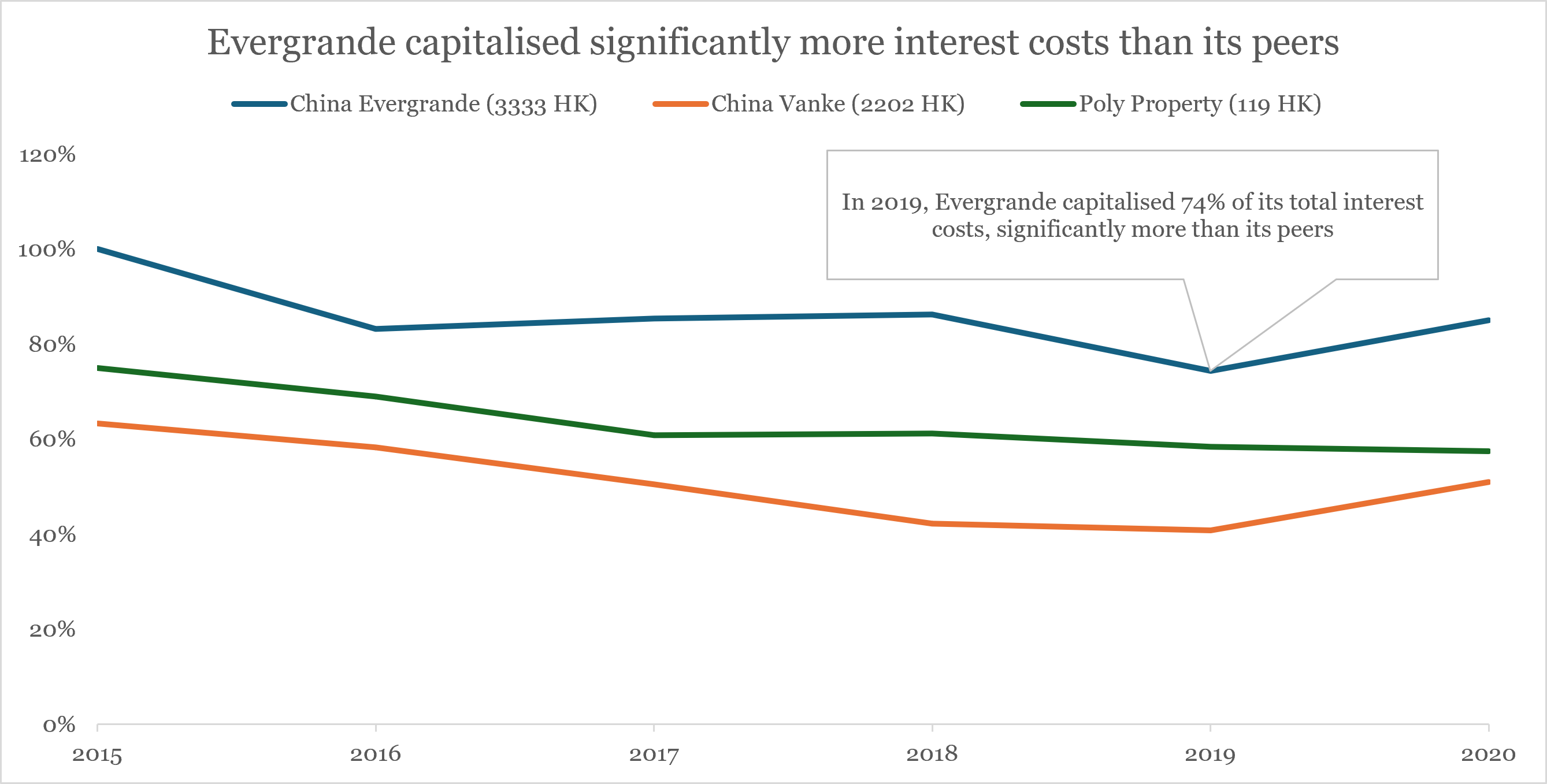
Source: Companies’ annual reports, Angsana Anderson
In 2019, China Vanke and Poly Property capitalised only ~50% of their interest costs, on average. Evergrande capitalised 74%!
If Evergrande had capitalised only 50% of its interest costs, this would have wiped out its net profits in 2019.
Why is Evergrande delaying payments to suppliers?
We’ve talked about how when demand starts weakening, customers start delaying payments.
The opposite is also true:
When demand starts weakening, companies start delaying payments.
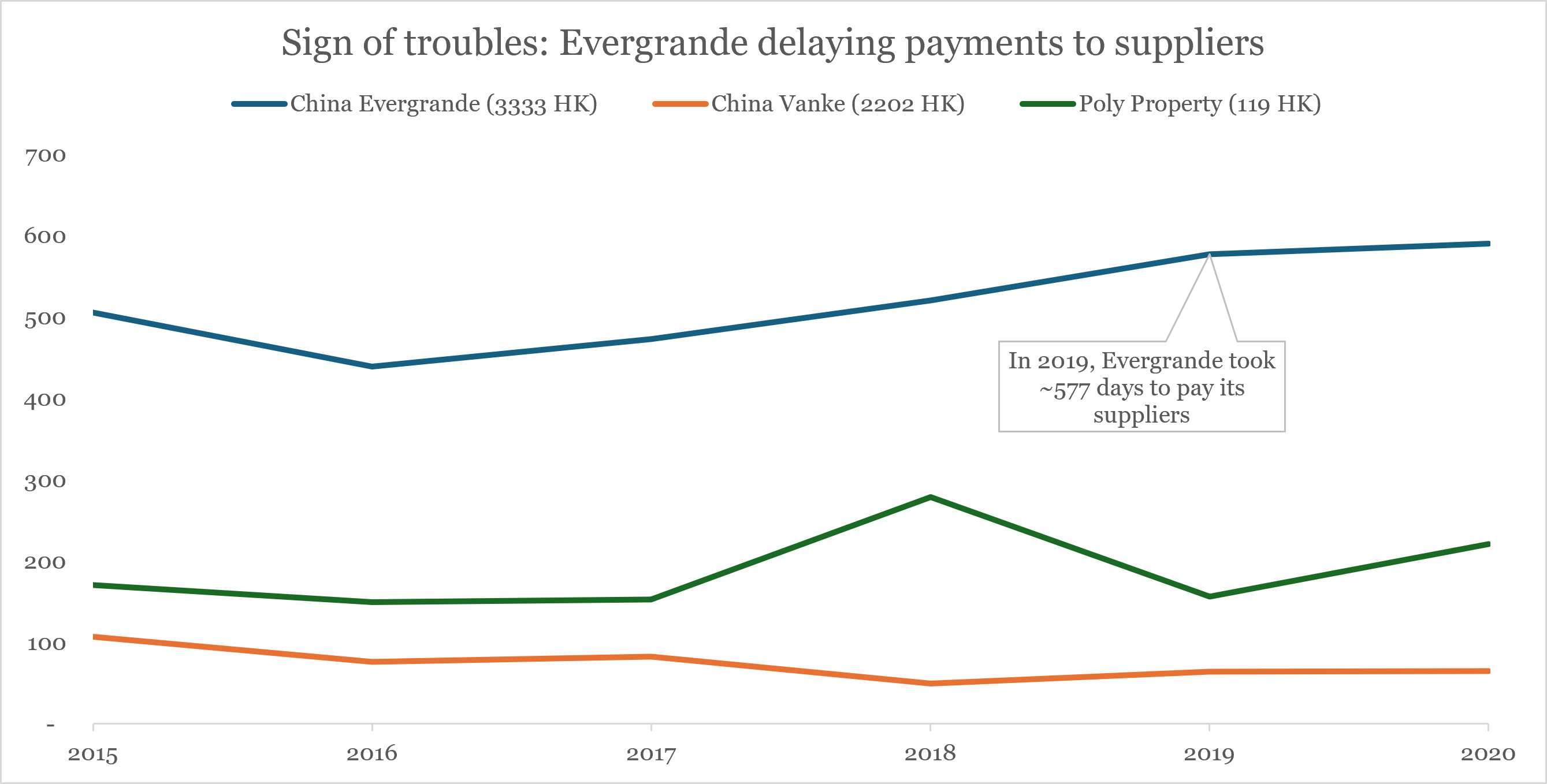
Source: Companies’ annual reports, Angsana Anderson
This chart highlights 2 important points.
The obvious point is the rising days payables. In 2016, Evergrande took ~ 439 days to pay its suppliers. By 2019, this has stretched into ~ 577 days. Whenever a company starts delaying payments, it’s a strong sign of weakening demand or cash flow issues or both.
Second point, compared to its peers, Evergrande is taking much longer to pay suppliers.
Trade payables are amounts owed to suppliers in the normal course of business. Whenever the time taken to pay trade payables exceeds the industry norm, you should start wondering whether these are actually loans from suppliers.
If we classified Evergrande’s excess payables as loans, its total debt in 2019 would have jumped more than 50%.
The collapse
Evergrande’s shares dropped like a brick during 2021.
Credit downgrades, missed payments on wealth management products, protests, defaults, fire sale, the end.
In March 2024, after shareholders were all but wiped out, the China Securities Regulatory Commission (CSRC) accused the founder of fraud.
Hui Ka Yan allegedly instructed his staff to “falsely inflate” revenue and profits. The inflated figures accounted for half of total revenue in 2019, and 79% in 2020, according to the regulator.3
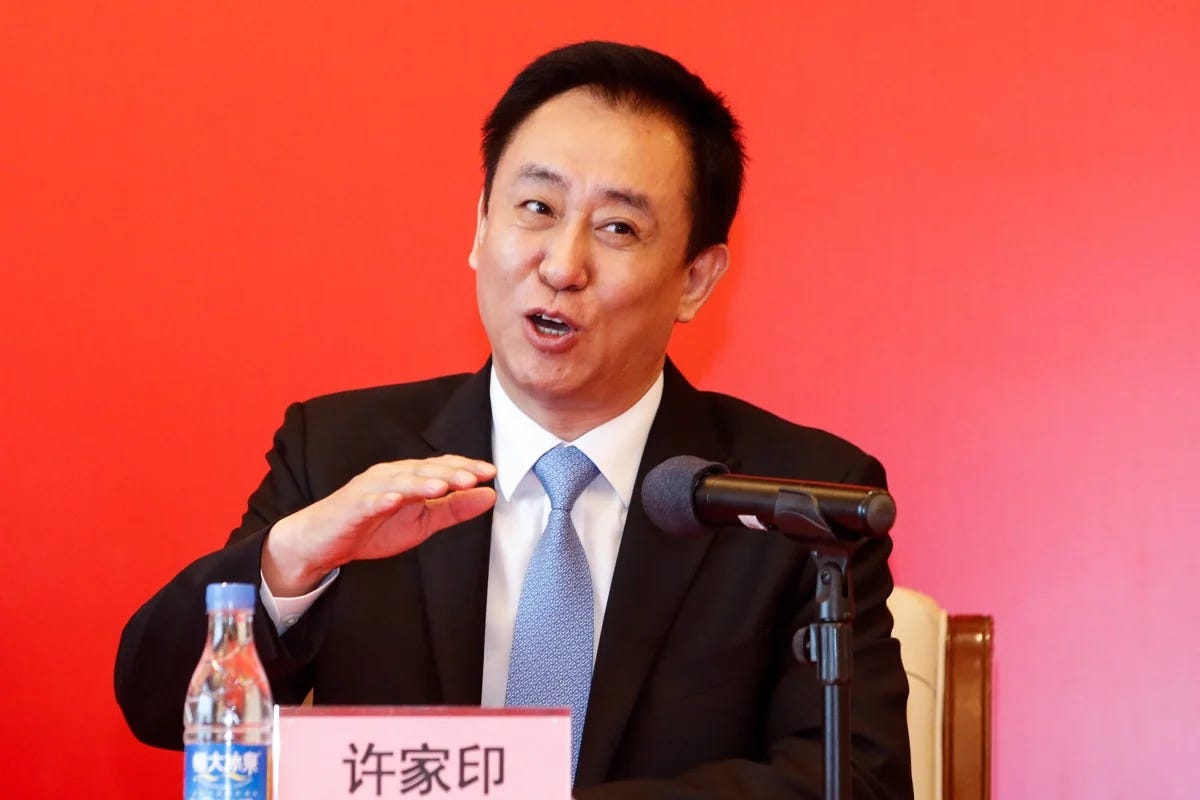
Evergrande founder Hui Ka Yan (source: SCMP, 2023)
You patted yourself on the back. Nobody could have known the problems ran so deep, but you spotted the red flags.
Spotting the red flags is easy, the hardest part is…
…convincing your PM to sell everything, especially when they have fallen in love with the stock.
If you make a strong case to sell, but the share price jumps before everything collapse, your head will be on the chopping board. That’s what Evergrande’s shares did.
Maybe it’s safer to just tell the PM what they want to hear.
Little wonder the “lenders and analysts” said the risk of default is relatively small for Evergrande!
Coming up next
Next week, I’ll be back with 3 more interesting ideas.
I’ll then analyse NEXON Co., Ltd. (3659 JP) in detail. That’s the idea you voted most interesting last week.
Thanks for reading! If you found this helpful, hit the “like” button.
If you’re not already a subscriber, sign up for weekly analysis on global SMID equities.
Disclaimer
This publication is for informational, educational, and entertainment purposes only and does not constitute financial, investment, legal, or tax advice. The content herein is a record of my personal research and investment process, and all analysis, forecasts, and opinions expressed are solely my own.
I make no representation or warranty, express or implied, as to the accuracy, completeness, or timeliness of the information provided. The stock market is highly volatile, and my forecasts, estimates, and assumptions may prove incorrect.
I am not acting as your financial advisor or fiduciary. You should not rely on any information in this publication to make investment decisions. Under no circumstances will I be held liable for any direct, indirect, or consequential losses or damages arising from your reliance on the content of this publication.
At the time of publication, I do not hold any positions in 3333 HK, 2202 HK, 119 HK, either long or short. I may change my views, predictions, or personal portfolio positioning at any time without notice.
References
There are developers that recognise revenue over time as the construction progresses. In this case, they are generally not allowed to capitalise interest costs. This scenario is not applicable to Evergrande because it recognises revenue at a point in time.