


Last week, you highlighted a potential opportunity in NICE, South Korea’s top credit bureau. Can we even buy it?
Interactive Brokers (IBKR) just opened trading access to the Korea Exchange (KRX) this year.
Very nice. What is your recommendation?
I recommend shortlisting NICE for further research.
But I assign this lower priority than CTOS Digital Berhad (CTOS MK).
Why lower priority?
There is a case for under-recognised growth, but it is not as strong as I first thought…
Before you continue, remind me again, what does NICE do?
NICE is the top credit bureau in South Korea.
The core business involves collecting data on borrowers, both individuals and corporations, and processing it into credit scores.
Its personal credit score holds ~70% market share in South Korea. NICE is also the largest player in the corporate segment, with ~ 34% market share.
Customers include major banks, insurers, telcos, etc. No single customer accounts for more than 10% of total revenue.
Although it just received a license to operate in Vietnam1, almost all revenue still comes from South Korea.
Here’s the revenue breakdown for the first 6 months of 2026:
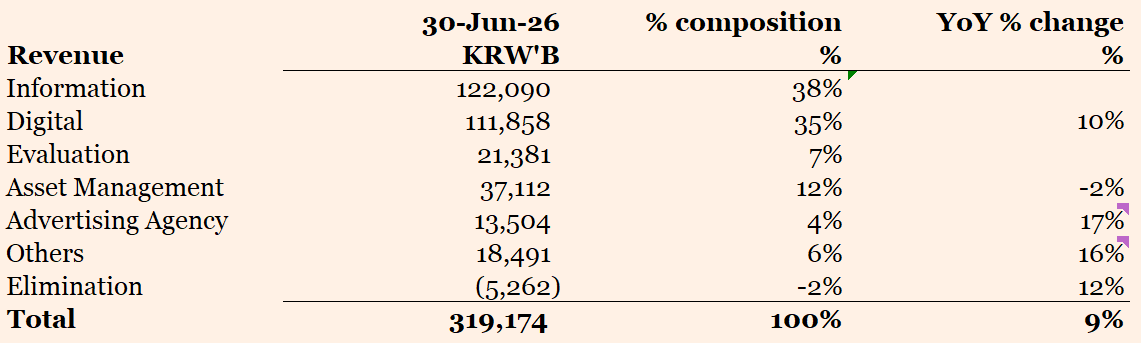

Source: NICE (2026)
Are the shares liquid enough?
18 Aug 2026
Share price: KRW 15,350
Market capitalisation: KRW 898 bn (USD 635 mn)
Enterprise value (EV): KRW 756 bn (USD 535 mn)
Average daily volume (ADV): KRW 1 bn (USD 1 mn)
NTM P/E: 9x
Between 2021 and 2023, why did NICE’s total return fall? What drove the subsequent recovery?
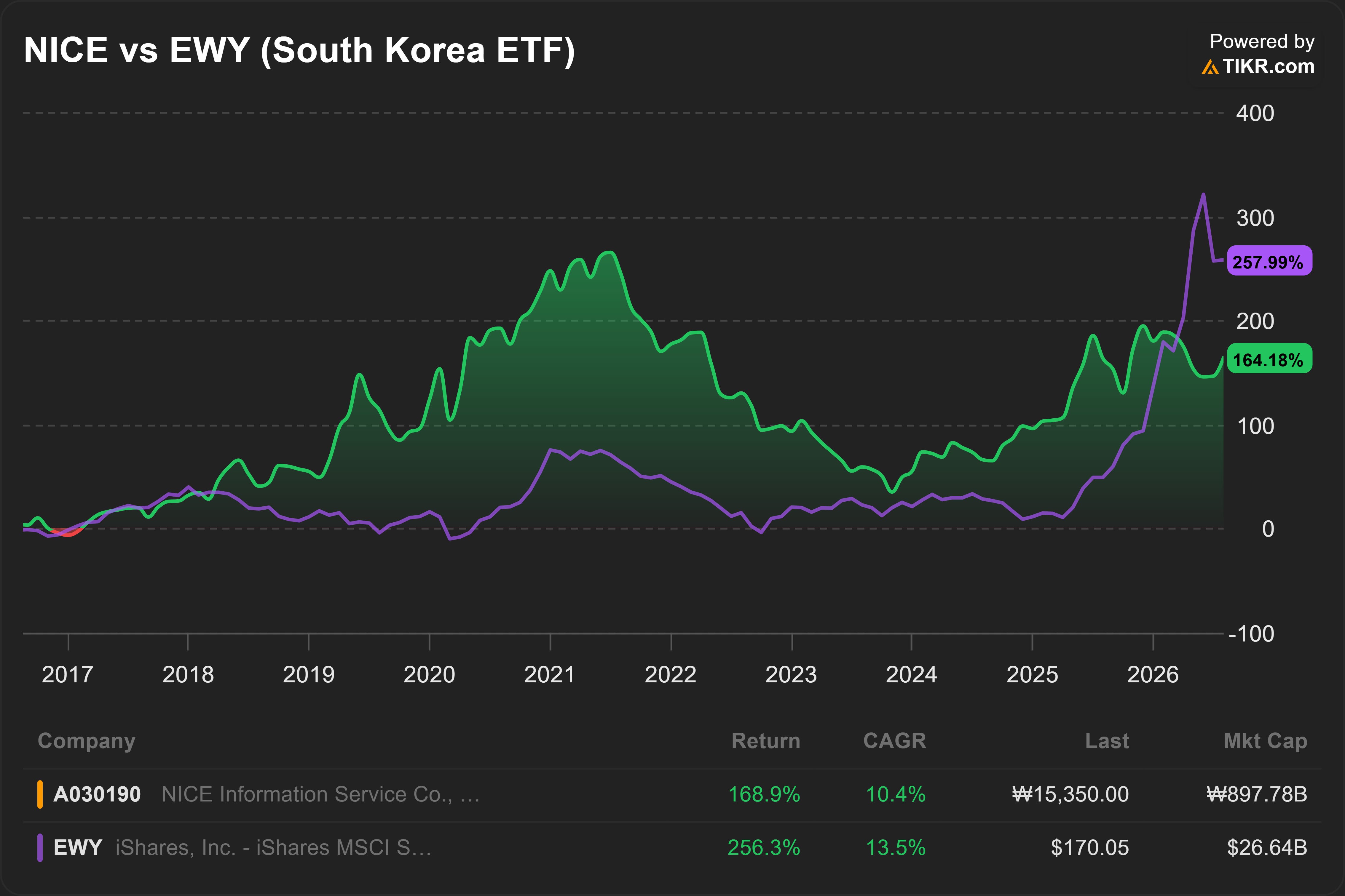
The short answer: revenue growth.
Between 2021 and 2023, revenue growth decelerated. It started recovering from 2024 onwards.
We’ll discuss the details later.
Ok.
Under-recognised growth
Going back to the original question: why do you think the under-recognised growth is not as strong as you initially expected?
At first, I thought the core business could grow at mid-single digit (MSD) over the long-term. Now, I believe a more realistic growth rate lies around low-single digit (LSD).
Let me first explain the main driver of revenue growth.
The core business (Information, Digital and Evaluation) makes up ~80% of group revenue. Their revenue is largely driven by change in loan volume. When banks give out more loans, they demand more NICE credit reports.
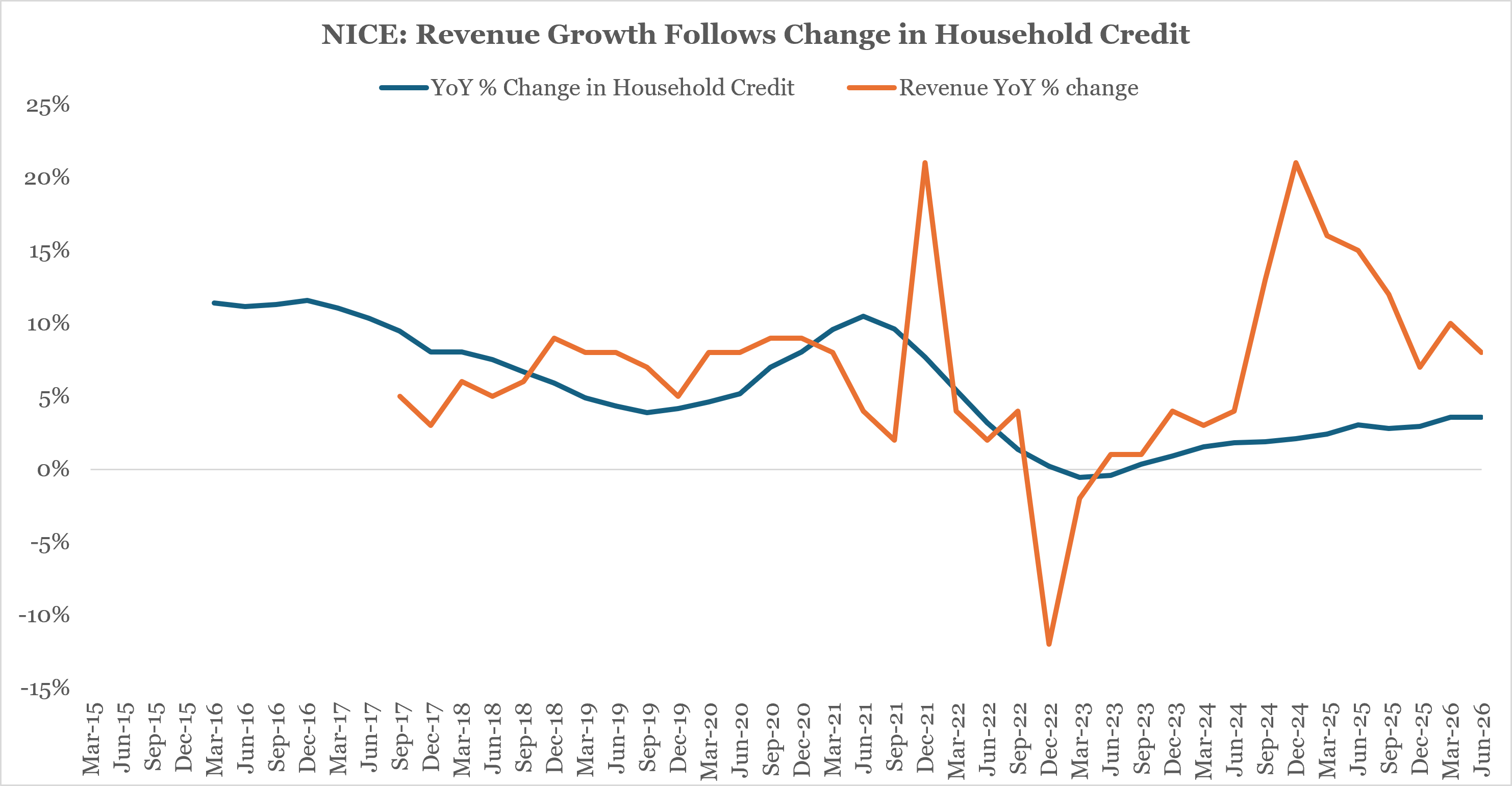
Data on loan volume is difficult to get. So, let’s use South Korea Household Credit as proxy.
Source: ECOS (2026); Tikr
By and large, NICE’s revenue growth ‘hugs’ growth in household credit.
Revenue growth starts diverging in 2024. That’s mainly because of acquisitions. In February 2024, NICE acquired NICE P&I, a valuation firm. In May 2024, NICE acquired 2 advertising agencies: Eins Media and Well Communications.
Without these acquisitions, revenue would have grown by only +6% in 2024.
As you can see, after the boost from acquisitions, revenue growth started converging back towards household credit growth.
So, if we know how household credit will grow, we’ll roughly know how NICE’s revenue will grow?
Exactly.
Household credit grew +4% YoY in H1’26. For H2’26, growth should be less than +3%. The Financial Services Commission (FSC), South Korea’s financial regulator, targets +3% growth for 2026.2
The FSC also maintained its goal of stabilising the household debt-to-GDP ratio at around 80% by 2030. In Q1’26, this ratio was around 85.3%.3
To achieve this goal, I estimate the FSC will need to slow down household credit growth to low-single digits, between +1% and +2%.
That’s essentially why I believe revenue growth at NICE will likely decelerate to LSD.
Can advertising help accelerate revenue growth? Previously, you said that the new law in 2020 allows NICE to sell its credit data to advertisers.
Advertising looked promising. After all, global peer Experian plc (EXPN LN) earns up to 20% of its revenue from advertising and other services.
Today, advertising contributes ~4% to NICE’s group revenue. If this % increases to 20%, this would mean an incremental KRW 118 bn revenue. This would be a +20% increase from the revenue earned in 2025.
Things look very promising. In H1’26, NICE’s Advertising Agency segment grew revenue by +17% YoY.
However, I am not very confident.
The H1’26 footnotes reveal that most of the growth was driven by the acquisition of J-Bridge in July 2025.4 Without this acquisition, Advertising Agency revenue would have grown by only +1% YoY.
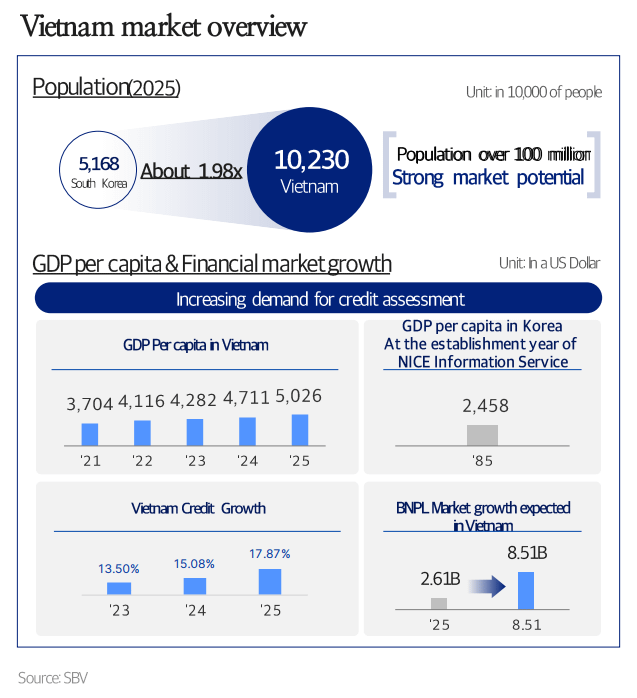
How about Vietnam? In May 2026, the State Bank of Vietnam issued a license for credit information service to NICE.
This is the main reason why I have not passed on NICE. Vietnam has the potential to exceed expectations.
Source: NICE (2026)
Vietnam’s credit market shows strong growth, mid-teens to high-teens. That said, I expect competition to be fierce. NICE is the 4th private credit bureau to enter the market.
NICE will officially begin operations in Vietnam in the first half of 2027.5
Let’s see how it performs.
I propose coming back to NICE after we complete the thesis for CTOS.
It’s easier to make a case for under-recognised growth and capital returns for CTOS. Plus, there’s a takeover catalyst. I suspect the major shareholder is looking to sell the business for 2x today’s price.
Coming up next
Previously, we talked about how working capital trends can help us understand future demand.
When demand is recovering, raw materials grow faster than finished goods. We saw how this is a good leading indicator of revenue growth at SK Hynix.
When China Evergrande started facing weak demand and cash flow issues, it started delaying payments to suppliers. This showed up in unusually long and rising payable days.
Could we also get useful insights from a detailed analysis of property, plant and equipment?
That’s what I will explore in my next analysis.
Subscribe for free to be notified immediately when I publish.
Subscribe for 2 to 3 analyses of global SMID equities every week.
Discover overlooked ideas and rethink familiar names.
Published by Andrew Wong, ACA, CFA
Disclaimer
This publication is for informational, educational, and entertainment purposes only and does not constitute financial, investment, legal, or tax advice. The content herein is a record of my personal research and investment process, and all analysis, forecasts, and opinions expressed are solely my own.
I make no representation or warranty, express or implied, as to the accuracy, completeness, or timeliness of the information provided. The stock market is highly volatile, and my forecasts, estimates, and assumptions may prove incorrect.
I am not acting as your financial advisor or fiduciary. You should not rely on any information in this publication to make investment decisions. Under no circumstances will I be held liable for any direct, indirect, or consequential losses or damages arising from your reliance on the content of this publication.
At the time of publication, I do not hold any positions in 030190 KS, either long or short. I may change my views, predictions, or personal portfolio positioning at any time without notice.
I'm Korean and know NICE is kinda oligopoly corporate. If you satisfied with LSD growth, it could be a NICE choice. They accuired some weird business because of LSD growth rate tho.
Really interesting read.
I particularly like your use of household credit as a proxy for loan volume (I will be stealing this in future… thank you!)
I looked into this company a bit myself.
NICE holdings owns roughly 44% of NICE information services.
NICE information services currently has a market cap of 871.46B KRW and NICE Holdings has a market cap of 474.72b KRW.
So, if you purchase NICE holdings you deduct their stake in NICE information service, you essential get the rest of their portfolio for 91.28B KRW