

[Shortlist] Li Ning Company Limited (2331 HK)
You highlighted a potential opportunity in Li Ning. What’s your suggestion?
Shortlist Li Ning.
The shares sold off after H1’26 earnings. Management cut revenue and margin guidance for 2026, driven by weak demand.
Today, the shares are trading at ~10% FCFF yield. The market seems to be pricing in another long and severe downturn, like the one from 2011 to 2017.
However, the current headwind will likely be less severe than expected. A detailed analysis of inventory and receivable reveal a good business that’s much healthier than expected.
Furthermore, investors are too focused on short-term earnings. They are overlooking the inflection point in Li Ning’s growth in international markets.
Liquidity?
8 Oct 2026
Share price: HKD 12.26
Market capitalisation: HKD 31,935 mn (USD 4,069 mn)
Enterprise value (EV): HKD 16,650 mn (USD 2,121 mn)
Average daily volume (ADV): HKD 303 mn (USD 39 mn)
NTM P/E: 9x
What does Li Ning do?
Li Ning sells sportswear under its own brand, mainly in mainland China.
It earned CNY 30 bn revenue in 2025 (+3% YoY):
49% footwear (+2% YoY)
42% apparel (+2%)
9% equipment and accessories (+13%)
Li Ning sells through these channels:
47% wholesale (+6% YoY)
30% e-commerce (+5%)
22% direct (-3%)
1% international (-20%)
How has its market share trended?
Historically, consumers viewed Li Ning as inferior to Western brands like Nike and Adidas.
This changed in 2021.
The Xinjiang controversy caused consumer preference to shift towards local brands.
Li Ning gained significant market share. It held the gains after consumers discovered its products are as good as Western brands.
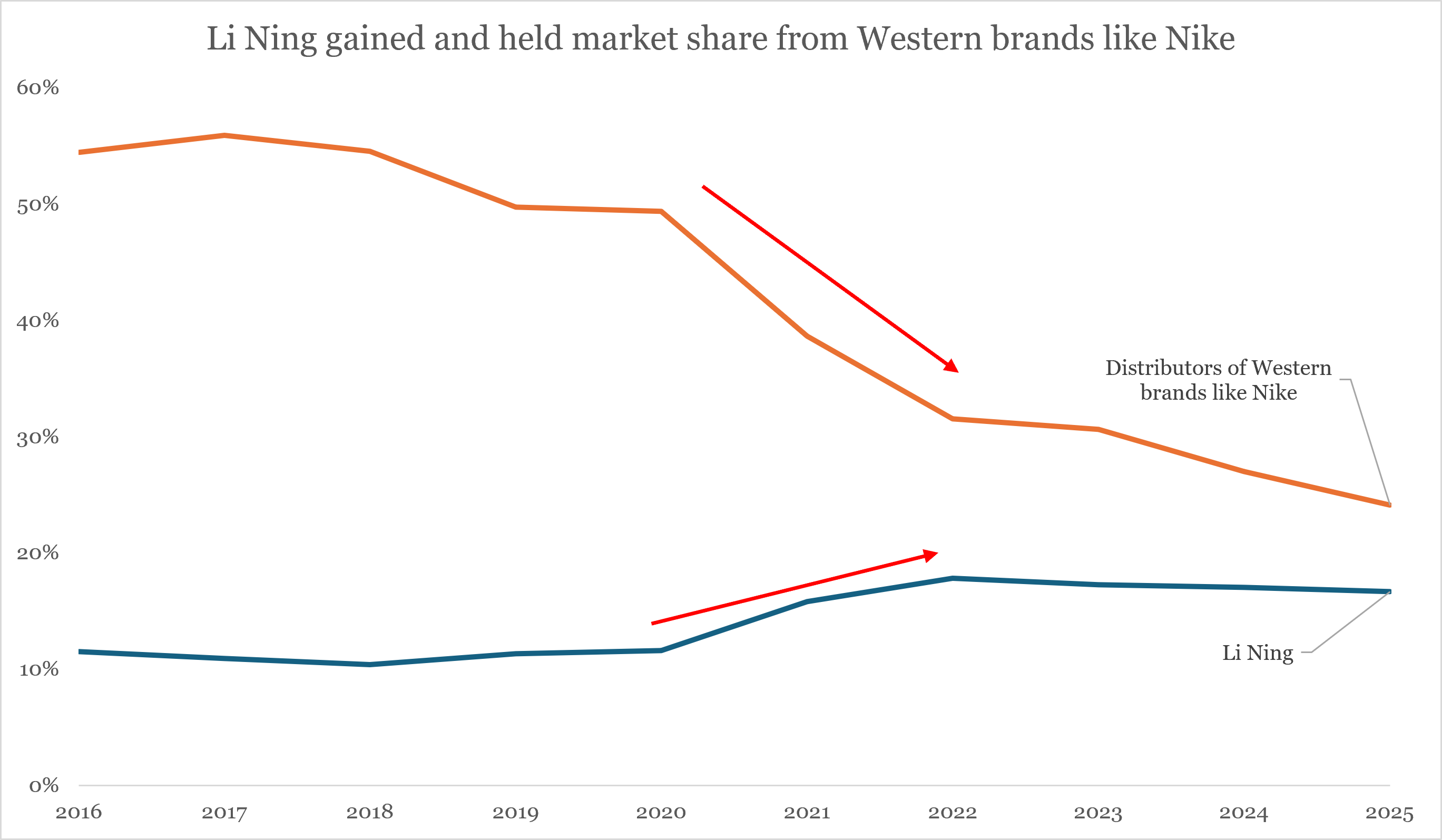
Source: Angsana Anderson estimates based on Topsports (6110 HK), Pou Sheng (3813 HK), Li Ning (2331 HK) and others
Good business, temporary headwinds
Why do you think the market is likely wrong to price in another long and severe downturn, like the one during 2011 - 2017?
The 2011 – 2017 downturn was caused by management significantly overestimating post-Olympic demand.
When the demand surge unexpectedly cooled off, Li Ning was stuck with too much inventory. Growth plummeted. Margins collapsed as the company cut prices to clear excess inventory.
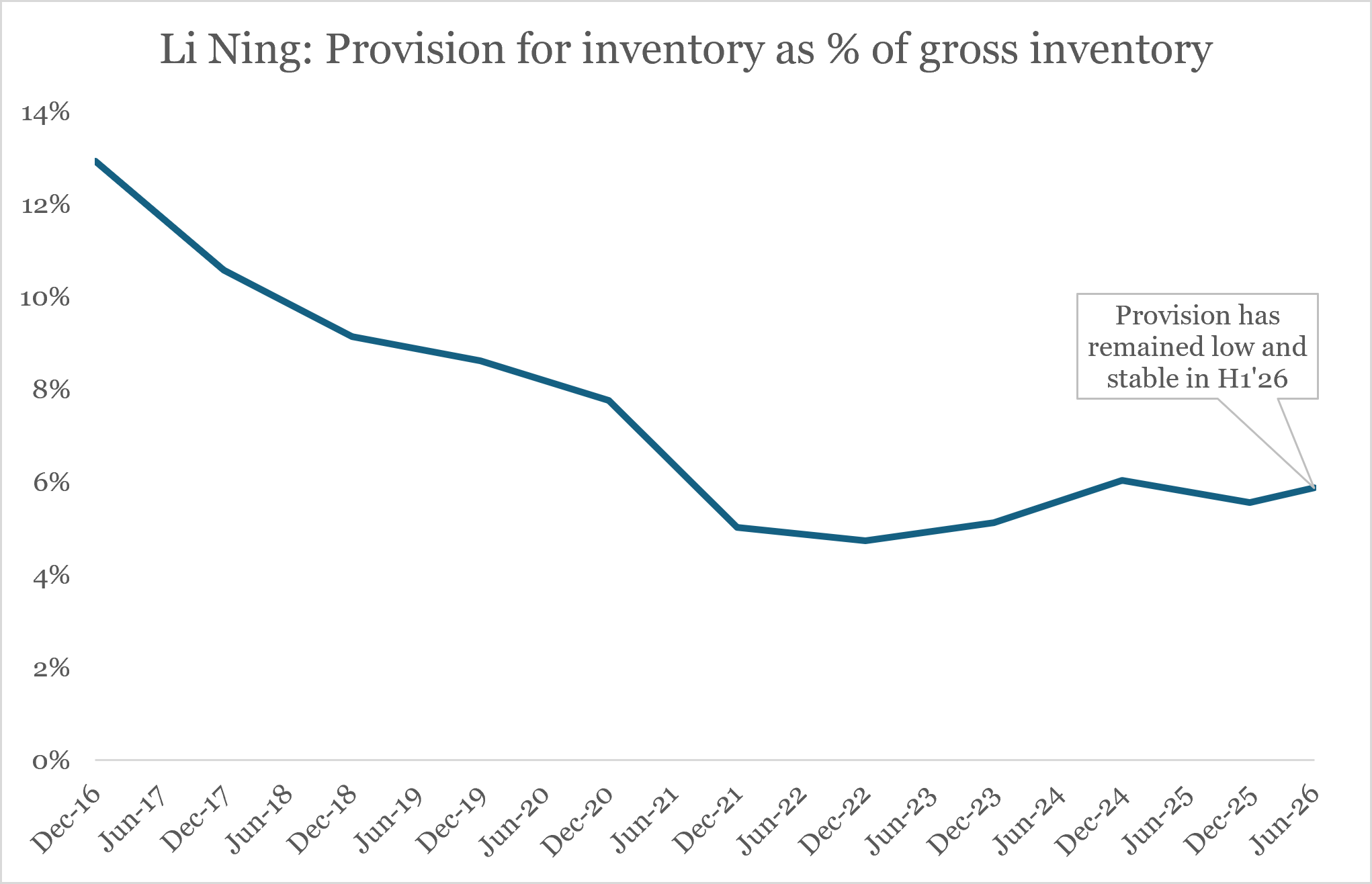
The current headwind will likely be less severe than expected. Compared to 10 years ago, inventory today is much healthier.
Provision for inventory write-down measures the percentage of inventory whose selling price has fallen below cost. In H1’26, this remained low and stable at 5.9%. 10 years ago, it was 12.9%.
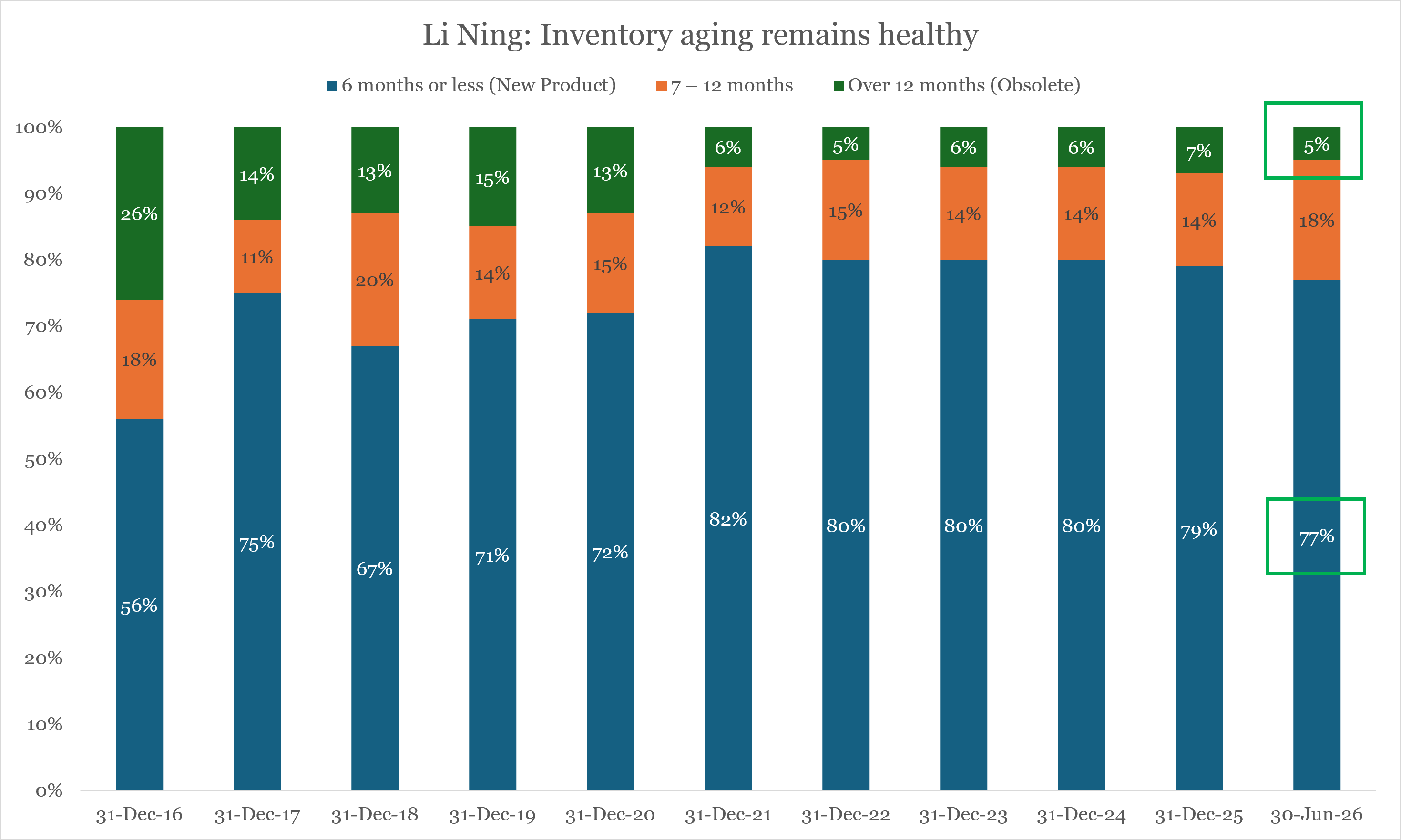
Inventory aging remains healthy in H1’26.
New products make up 77% of inventory, significantly higher than the 56% in 2016.
More importantly, obsolete products remain near all-time low at 5%.
Ok. We’ve discussed these before.
Inventory at Li Ning may be healthy. But how about channel inventory?
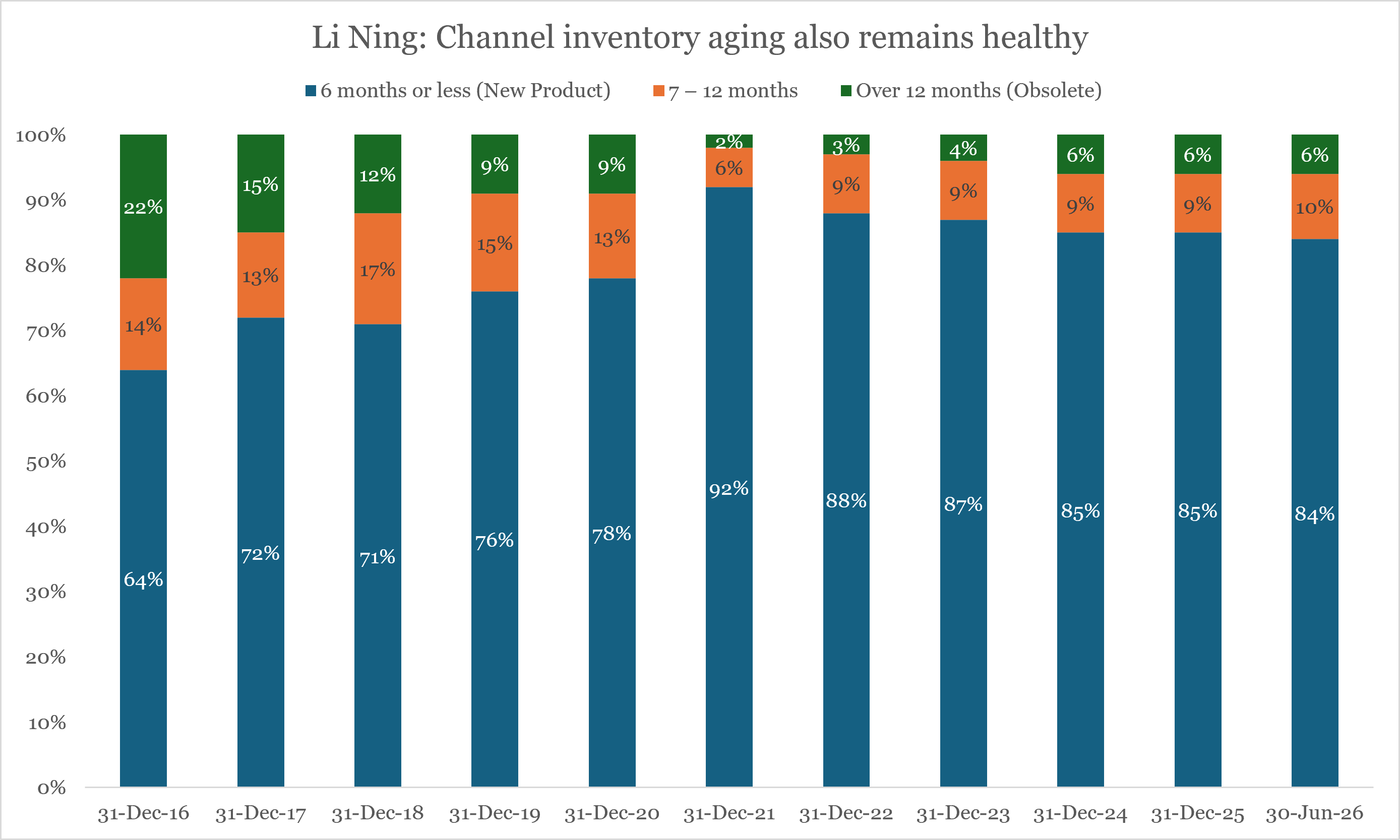
Channel inventory also looks healthy.
New products make up 84% of inventory. Only 6% of inventory is obsolete.
Both % remained stable in H1’26.
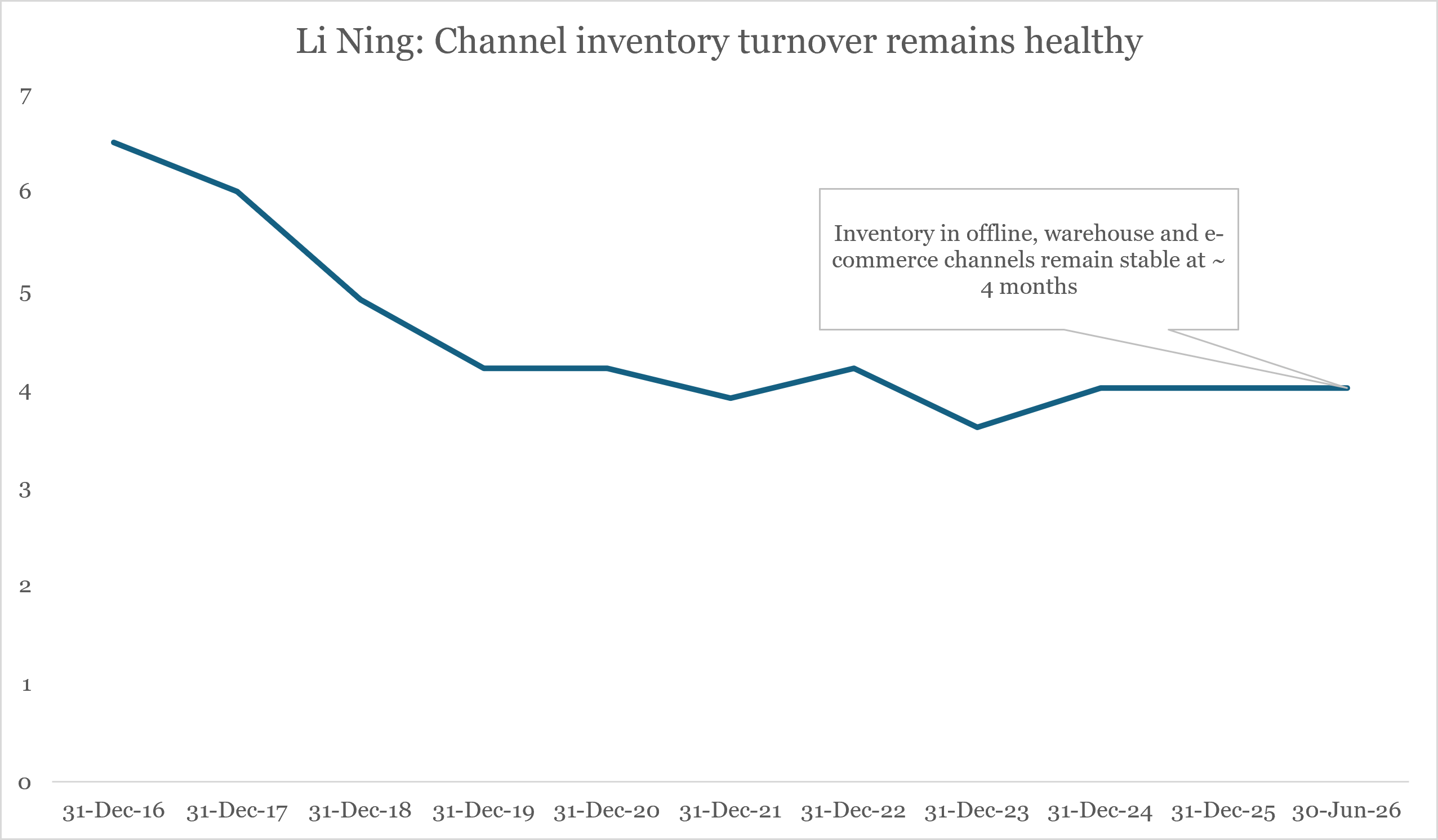
Finally, turnover in channel inventory also remains healthy and stable at ~ 4 months.
What is the risk of channel stuffing?
Low risk.
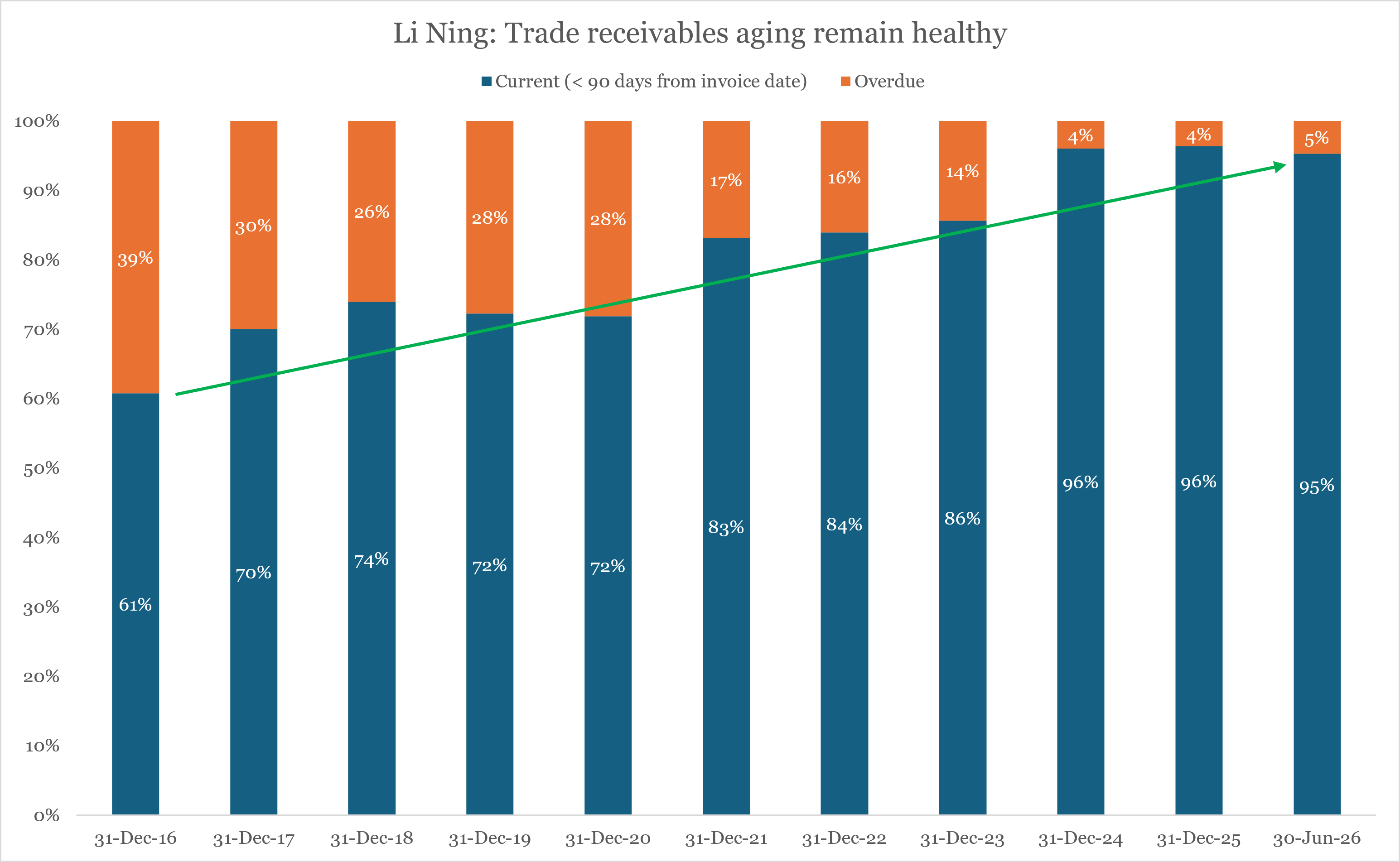
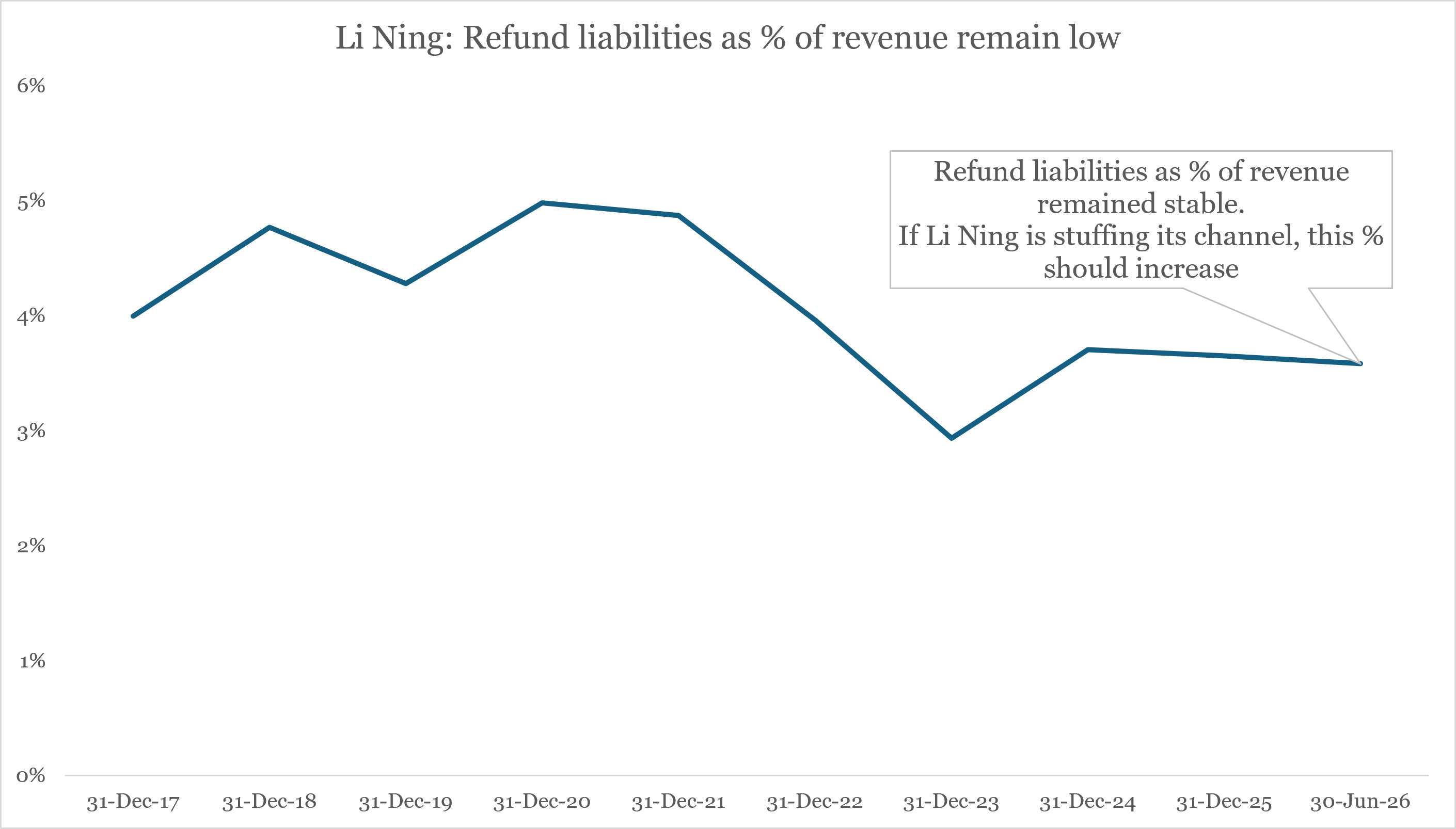
If this is happening, channel inventory would deteriorate, customers would take longer to settle invoices and refunds would increase. No indicators of these so far.
Trade receivables aging remains healthy.
Refund liabilities remain low and stable too.
Under-recognised growth
Why are investors overlooking Li Ning’s growth potential?
Investors are distracted by the near-term guidance cut. They are overlooking Li Ning’s long-term growth potential in international markets.
In 2009, the company opened stores in Singapore and Hong Kong, followed by the US in early 2010. By H1’26, international markets account for only 1.2% of total revenue.
However, we have reached an inflection point.
Thanks to pioneers like BYD, Chagee and Luckin, international consumers are now more open to Chinese brands like Li Ning and Anta. We talked about this before.
Li Ning is moving to capture the growth potential.
In October 2024, Li Ning formed a joint venture with HongShan (formerly Sequoia China). The JV’s purpose is to develop Li Ning’s business outside China.
The agreement sets a target of USD 1 bn (CNY 6.7 bn) revenue by 2028. This is equivalent to ~ 22% of last twelve month’s revenue.
In 2025, Li Ning became the official sportswear partner for the Chinese Olympic Committee from 2025 to 2028. In June 2026, Li Ning signed a partnership with Stephen Curry, a popular basketball player in the US.
These partnerships contributed to near-term margin compression and the share sell-off. However, investors are overlooking Li Ning’s potential to earn attractive incremental return on capital overseas.
What can close this valuation gap?
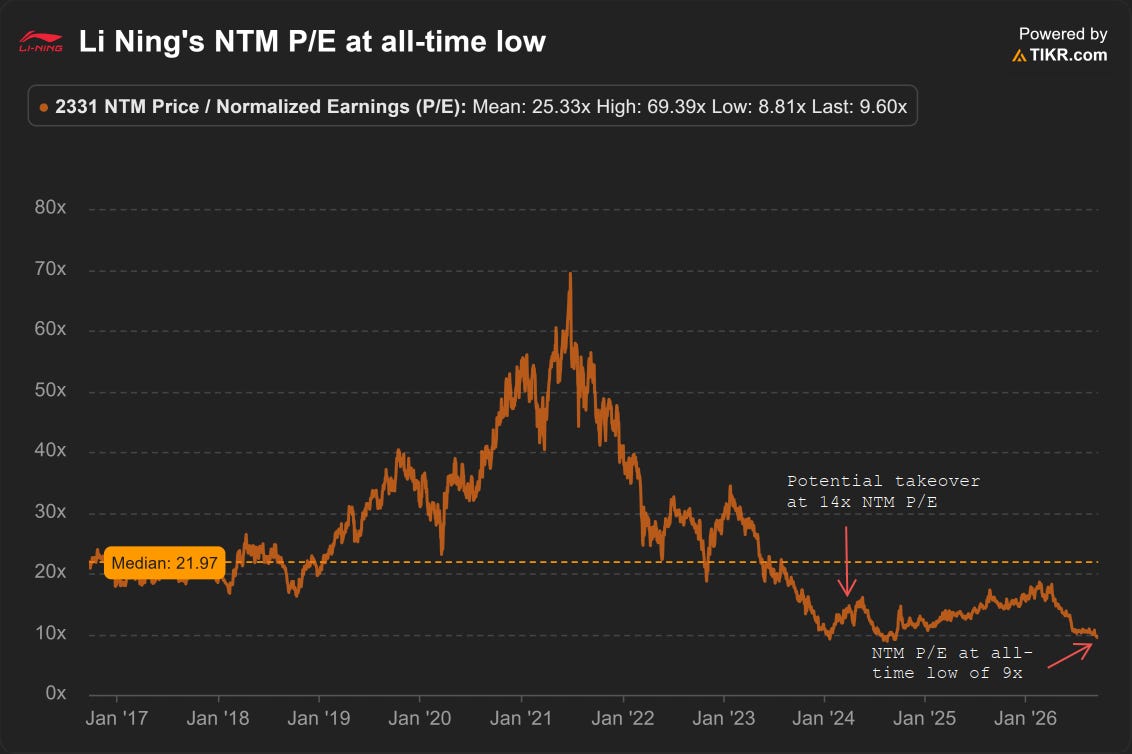
Potential takeover
In March 2024, Reuters reported founder and CEO Li Ning is considering a takeover.1
The shares were trading ~ HKD 22.00 per share and 14x NTM P/E.
If no takeover happened 2 years ago, why now?
2 reasons
(1) Valuation is much more attractive today.
Despite good growth potential, the share price has almost halved to ~ HKD 12.
The company is trading at only 9x NTM P/E.
(2) Cash outlay for a takeover is lower today.
The founder also owns more of the company today: ~20%, up from 10% previously. He is buying shares directly on the market.
The most recent purchase was on 11 Sep 2026, at ~ HKD 12.92 per share.2
Sounds interesting.
How successful can they expand overseas? What do customers think about their products vs. Western brands?
What is the risk of the recovery taking longer than expected?
Please find out more
Coming up next
Next week, I’ll be back with 2 to 3 more interesting ideas.
I’ll then analyse the most voted idea from my last post.
Right now, that’s Genting Singapore Limited (G13; GENS SP). ANTA Sports Products Limited (2020 HK) is the runner-up.
Haven’t voted yet? Check out my last post: 2 Attractive Ideas Again
Subscribe for 2 to 3 analyses of global SMID equities every week.
Discover overlooked ideas and rethink familiar names.
Published by Andrew Wong, ACA, CFA
Disclaimer
This publication is for informational, educational, and entertainment purposes only and does not constitute financial, investment, legal, or tax advice. The content herein is a record of my personal research and investment process, and all analysis, forecasts, and opinions expressed are solely my own.
I make no representation or warranty, express or implied, as to the accuracy, completeness, or timeliness of the information provided. The stock market is highly volatile, and my forecasts, estimates, and assumptions may prove incorrect.
I am not acting as your financial advisor or fiduciary. You should not rely on any information in this publication to make investment decisions. Under no circumstances will I be held liable for any direct, indirect, or consequential losses or damages arising from your reliance on the content of this publication.
At the time of publication, I am long 2331 HK. I may change my views, predictions, or personal portfolio positioning at any time without notice.