

You’re an online retailer. You’re running heavy losses and burning through cash. Investors won’t touch you with a ten-foot pole.
How to fix?
Easy. Just one small change to your accounting.
If you do this, you’ll show profits immediately. Free cash flow overflow. Investors will trample over one another to give you their money. Celebrity investors hail your name.
What’s that small change?
Start capitalising software costs
We talked about capitalisation of costs before. When you capitalise a cost, you exclude it from expense and include it as an asset.
If a physical retailer spends $2 mn to build a new warehouse, they are allowed to capitalise this cost as ‘property, plant and equipment’ on their balance sheet.
Software is the equivalent of ‘property, plant and equipment’ to an online retailer.
If an online retailer spends $2 mn to build new software, they are also allowed to capitalise this. Think of costs like the software engineer’s salary, consulting fees, etc.
But don’t stop there.
Capitalise as many costs as you can. There’s a lot of judgement involved in determining which costs are truly attributable to building the software.
If a software engineer splits their time between maintenance and building new software, how much of their salary gets capitalised?
Aggressive management can push these assumptions to the limit to understate expenses.
One stone, two birds.
You have removed huge costs from your expenses. You’re showing profits now.
Capitalisation boosts free cash flow too
Best of all, you’re showing huge free cash flow.
How come?
Because some investors still calculate free cash flow like this:
From the statement of cash flow:
Free cash flow = operating cash flow - capex
There are many problems with this. It doesn’t account for stock-based compensation, non-cash capex, etc. But that’s for another time.
For today, we will focus on capitalisation of software.
When you capitalise software costs, it shows up on the cash flow statement as ‘purchase of intangible assets’. Not ‘capex’.
That means, the formula above will completely miss this out.
Sounds simple. But I’ve lost count of how many times I’ve seen ‘analysts’ overestimate free cash flow like this.
Company A: Online Retailer in the UK
It’s normal to capitalise software costs.
But investors must understand how much capitalisation contributes to profits. They should pay attention when a company is profitable because of capitalisation.
Many investors saw this online retailer as a profitable cash flow generative high growth quality compounder (How many more glittering generalities can you fit in?).
But what they don’t realise is that, without capitalisation of software costs, Company A1 would be showing losses.
In 2017, Company A reported net profits. If it had not capitalised software costs, it would have reported net losses. Same story for other years.
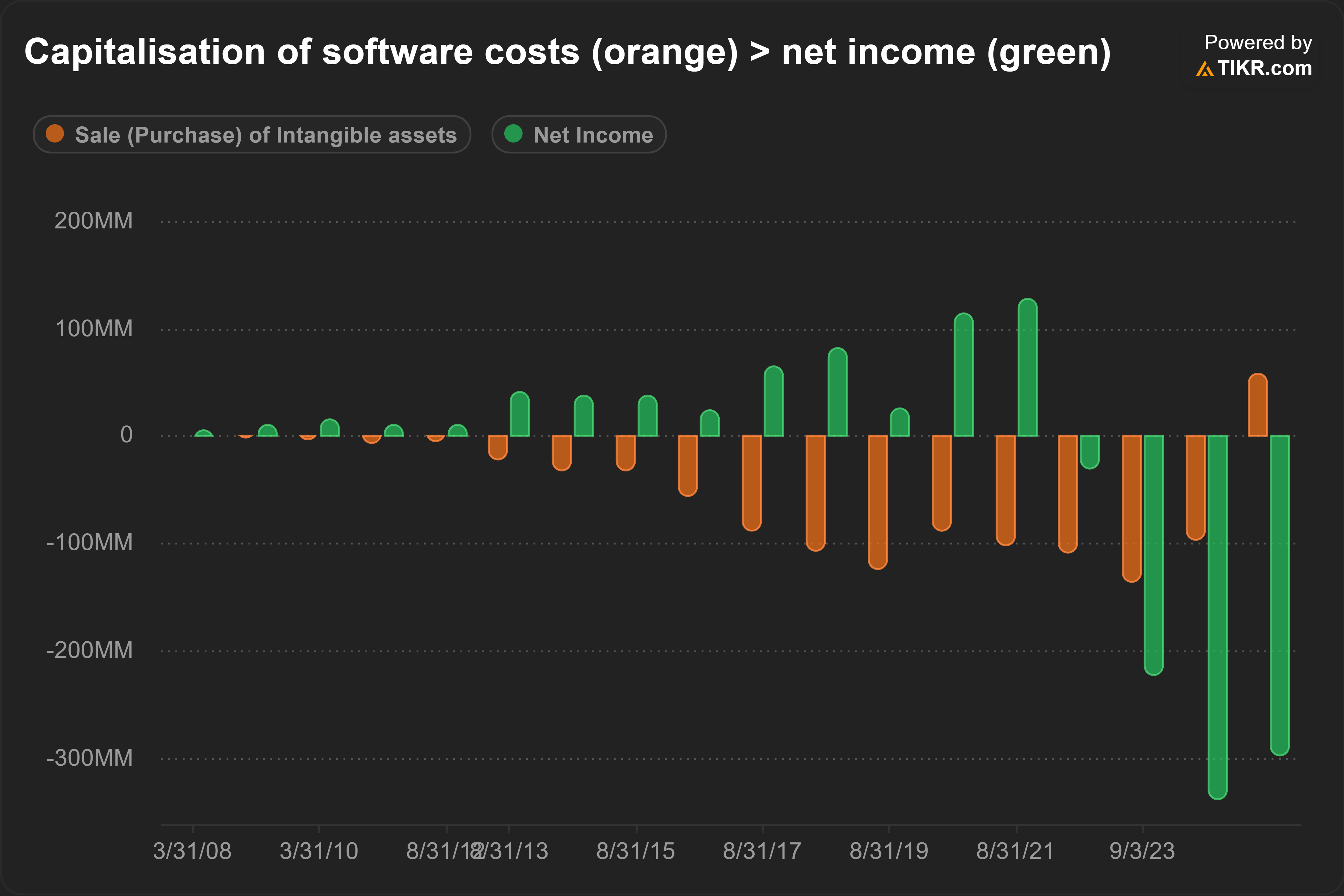
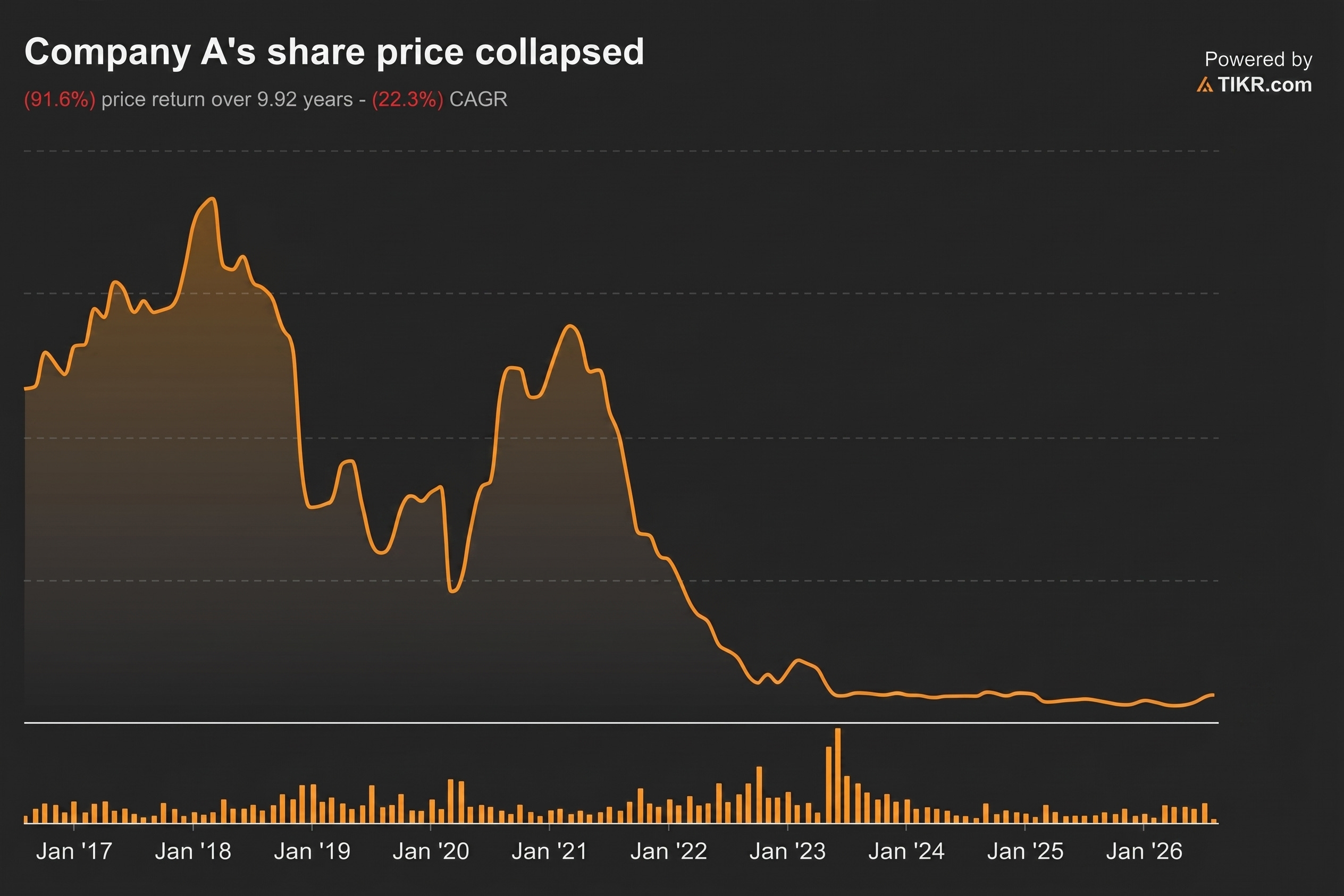
After 2021, Company A slipped into losses. The share price fell off a cliff.
This is not a surprise to careful investors.
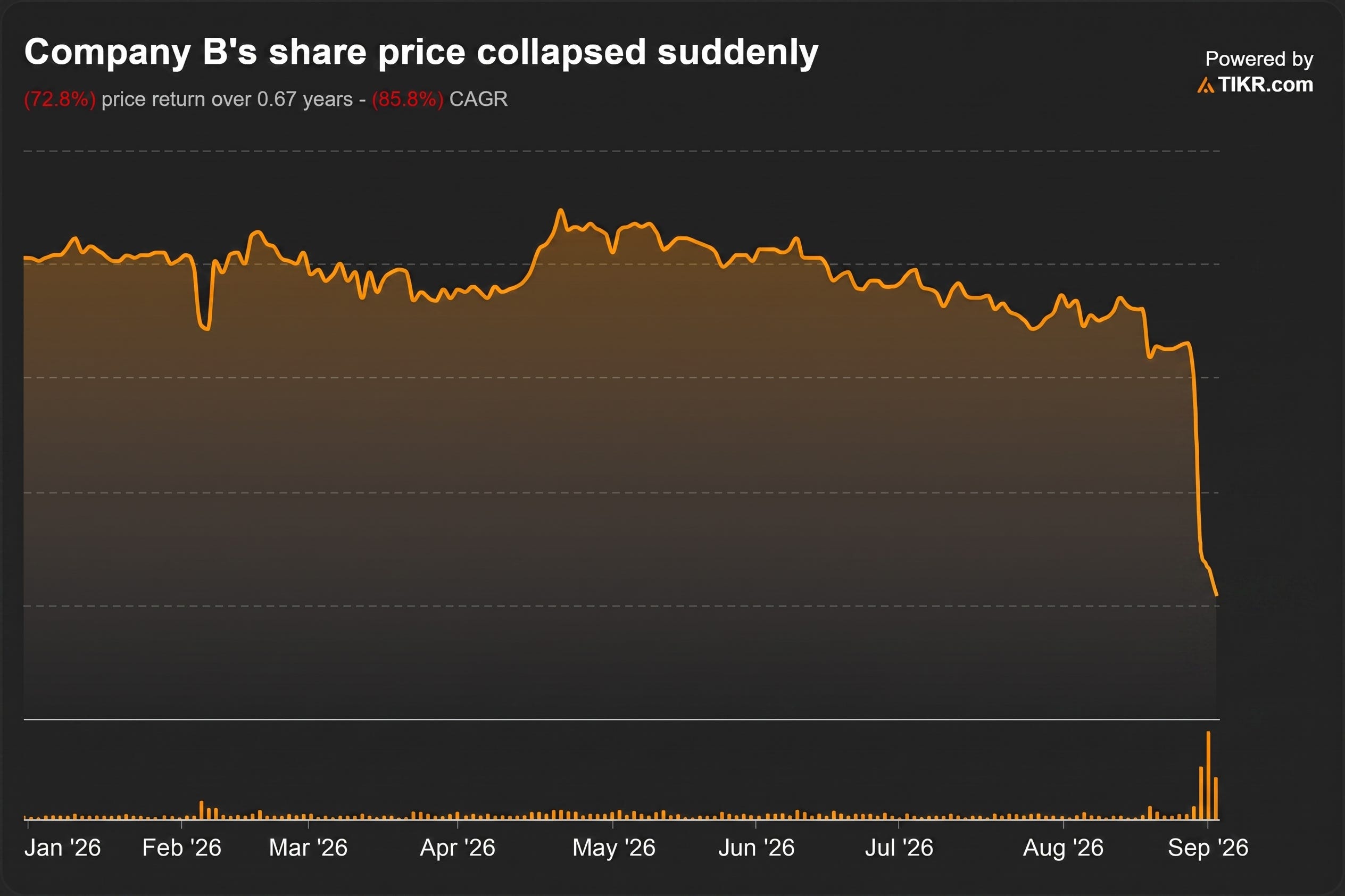
Company B: Technology company in Malaysia
Similar concerns at Company B:
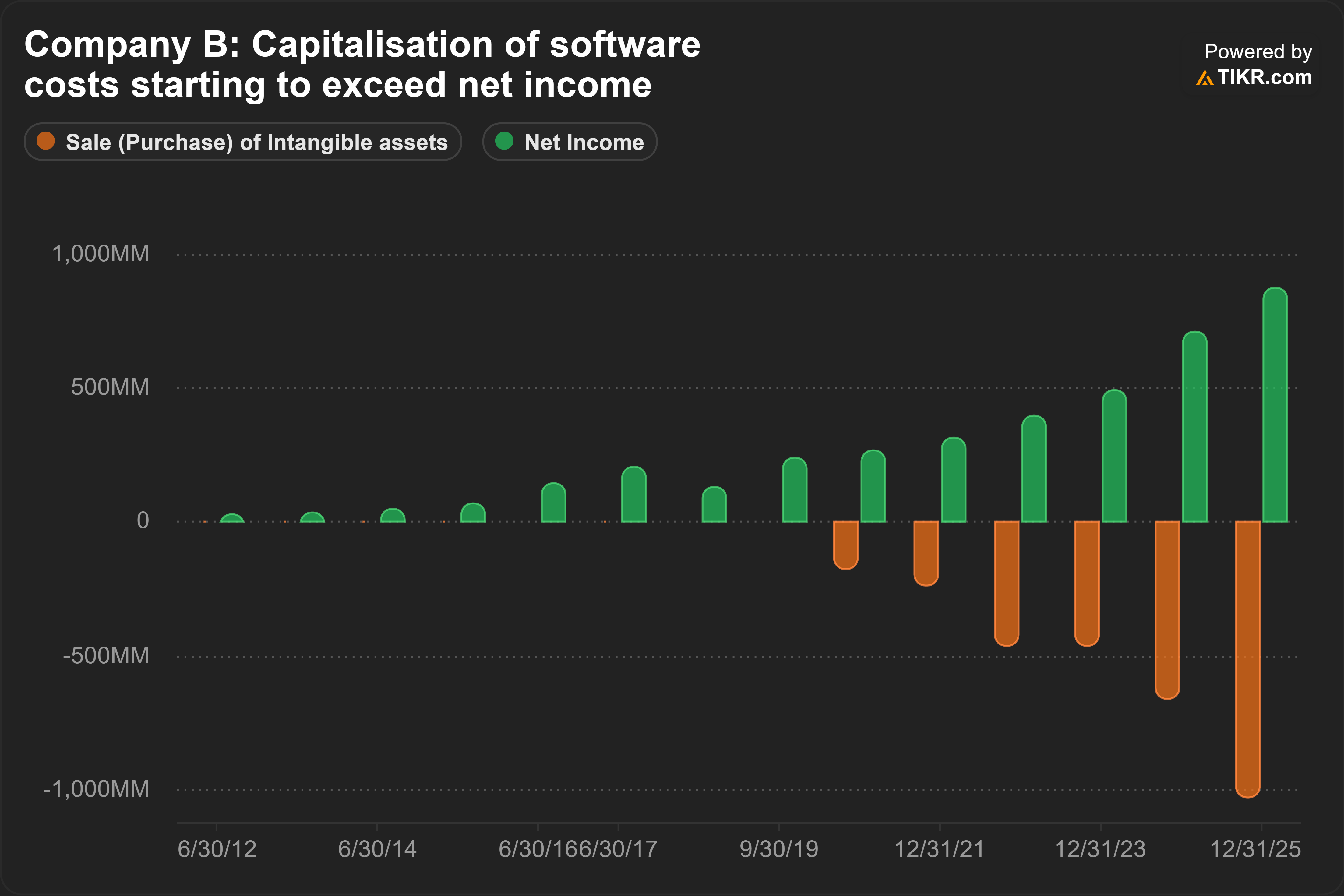
The share price suddenly collapsed this year. Concerns over management quality.
Afterword
I want to be clear that I am not alleging accounting shenanigans at these two companies.
Rather, I want to highlight the importance of digging beneath the headline profit numbers.
Accounting quality usually reflects business and management quality.
Coming up next
Next week, I’ll be back with 2 to 3 more interesting ideas.
I’ll then analyse the most voted idea from my last post.
Right now, that’s Elan Corporation (6099 JP). B&M European Value Retail plc (BME LN) is the runner up.
Haven’t voted yet? Check out my last post: 2 Interesting Opportunities Again
Thanks for reading! If you found this helpful, hit the “like” button.
If you’re not already a subscriber, sign up for weekly analysis on global SMID equities.
Disclaimer
This publication is for informational, educational, and entertainment purposes only and does not constitute financial, investment, legal, or tax advice. The content herein is a record of my personal research and investment process, and all analysis, forecasts, and opinions expressed are solely my own.
I make no representation or warranty, express or implied, as to the accuracy, completeness, or timeliness of the information provided. The stock market is highly volatile, and my forecasts, estimates, and assumptions may prove incorrect.
I am not acting as your financial advisor or fiduciary. You should not rely on any information in this publication to make investment decisions. Under no circumstances will I be held liable for any direct, indirect, or consequential losses or damages arising from your reliance on the content of this publication.
At the time of publication, I do not hold any positions in the companies mentioned in this article, either long or short. I may change my views, predictions, or personal portfolio positioning at any time without notice.
Notes
These are real companies. I removed their names because I don’t want to damage them. For educational purposes only.
A practical one-line fix for anyone using the operating-cash-flow-minus-capex shortcut: subtract purchase of intangible assets as well, since it is the same economic outflow wearing a different label, and the trick described here disappears. A second quick test that needs no judgement calls: compare capitalised software additions with the amortisation charge over a few years. When additions run persistently ahead of amortisation, reported profit is running ahead of the cash economics by roughly that difference, and you have measured the dependency this post warns about without guessing anyone's motives. The distinction worth keeping is that capitalisation itself is legitimate matching; the red flag is profitability that exists only because of it.