

[Shortlist] Siltronic AG (WAF GR)
Last week, you highlighted a potential opportunity in Siltronic. What’s your suggestion?
Shortlist WAF.
The market sees it as a lousy business. It’s still loss-making in the midst of a semiconductor boom.
However, my preliminary research suggests WAF is reaching a cyclical inflection.
Liquidity?
15 Sep 2026
Share price: EUR 68.00
Market capitalisation: EUR 2,040 mn (USD 2,354 mn)
Enterprise value (EV): EUR 3,025 mn (USD 3,492 mn)
Average daily volume (ADV): EUR 8 mn (USD 9 mn)
NTM P/E: -13.5x
LTM P/B: 1x
What does WAF do?
WAF is the world’s fourth largest maker of semiconductor wafers.
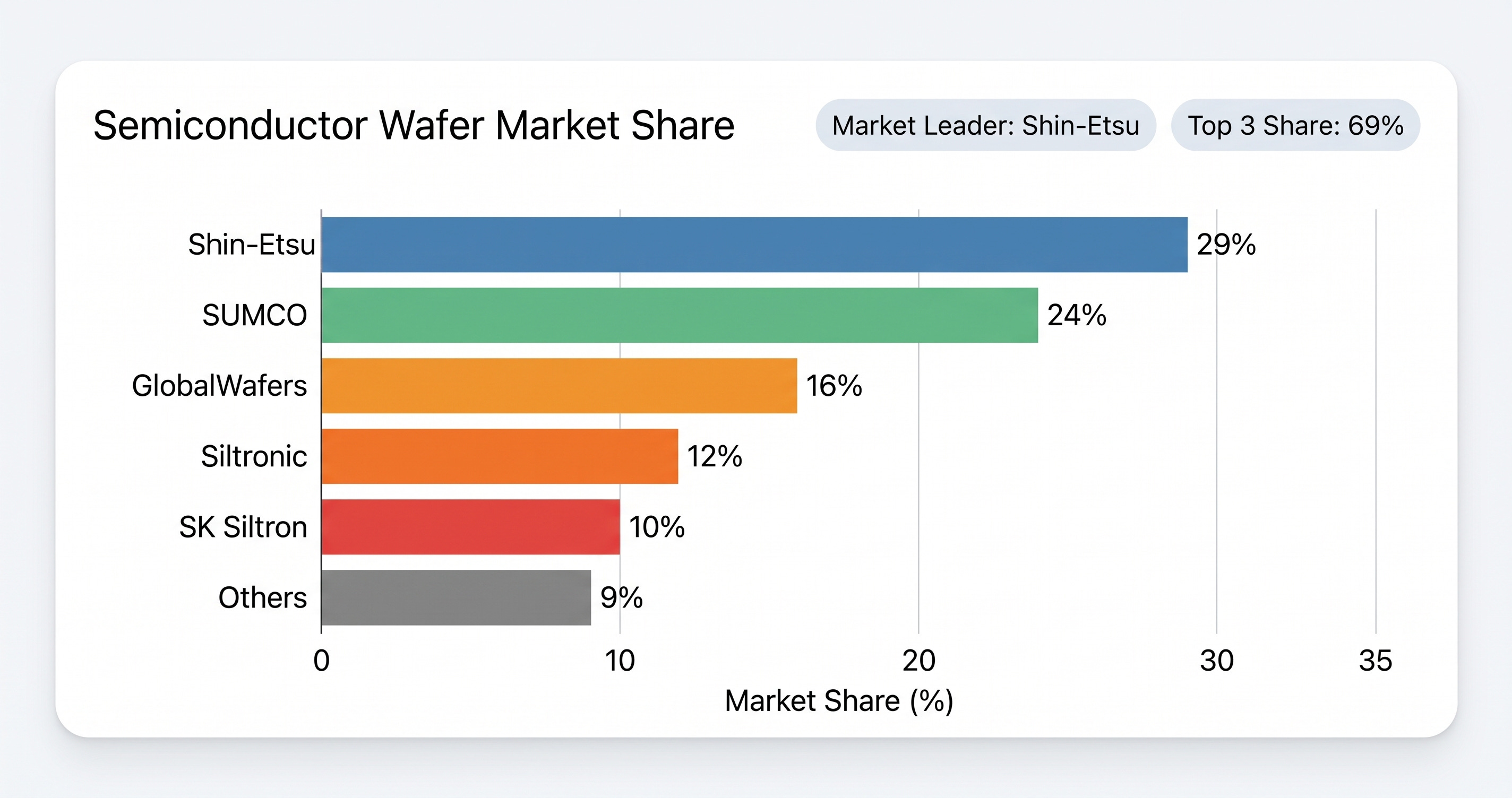
Source: Angsana Anderson estimates
Top 3 customers contribute 57% of revenue. They include Intel Corporation (INTC 0.00%↑ US), Samsung Electronics Co., Ltd. (005930 KS) and Taiwan Semiconductor Manufacturing Company Limited (TSM 0.00%↑ US).
~ 66% of revenue is contracted with customers under long-term agreements. Pricing and volume are fixed there.
Why is WAF’s total return lagging SOXX?
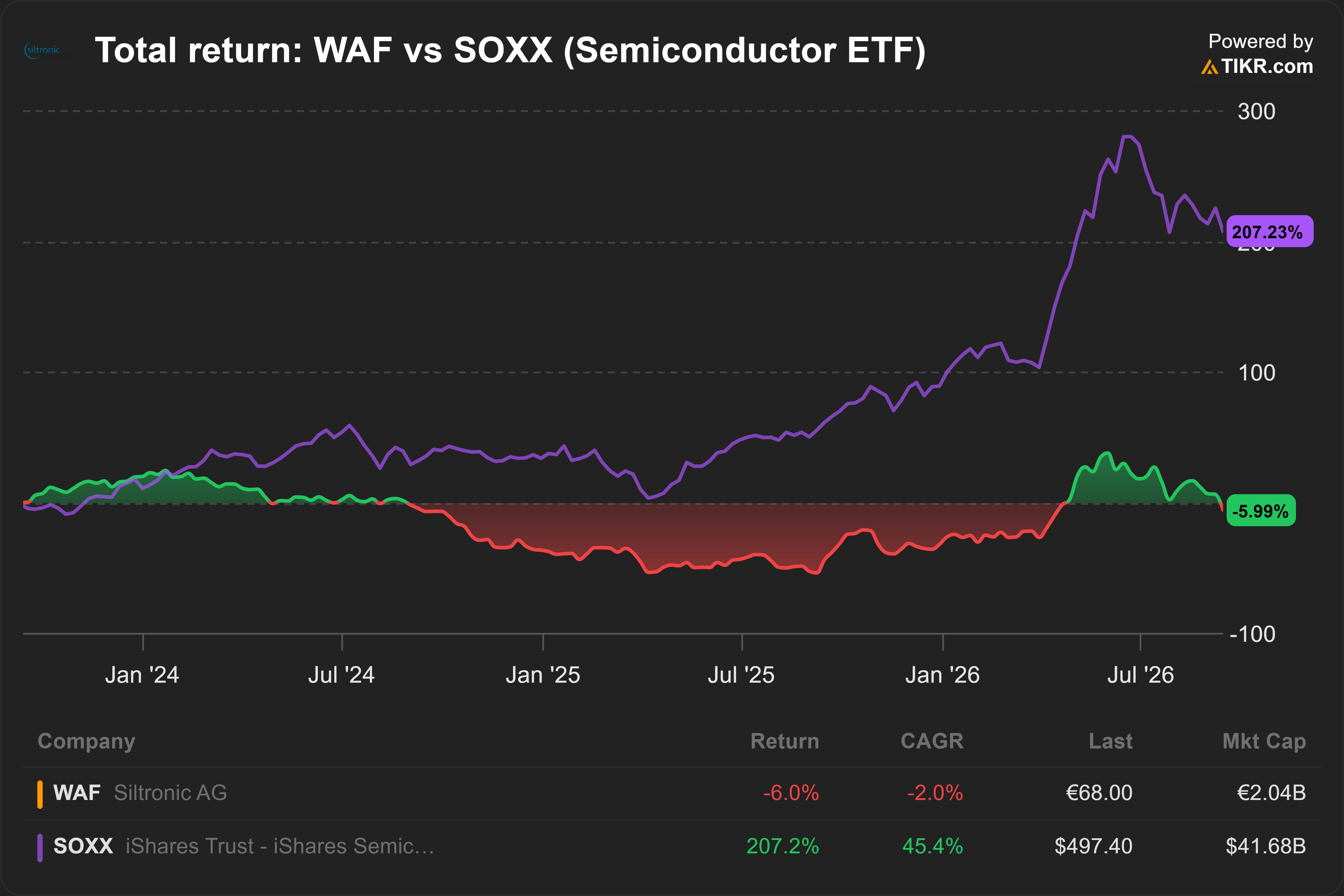
Major companies in SOXX like NVDA and MU are more directly exposed to AI (more downstream). The shortage has not reached WAF yet because it makes semiconductor wafers (more upstream).
I believe this is about to change.
Cyclical inflection
2 pieces of evidence point towards a cyclical inflection.
First, inflection in major customers’ raw materials.
Semiconductor wafers are the major raw materials used to make chips. The trend in raw materials at major customers should give us a good picture of WAF’s revenue.
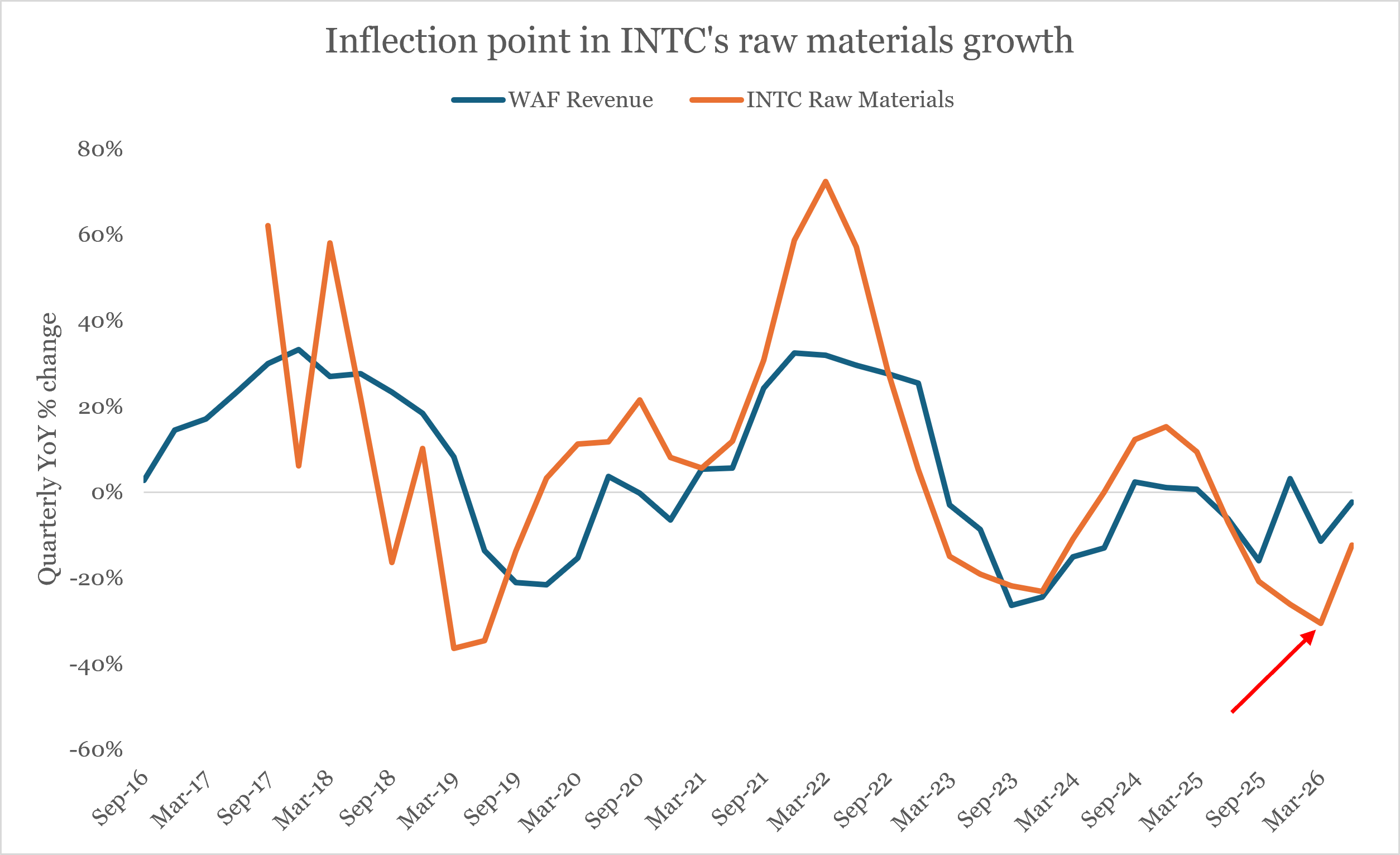
In the charts below, I plotted YoY% change in major customers’ raw materials vs WAF’s revenue growth. The data is quarterly.
INTC’s raw material shows the strongest relationship with WAF’s revenue.
Source: Tikr
There seems to be better-than-expected upside to WAF’s revenue growth. INTC’s raw material growth has only just started to inflect, and it is still at a relatively low level.
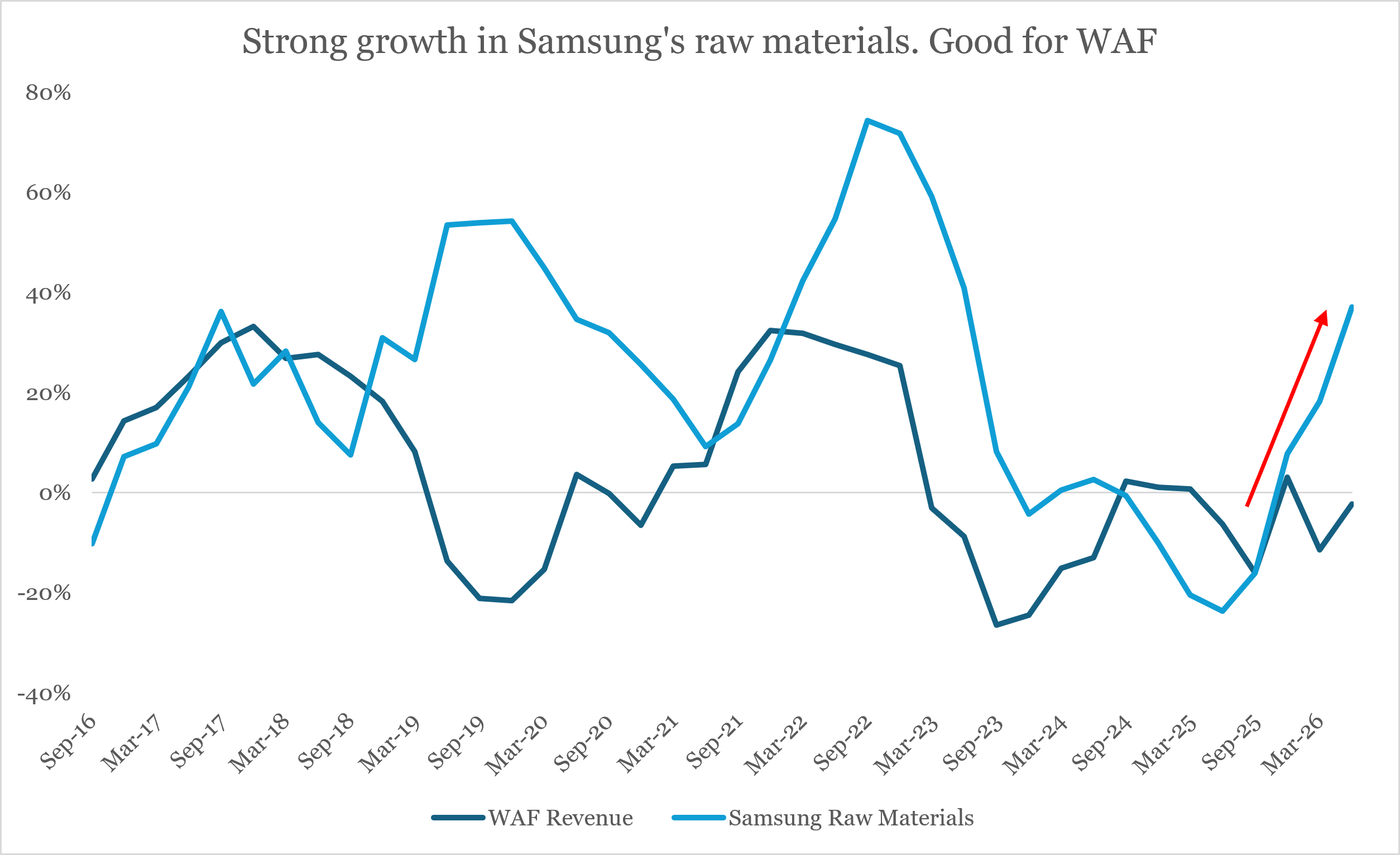
How about Samsung Electronics?
Source: Tikr
The relationship with Samsung is weaker.
I suspect Samsung is a smaller customer. Being a Korean company, they probably buy more from WAF’s Asian competitors like SK Siltron (Korea) or SUMCO (Japan).
Nevertheless, the strong growth in Samsung’s raw materials bodes well for WAF’s revenue growth.
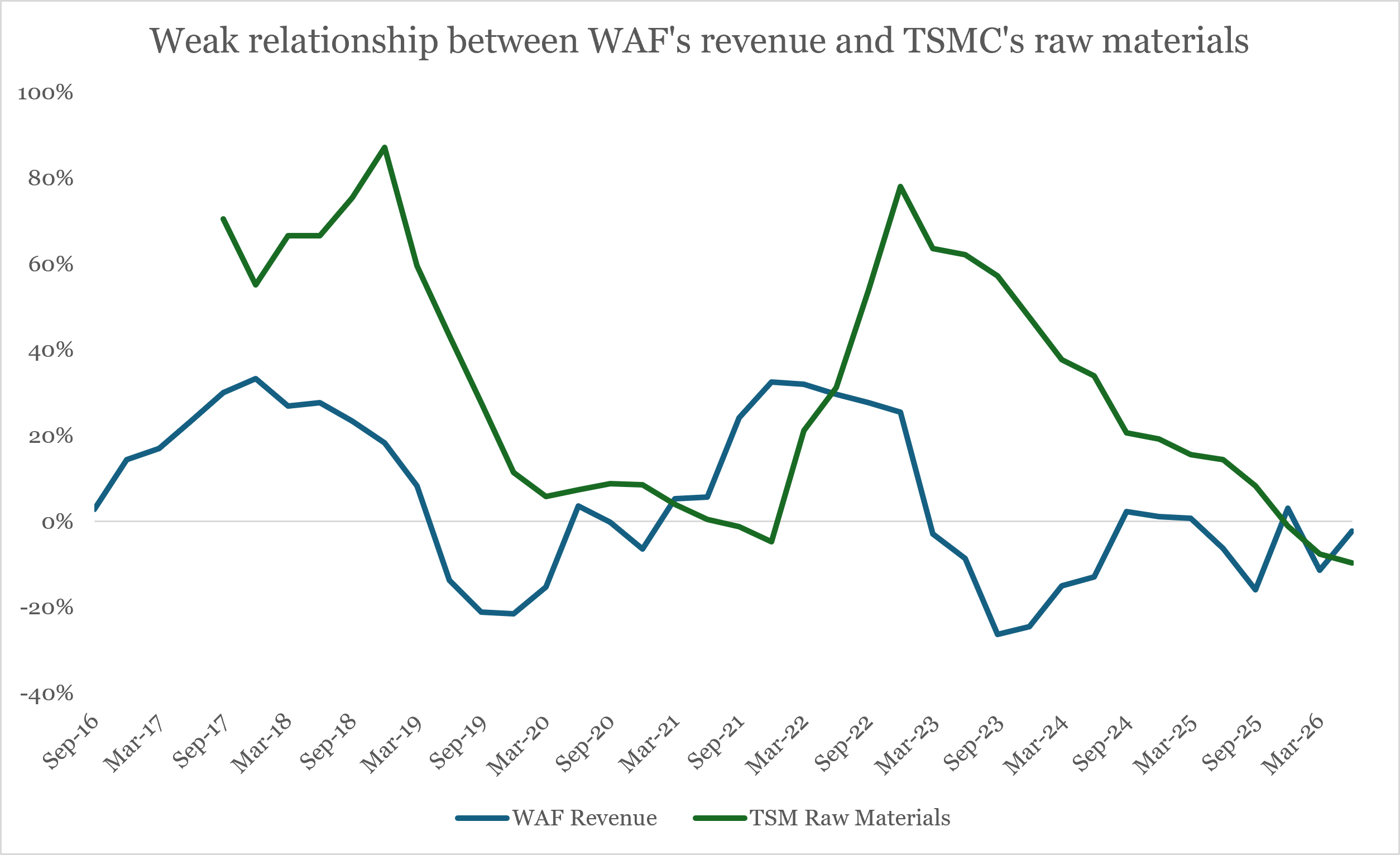
TSMC?
TSMC’s raw materials growth shows a very weak relationship with WAF’s revenue. I am still trying to figure out why.
TSMC seems to be managing its raw materials differently from INTC and Samsung Electronics.
Source: Tikr
What’s your second evidence of an inflection point?
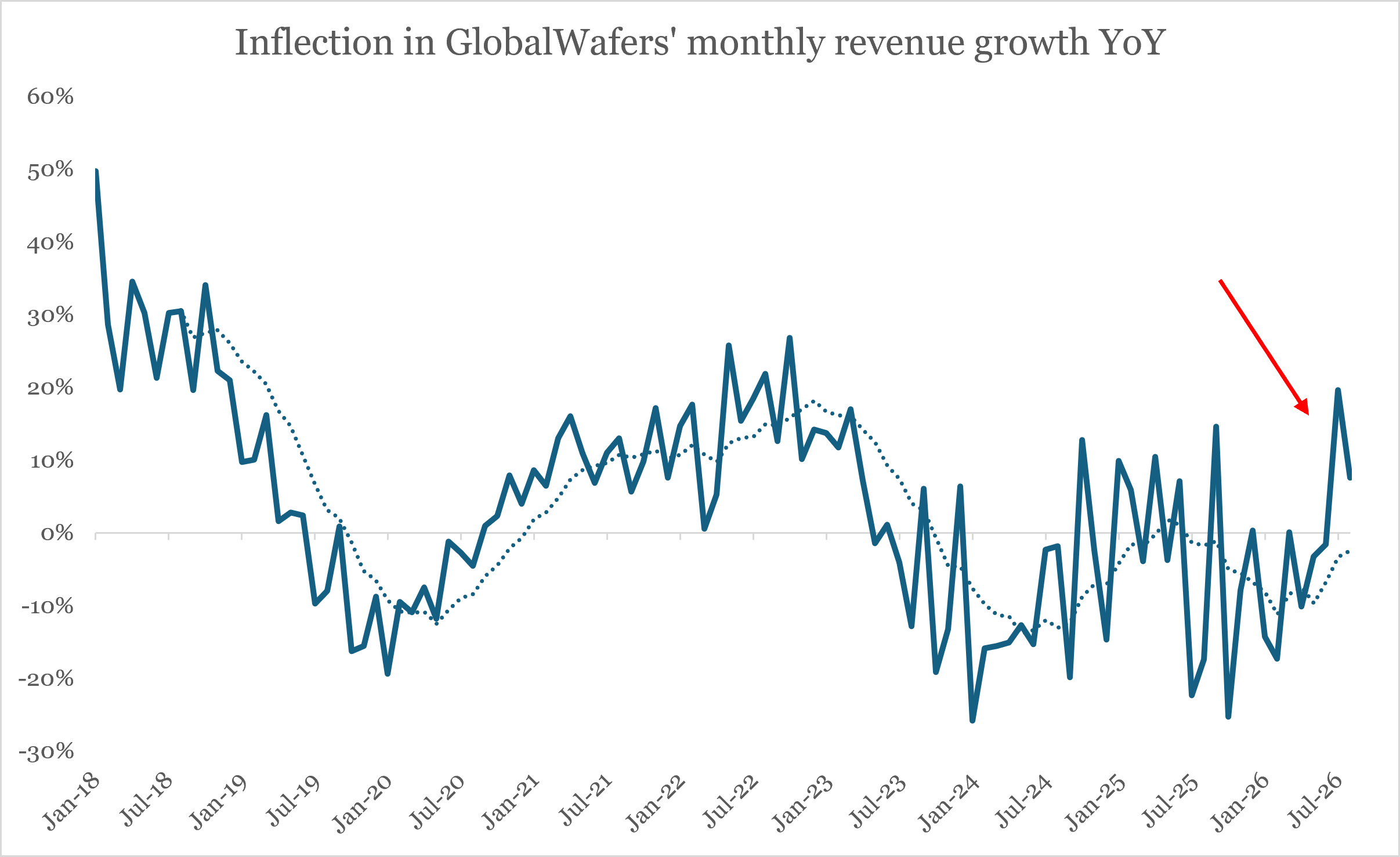
Inflection in GlobalWafers’ monthly revenue growth.
Because both GlobalWafers and WAF operate in the same industry, their revenue trend should be similar.
Between April and June 2026, GlobalWafers reported -10%, -3% and -2% YoY revenue growth respectively.
That has changed.
In July 2026, the company reported +20% YoY revenue growth. This was followed up by +8% in August 2026.
You can see the inflection point here:
Source: GlobalWafers (2026)
If GlobalWafers is growing +20% and +8% in Q3’26, WAF’s guidance of low to mid-single digit revenue growth in 2026 may look too modest.
Why hasn’t the market recognised the inflection point yet?
At first glance, Siltronic looks like a lousy business. Revenue declined for 3 consecutive years. Loss-making since 2025.
However, Siltronic’s revenue has actually stabilised.
The YoY revenue declines in 2025 and H1’26 were driven by the depreciation of USD against EUR and the closure of its loss-making small diameter wafers business. Without these two factors, revenue would be flat in 2025 and H1’26.
The losses in 2025 were due to the completion of its latest fab in Singapore.
WAF has to start recording depreciation, even though FabNext is still ramping up production. Once volume ramps up, profits will return.
Catalysts?
Revenue grows faster than expected and WAF returns to profits sooner than expected. This could happen as early as the Q3’26 earnings release, scheduled for 11 November 2026.
Longer-term, there is still a chance that WAF is taken over. The previous offer price was EUR 145 per share. We talked briefly about this last week.
This all sounds reasonable. But I am confused.
I just remembered you said we are close to the end of the semiconductor shortage. If that’s true, why are we looking at a semiconductor company?
To be precise, I was trying to say that we are closer-than-expected to the end of the memory chip shortage.
The shortage is travelling up the semiconductor supply chain. There are emerging signs of an inflection point at more upstream players like WAF, but not many investors are noticing this yet.
That’s essentially my thesis.
Interesting. Let’s shortlist this for further research.
Look into their ability to repay their debt. They took on a lot of debt to build FabNext.
If the recovery is slower than expected, can they repay or refinance their debt? How much headroom do they have?
Coming up next
Buffett is wrong. Volatility is risk.
I’ll explain why, and how I evolved my investment strategy and process to accommodate this.
Subscribe for free to be notified immediately when I publish.
Subscribe for 2 to 3 analyses of global SMID equities every week.
Discover overlooked ideas and rethink familiar names.
Published by Andrew Wong, ACA, CFA
Disclaimer
This publication is for informational, educational, and entertainment purposes only and does not constitute financial, investment, legal, or tax advice. The content herein is a record of my personal research and investment process, and all analysis, forecasts, and opinions expressed are solely my own.
I make no representation or warranty, express or implied, as to the accuracy, completeness, or timeliness of the information provided. The stock market is highly volatile, and my forecasts, estimates, and assumptions may prove incorrect.
I am not acting as your financial advisor or fiduciary. You should not rely on any information in this publication to make investment decisions. Under no circumstances will I be held liable for any direct, indirect, or consequential losses or damages arising from your reliance on the content of this publication.
At the time of publication, I am long WAF GR. I may change my views, predictions, or personal portfolio positioning at any time without notice.