

Disclaimer: This is a record of my investment decisions, not financial advice. I may change my decisions without notice. Use this only for education and entertainment. Do not rely on this for your investment decisions.
About
Share price: SGD 0.44
Market capitalisation: SGD 91 mn (USD 72 mn)
Enterprise value (EV): SGD 59 mn (USD 47 mn)
Average daily volume (ADV): SGD 0.02 mn (USD 0.02 mn)
LTM P/E: 8x; LTM P/B: 1x
Time spent: ~6 hours
My Decision
Shortlist
Background
Singapore’s construction industry is booming.
In the past 3 years, Soilbuild Construction Group Ltd. (V5Q; SOIL SP) is up +135% p.a. Over the same period, Choo Chiang Holdings Ltd. (42E; CCHL SP) increased only +10% p.a. What happened?
The short answer: timing difference. Soilbuild earns from construction services and precast/prefab components that are needed throughout the construction project lifecycle. Choo Chiang sells electrical products and accessories that are typically installed in the later stages, such as interior fit-out. So its demand tends to lag the construction boom.
I shortlisted Choo Chiang. At today’s valuation, I believe the market is under-recognising 3 things:
Its growth potential as projects move into later stages
The probability of higher capital returns to shareholders
The value hidden in its investment properties
In my Substack post, I walk through these in detail and what factors I will focus on next.
For more analysis like this, click on the link below and subscribe to my Substack.
Business model
Breakdown of 2024 revenue (SGD 90 mn, -1.5% YoY):
• 99% from distribution business (-1.6% YoY)
• 1% from property investment business (+10.5% YoY)
In the distribution business, 42E retails and distributes electrical products and accessories for residential and industrial use. The business offers eight main product categories: electrical circuit protection & wiring devices, electrical wiring accessories, lightning protection, cables, cable support system, power tools & hardware, fans and luminaires, lamps and accessories.
42E’s customers include electrical contractors, interior designers and walk-in customers. The customer base is diversified, with no major customers.
A relevant public comparable is Tai Sin Electric Limited (500; TSE SP). The comparison is not perfect because 500 focuses on manufacturing cables whereas 42E focuses on distributing electrical products, of which cables are just a subset.
At its 2015 IPO, 42E considered Albert Hoo Electrical Pte. Ltd. (“Albert Hoo”) (not listed) to be its closest competitor. However, Albert Hoo operates only 4 retail outlets vs 42E’s 10 outlets. UOB Kay Hian estimates 42E holds ~60% market share in Singapore [1].
My Reasons
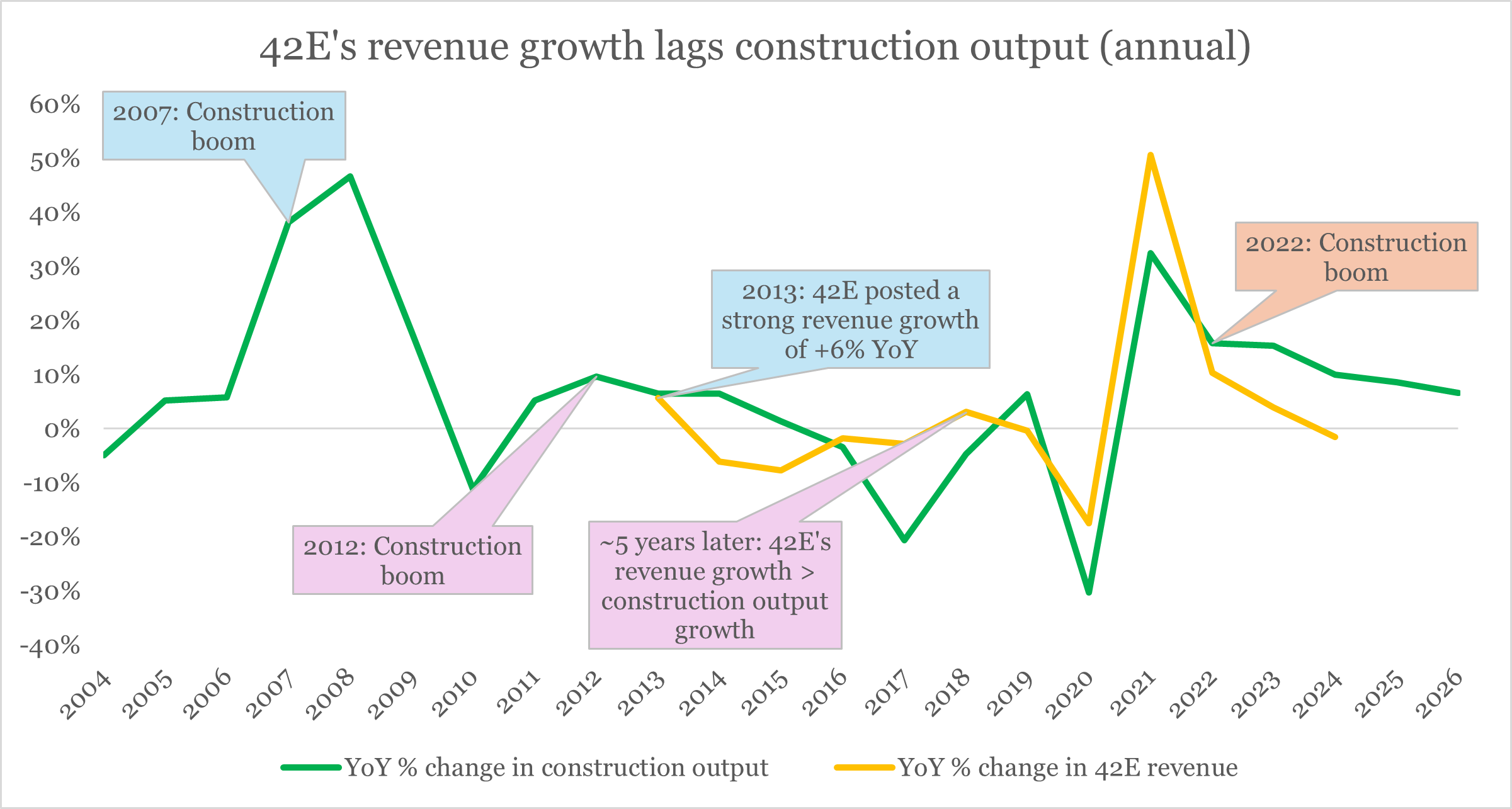
Under-recognised growth? In 2024, 42E’s revenue declined -1.5% YoY. This was despite a construction boom in Singapore. During the same year, construction output (i.e. total progress payments certified) increased 10% YoY [2].
However, it is likely a mistake to extrapolate the recent negative revenue growth. 42E supplies electrical products and accessories used mainly during the later stages of construction like interior fit-out stages. As such, it seems to me that 42E’s revenue growth will typically lag construction booms. This is also management’s view [3].
The previous construction boom started around 2012. Construction lead times for residential projects were typically between 4 to 5 years. This means interior fit-out started around 2016/2017. During this period, demand for 42E’s products should have been strong. Indeed, 42E’s revenue growth improved from -8% in 2015 to -2% in 2016 and -3% in 2017 before reaching +3% in 2018.
A similar pattern repeated during the construction boom that started around 2007. Construction lead time were ~4 to 5 years. By 2012, interior fit-out began. In 2013, 42E posted a strong revenue growth of +6% YoY.
Source: Tikr, SingStat
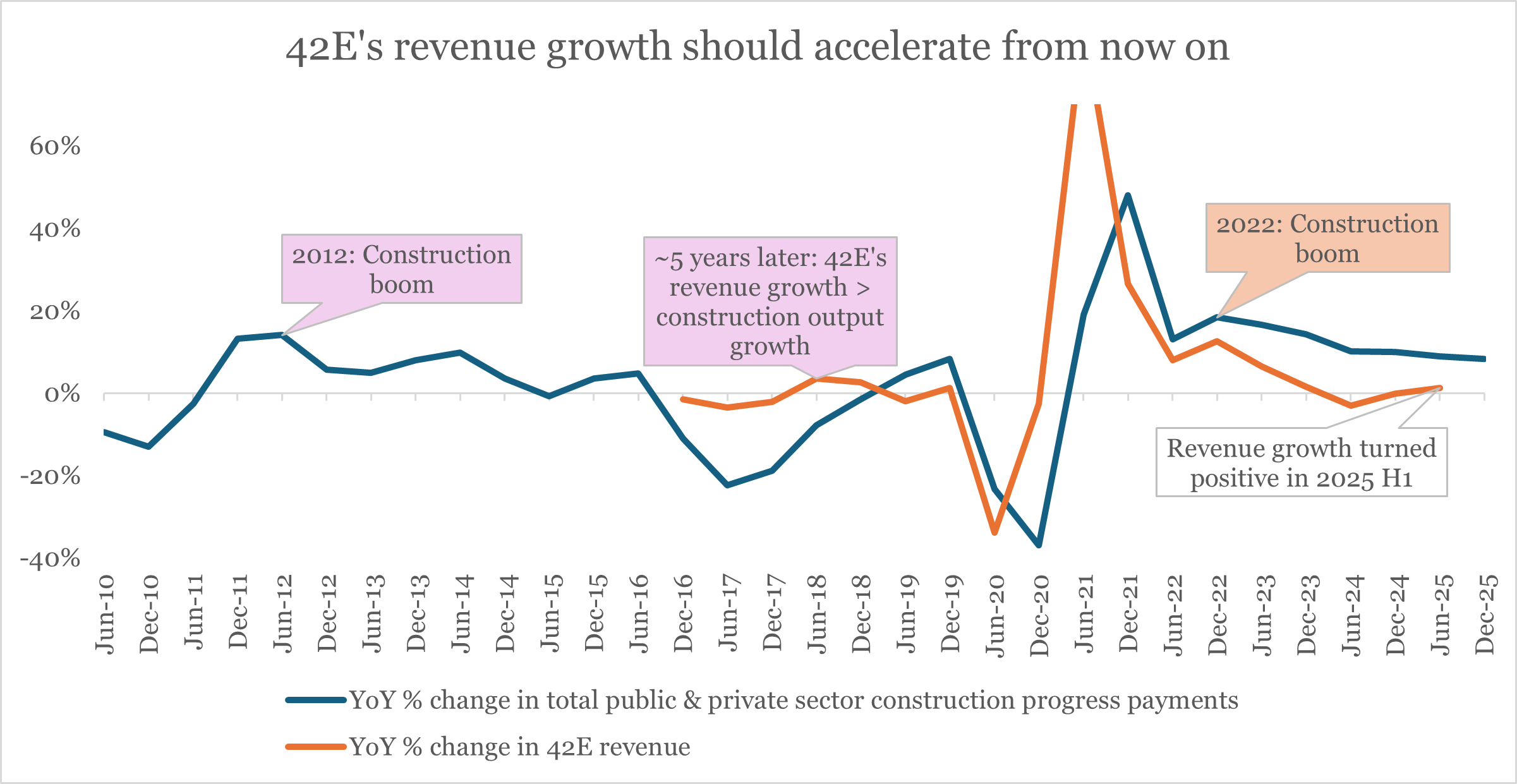
Accordingly, the construction boom that started in 2022 should reach interior fit-out stages around 2026/2027. This suggests that 42E’s revenue growth should accelerate from now on. Indeed, 42E’s revenue growth has inflected and reached +1% YoY in 2025 H1. This was after 42E posted YoY revenue growth of -3% in 2024 H1 and 0% in 2024 H2.
Source: Tikr, SingStat
The trends in 42E’s working capital suggests demand is strong. In 2025 H1, 42E’s trade payables increased more than inventories. At the same time, trade payables days remained stable. This suggests demand is strong because inventories are sold soon after 42E purchased them.
The consensus seems to be under-recognising 42E’s growth potential. The business currently trades at a valuation that is low in both absolute and relative terms. 42E’s LTM dividend yield of 6.6% implies an attractive 4.7% premium over Singapore 10y government bonds. Its LTM P/E ~8x is significantly lower than the 14x enjoyed by its closest public comparable, Tai Sin Electric Limited (500; TSE SP).
Capital returns? There is a good chance that 42E will return more capital to shareholders. First, 42E has the ability to increase its dividends. Its cash balance is ~40% of its revenue and market capitalisation. Second, 42E has shown some willingness to return excess cash. In 2024, it paid a special dividend of SGD 0.003 per share. This is the first special dividend since COVID-19.
Hidden assets? 42E reports SGD 12.5 mn of investment properties on its balance sheet. However, these are carried at cost less accumulated depreciation. 42E estimates their fair value at SGD 17.0 mn. The excess of SGD 4.5 mn is ~ 5% of 42E’s market capitalisation.
Factors to focus on
Outlook on revenue growth. Gather more data to support or disprove my hypothesis on revenue growth. What are the risks that this time will be different? Besides construction output, are there any other significant factors that can and will influence revenue growth?
Capital allocation. What does 42E plan to do with its cash pile? Where does management see growth potential and how will they allocate capital to support this?
42E does not have a formal dividend policy. Since 2019, their dividend payout ratio averaged ~50%, including special dividends. If 42E does not increase capital return to shareholders, its cash pile will continue growing. Are there any plans to increase capital returns to shareholders and reduce the cash pile?
How did 42E decide on the SGD 0.003 special dividend in 2024? How will they decide special dividends in the future?
Considering Singapore’s EQDP, are there any plans to implement a formal dividend policy?
Investment properties. Assess 42E’s valuation of its investment properties. What is 42E’s goal by investing in these properties? What are their investment criteria? Are there any plans to unlock the value in these properties for shareholders?
For more analysis like this, subscribe to my Substack