

[Shortlist] Pets at Home Group Plc (PETS LN)
Last week, you highlighted a potential opportunity in PETS.
Do you have any updates? Make it quick.
I will shortlist PETS as a long.
PETS was a COVID darling. When the world reopened, the shares crashed. Investors wrote it off as a busted COVID play. Specifically, the bears point to decelerating growth, regulatory threats, abrupt CEO departure and slashed dividends.
However, the market is probably over-reacting.
Headline numbers are obscuring the valuable vets business. The regulator could not find conclusive evidence that PETS charges significantly higher prices.
The previous CEO suddenly left after consecutive quarters of like-for-like retail revenue decline. The board appointed a new CEO with a strong track record in retail.
Finally, after feedback from investors, the Board rebased the dividend payout ratio to 50%.
The cash savings are used to launch a new share buyback. This makes sense, especially with the shares having sold off to a more attractive valuation.
Essentially, the potential thesis is:
Hidden asset
Under-recognised growth
Good business, temporary headwinds
My initial estimate suggests ~ 9% free cash flow yield on EV, which is an attractive ~4% premium over UK 10y gilt yield.
Looks interesting. Liquid enough?
Share price: GBP 1.99
Market capitalisation: GBP 871 mn (USD 1,166 mn)
Enterprise value (EV): GBP 1,229 mn (USD 1,644 mn)
Average daily volume (ADV): GBP 3 mn (USD 4 mn)
NTM P/E: 12x
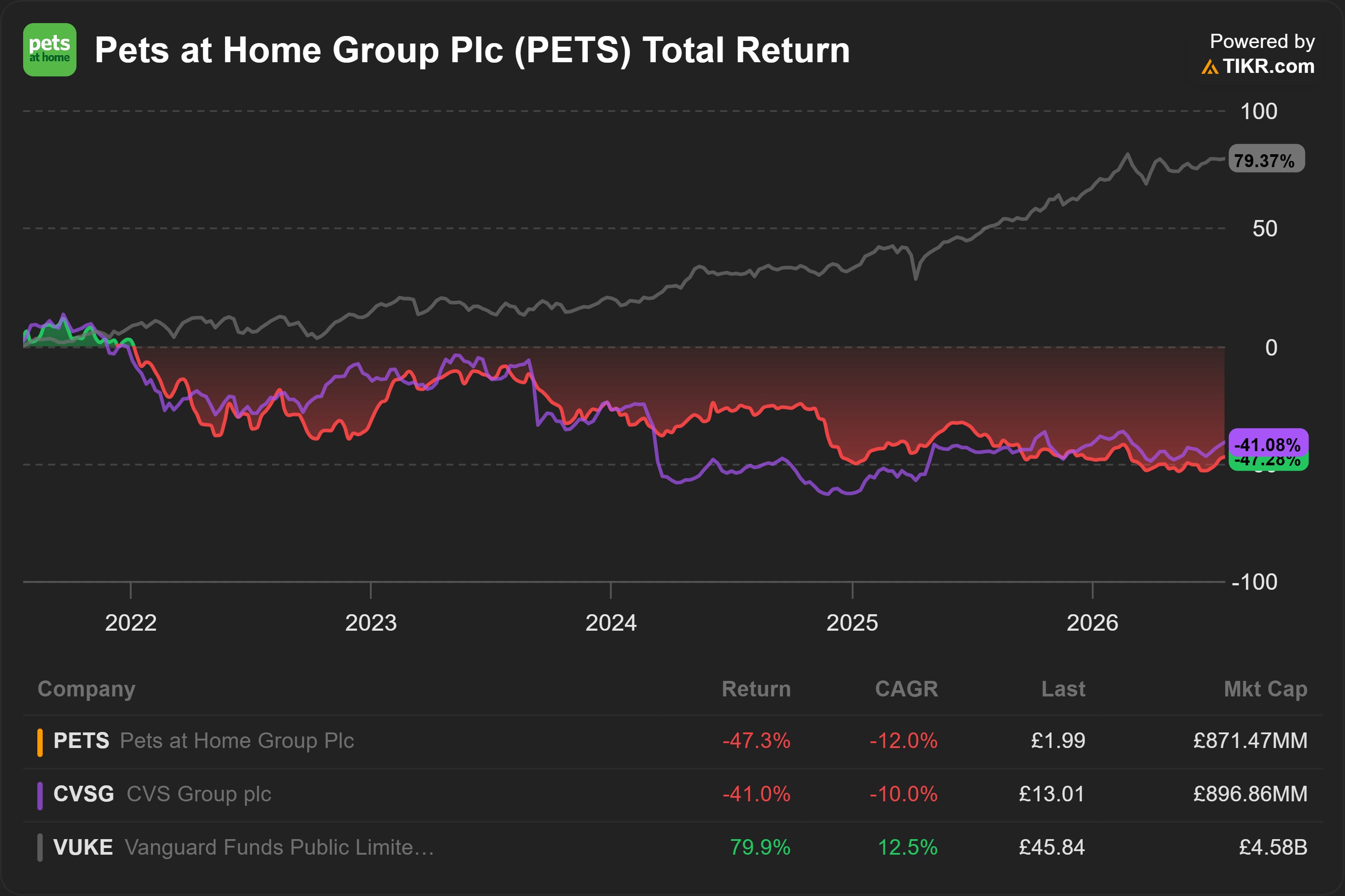
PETS’ financial year ends in Mar. Unless stated otherwise, all time references will follow its financial year. For example, Q4’26 refers to Jan 2026 – Mar 2026.
What does PETS sell?

The retail segment sells pet food and accessories. Pet food makes up ~62% of total retail revenue. Accessories make up another 34% but carry higher margins.
The company sells through a network of ~ 460 stores. It also sells online.
The Vet Group segment looks small. Can we ignore it?
Even though this segment contributes only ~12% of revenue, it accounts for ~80% of operating profit.
The Vet Group segment provides support and administrative services to ~407 vet practices in return for a fee. The vets own these vet practices and retain clinical and operational freedom. PETS provides financial, marketing, supply chain support.
Without PETS, new vets will struggle to fund start-up costs and attract clients. They will also have to deal with cumbersome administrative tasks like compliance and accounting.
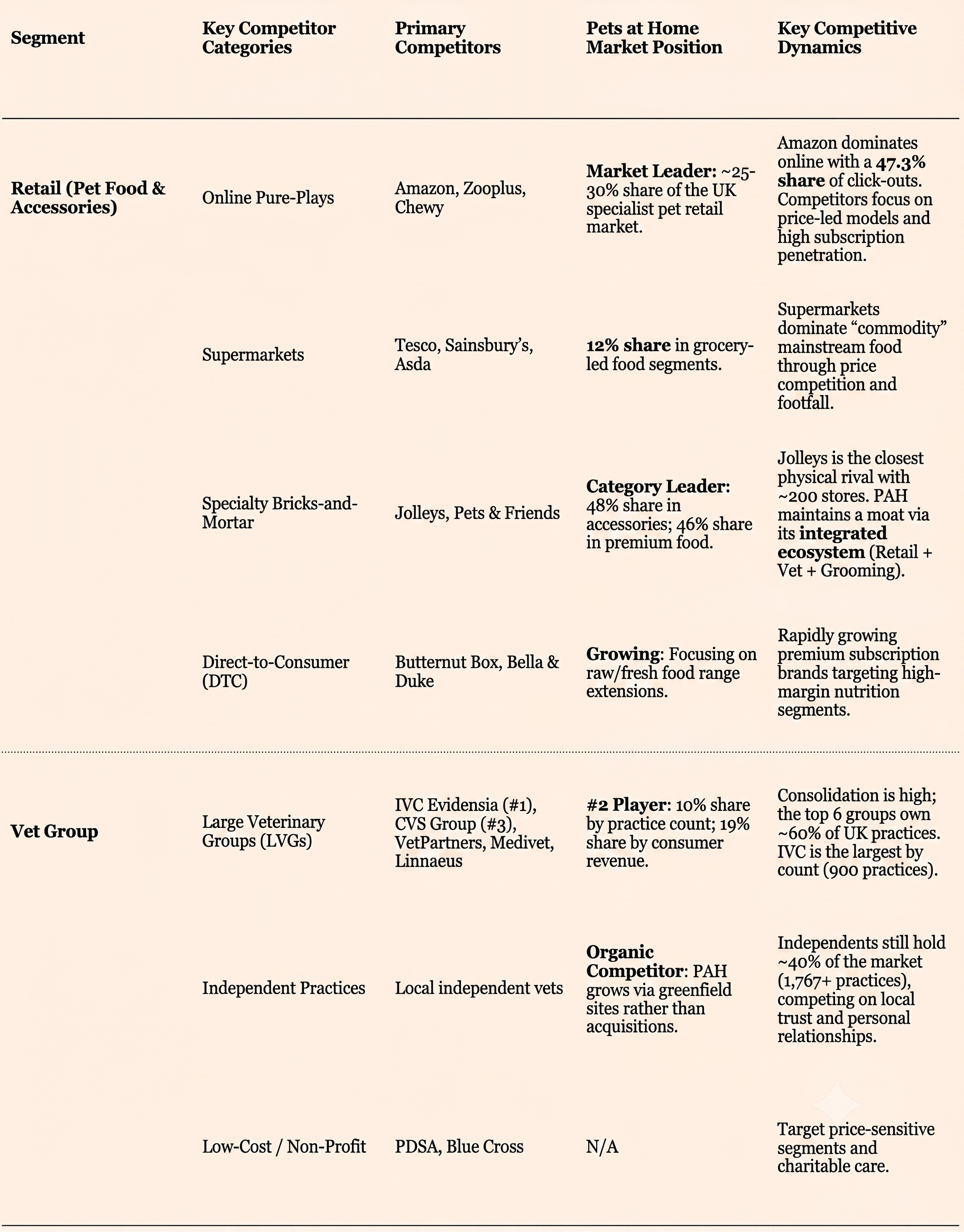
What does the competitive landscape look like?
Here’s what Gemini Notebook gathered:
Ok. You said there’s a hidden asset. Headline numbers are obscuring the valuable vets business.
What do you mean by this?
If you look at a screener, PETS look like a dying business. Revenue declined -1% in FY2026. Operating profit plunged -25% YoY.
However, these headline numbers are obscuring the growth in the Vets Group segment.
In FY2026, Vets Group grew revenue by +1% YoY and operating profit by +9% YoY.
+1% YoY revenue growth doesn’t look that fantastic either.
Growth is actually stronger. Like-for-like revenue growth at the Vets Group segment was +3%.
Why did the segment report only +1% revenue growth?
That’s because during the year, PETS converted some company-owned vet practices to vet-owned practices. Instead of recognising all of the sales from that vet practice, PETS now only recognises the fees it charges to those vet practices.
That sounds reasonable enough.
So, group operating profit fell -25% YoY. But operating profit at the Vets Group segment actually grew +9% YoY. This means the Retail segment must have collapsed?
Yes, Retail operating profit fell -49% YoY.
But there are signs that this is a temporary headwind and that the share price today has not priced in a recovery. We’ll get back to this later in our last point: (c) good business, temporary headwinds.
Since we’re on the Vets Group segment now, I want to discuss the other reason why investors are overlooking PETS.
You’re talking about the Competition and Markets Authority (CMA)’s investigation of the UK veterinary sector?
Yes. The CMA, UK’s competition watchdog, launched an investigation in 2023.1
They cited soaring costs. Between 2016 and 2023, average prices for veterinary services surged by 63%. This was significantly faster than the general rate of inflation. The CMA also found that Large Veterinary Groups (LVGs) tended to charge significantly higher prices than independent practices.2
That’s terrible. Let’s just pass on PETS. We don’t want businesses facing price controls in our portfolio.
Wait. I’m not even done yet.
The CMA is only capping the price of written prescriptions. This is not a disaster. The price caps on prescription fees are at levels at which a substantial proportion of vet practices in the market, including both independent businesses and LVGs, already choose to set their prices.3
PETS may even benefit from the remedies that the CMA is proposing.
What do you mean?
While the CMA found that five major LVGs charged average prices 18.3% higher than independents, it excluded PETS from this finding. There was no conclusive evidence that prices at PETS are higher.
PETS’ own analysis showed that when weighted by market-wide expenditure shares, its practices appeared cheaper than independent practices.4
CMA wants to improve price transparency. It will require all vet practices to publish clear, standard price lists.
By making it easier for customers to compare prices, these price lists should drive more customers to the cheaper prices at PETS.
Ok. That’s a relief.
It gets even better.
The CMA reported that while the other LVGs had significantly lower net satisfaction scores, the competition watchdog found that customer satisfaction at PETS was similar to independents.5
The CMA’s finding that after a vet practice was acquired, average prices typically increase 9% within four years.
This did not apply to PETS. The company is the only LVG to have grown organically via greenfield sites rather than through acquisitions. In fact, between 2014 and 2024, ~33% of all openings were established by PETS.6
That’s even better!
How about under-recognised growth?
The consensus is estimating low single-digit revenue growth over the next 5 years. I believe revenue growth will likely exceed that.
During COVID-19 lockdowns, people bought more pets. Look at the spike in the population of cats and dogs between 2020 and 2023. Let’s call this cohort “COVID-19 pet boomers”.
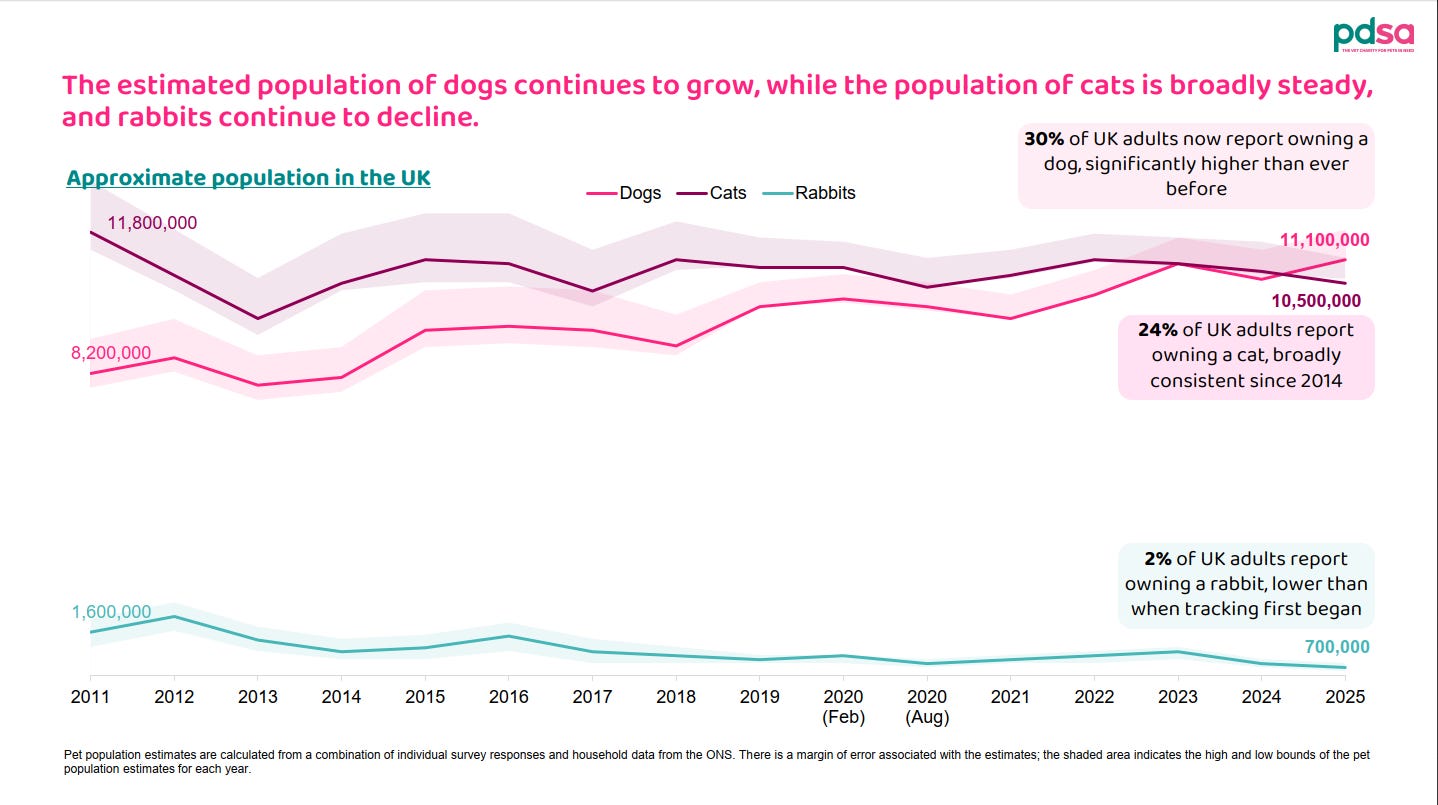
Source: pdsa (2025)
Veterinary expenses for a dog follow a distinct U-shaped trajectory over their 10- to 15-year lifespan.
During the puppy stage (2021), owners typically face a front-loaded spike in vet expenses for initial wellness visits, vaccination series, and sterilization procedures.
Expenses then stabilize at a much lower level throughout the healthy adult years (2022 to 2027). Not much vet expenses except for routine check-ups, baseline dental maintenance, and preventative parasite care.
However, as dogs cross into the senior stage (typically around 7 years of age, 2028 up to 2035), veterinary costs surge exponentially due to the onset of chronic conditions like arthritis or diabetes.
The dynamic is similar for cats.
The unprecedented COVID-19 pet boomers will drive a massive wave of high-margin geriatric veterinary spending as they reach their senior years later this decade.
That’s interesting.
Not only that, PETS is also transitioning from merely earning commissions through third-party insurance referrals (historically via Petplan) to launching its own proprietary, PETS-branded insurance.
The Financial Conduct Authority (FCA) has approved PETS. The service is on track to launch in calendar 2026.
PETS believe over time the insurance business can contribute ~10% of group profits.7
Great. But all this doesn’t matter if the Retail segment continues falling, right? What makes you think the headwinds are temporary?
Even though Retail revenue declined -1.0% in FY2026, it has returned to growth in Q4’26 (+2.2%).
Retail revenue started its consecutive declines in Q3’25. By Q2’26, the previous CEO departed. The board launched a Retail Turnaround Plan (RTP) in Q3’26. In that same quarter, they appointed a new CEO with strong retail experience. He took over in Mar 2026.
By Q4’26, Retail revenue has returned to growth (+2.2%).
You also said something about a takeover catalyst.
PETS has seen recurring but unconfirmed takeover speculation, most notably in Feb 2025 when rumors surfaced of a private equity bid from BC Partners, though the PE firm later denied involvement.8
The company’s history as a repeated PE buyout target, Bridgepoint (2004), then KKR (2010), keeps the market primed for speculation, especially now that its share price is depressed.
That sounds promising.
Go ahead and develop the thesis. Focus on collecting more evidence that the retail headwinds are temporary, and what’s the timing of the recovery.
Coming up next
Last week, we looked at how the “raw spread”, the difference in the growth of raw materials and finished goods, can help us understand the semiconductor cycle.
Can we also get a glimpse into the cycle through accounts receivable? Specifically, the aging of receivables?
That’s what I will explore in my next post.
Subscribe for free to be notified immediately when I publish.
Subscribe for 2 to 3 analyses of global SMID equities every week.
Discover overlooked ideas and rethink familiar names.
Published by Andrew Wong, ACA, CFA
Disclaimer
This publication is for informational, educational, and entertainment purposes only and does not constitute financial, investment, legal, or tax advice. The content herein is a record of my personal research and investment process, and all analysis, forecasts, and opinions expressed are solely my own.
I make no representation or warranty, express or implied, as to the accuracy, completeness, or timeliness of the information provided. The stock market is highly volatile, and my forecasts, estimates, and assumptions may prove incorrect.
I am not acting as your financial advisor or fiduciary. You should not rely on any information in this publication to make investment decisions. Under no circumstances will I be held liable for any direct, indirect, or consequential losses or damages arising from your reliance on the content of this publication.
At the time of publication, I do not hold any positions in PETS, either long or short. I may change my views, predictions, or personal portfolio positioning at any time without notice.
Thanks for write up mate.
Dont think Chewy competes in UK yet (vs what table from Gemini is saying). Why not buy Chewy instead? Trades like 7-8x fwd EV/EBITDA and #1 specialty leader in the space (minus AMZN ofc); got no physical footprint exposure to worry about like PETS; driving better group ROIC via diversifying into health (ie vet clinics)... Wayfair trades at ~15x and probs at worse cash conversion cycle + ROIC. Just food for thought. Thanks