

Background
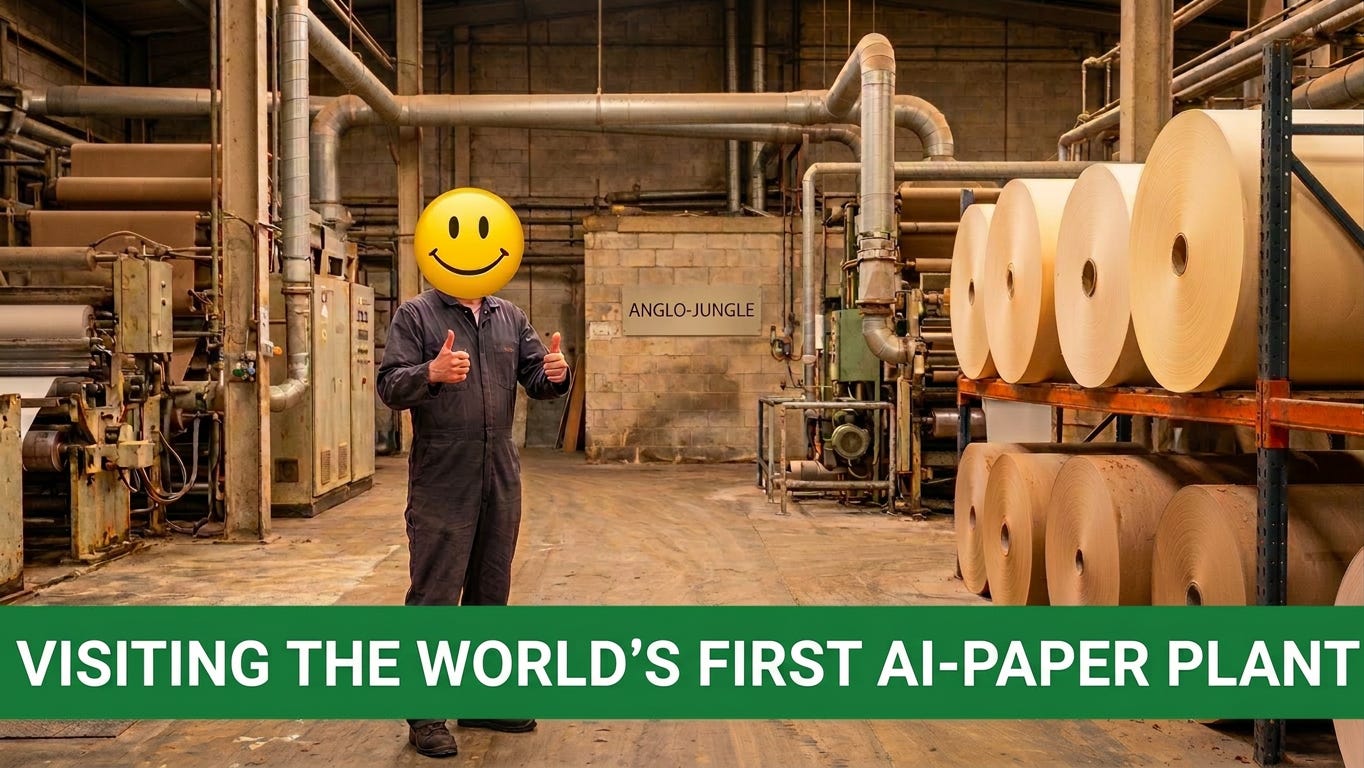
I visited the world’s first AI-paper plant.
My senior analyst Becky Madon and I made the 8-hour flight to Anglo-Jungle Corporation’s paper plant.
Here in the outskirts of Shangri-La is where Anglo-Jungle crafts the world’s first AI-paper. After our thorough due diligence, we walked away with a conviction higher than anything we’ve experienced before and will ever experience.
This is a game changer.
How does the AI-paper work?
Who is behind this innovative best-in-class AI-paper?
I answer these questions in my latest Substack post.
How we found Anglo-Jungle Corporation
Generative AI has been with us for almost 4 years, and it has provided a lot of benefits to humanity (and returns to investors).
But building out the infrastructure to support generative AI has become increasingly capital-intensive. The Wall Street Journal reported on this as early as Sep 20251.[1] As a result, development has decelerated significantly.
What is the next paradigm shift?
Imagine our surprise and delight when an initiation report came across our desks. In Shangri-La, a dropout from Standford University has defied all odds to invent the world’s first AI-paper.
The paper plant has entered mass production. Every day, Anglo-Jungle races against time to ship 67 billion pieces. Yet, demand is insatiable.
The company is looking to double production capacity. To that end, it is pursuing an IPO next quarter and is looking for cornerstone investors.
That’s where our fund, Extra Long Term Capital Management (ELTCM) comes in. Together with my senior Becky Madon, we visited Anglo-Jungle to conduct thorough due diligence.
Visiting the plant
Anglo-Jungle’s head of investor relations Mr. Lau FZ greeted us at the entrance of the paper plant. After donning our safety PPE, we started the tour.
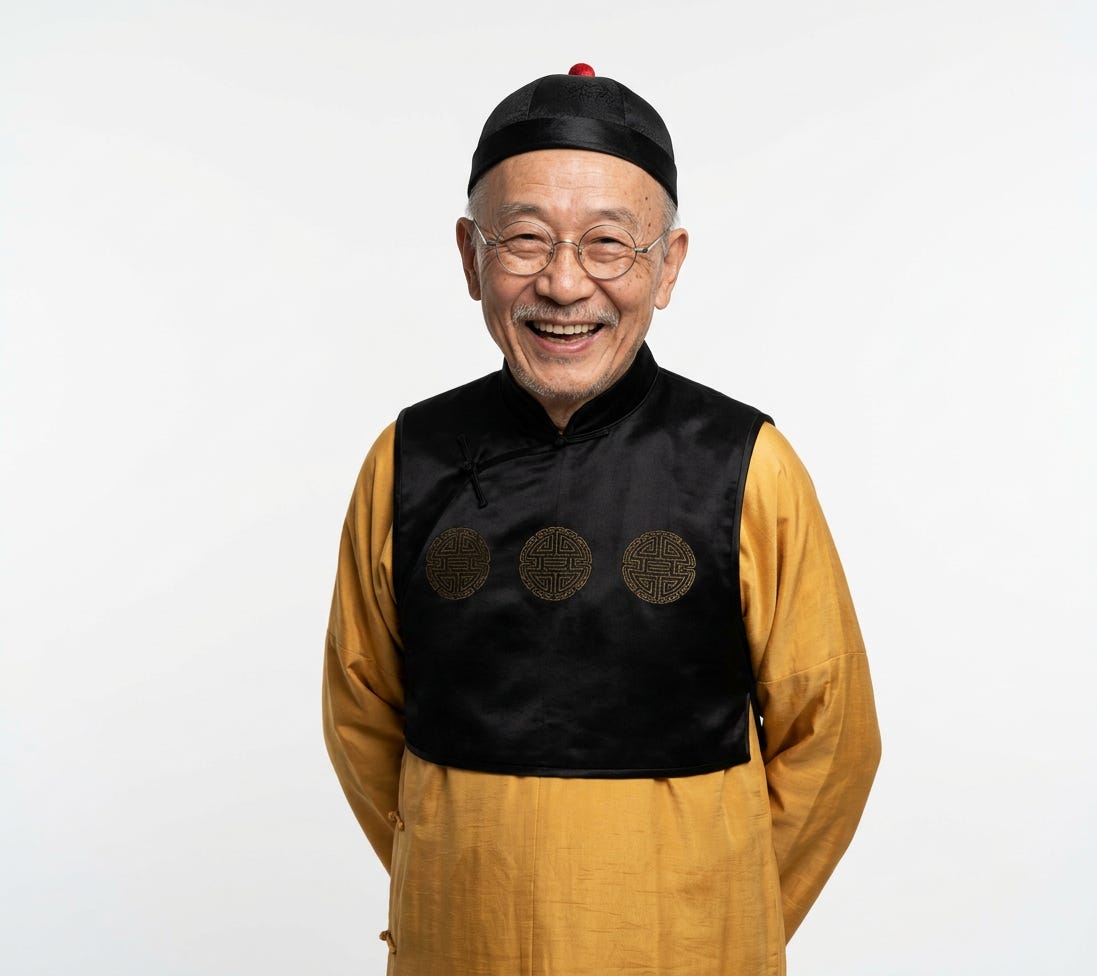
Mr. Lau FZ, head of investor relations at Anglo-Jungle
We requested to see all 20 production lines. However, Mr Lau FZ showed us only 2. The rest have shut down for maintenance.
I was surprised by the tremendous amount of steam and water inside this paper plant. Wouldn’t the steam condensate on the ceilings and drip down to the paper below?
I saw some parts of the first production line covered with flimsy plastic sheeting. A desperate attempt to keep water out. Pointing at the plastic sheeting, Becky Madon instructed me to take a photograph with these captions:
“Anglo-Jungle adopts highly innovative techniques to overcome the challenges of producing the world’s first AI-paper. Its resourcefulness is unmatched”
I was puzzled, but I trust my senior analyst. She has been in this business for 10 years.
As I walked along the second production line, I believed I saw the drive gears at the input end of the production line were not connected by any belts. If this is correct, then it would mean that no pulp was actually running into the machine. Rather, the machine was merely looping the finished product.
Becky gestured. Without missing a beat, I snapped photos of the disconnected drive gears and the paper whizzing past us. I knew what was going on. I don’t need to be told twice.
“Put that down as ‘Anglo-Jungle adopts the infinite production technique. This is the secret sauce behind their best-in-class efficiency.’” What? Becky must have seen the confusion streaking through my face. “Just do as I say!”
Meeting CEO Eliza Holm
Our plant tour ended. Mr Lau FZ ushered us to a conference room. There, we were shown a video demonstration of Anglo-Jungle’s AI paper.
CEO Eliza Holm pricked her finger with a safety pin. She dripped just one drop of her blood onto the AI paper. The paper absorbed her blood, and magically, words started forming on the paper out of her blood: “Hello world. This is Anglo-Jungle AI. How can I help you today?”
That was so impressive.
Seconds before the video demonstration ended, I noticed something. Is that an extra finger on CEO Eliza Holm’s right hand? I asked to replay the video, but Mr Lau FZ quickly admonished us to move on to the next room, where the CEO awaits.
After shaking her hand, I am glad to confirm that she has only five fingers.
De-briefing
Back at the hotel, we refreshed ourselves and settled in the lounge. There, we discussed our key findings and our valuation model.
I wasn’t sure what weighted average cost of capital (WACC) would be sufficient for a frontier market like Shangri-La. I estimated 15%. I asked Becky, is this correct?
Just pencil in 0.67%. That’ll give us a nice big fat margin of safety.
The correct WACC is the WACC that supports our portfolio manager (PM)’s decision.
Our PM already bought the shares?
He had already subscribed to the IPO last month.
Then why are we here?
Because it looks good. The fund investors like it when we visit companies. It makes us look competent. Plus, I get to expense this cognac.
She slowly lifted her cup. With her eyes staring at me, she took a sip, licked her lips and clicked her tongue. Satisfied, she put her cup down. The ice gently clinks against her cup.
Regardless of the valuation, I decided to recommend selling the shares in Anglo-Jungle. The plastic sheets, disconnected drive gears and extra finger are all big red flags.
Does this AI paper actually work? Anglo-Jungle has never shown us a real-life product demonstration. Why are 18 out of 20 production lines all down for maintenance, during a supposedly peak period?
I pressed my case.
Why can’t you learn to be adaptable? If you want to keep your head in this industry, you must be adaptable.
I’ll let you in on a trade secret. During bull markets, our job is to buy shares in companies that are in vogue, that our fund investors will like. They like compounders, whatever that means.
Valuation is just a justification. Red flags do not matter.
Come on, it’s a bull market! Make some money!
But what happens when the bear market comes and the risks crystalise?
Then we blame it on the macro, on wars, on inflation. Whatever, it doesn’t matter because we already got our performance fees.
In any case, everyone else will be down. This is when we become long-term investors. We tell clients that we invest for the long-term, and that they should invest in us for the long-term too.
That’s why we are Extra Long Term Capital Management.
Conclusion
Back in my office, I am still perplexed. My confusion stretches beyond the AI-paper industry and my own industry.
Why does Mr. Lau FZ remind me so much of my favourite childhood cartoon?
Why was CEO Eliza Holm wearing such a thick turtleneck in that sweltering heat?
Why does our fund share such as similar name with a hedge fund that blew up in 1998?
While the odds of definitive answers are slim, I promise to draw on my wide network and cutting-edge AI-papers to figure this out, and I will do my best to give my readers a smart, logical, and clear explanation by 1 April next year.
Disclaimer: This is a work of fiction. Names, companies, and scenarios are invented or used in a fictitious manner and are not intended to depict any actual person, firm, or event. Nothing in this piece constitutes investment advice or a recommendation to buy or sell any security. It is for entertainment and educational purposes only.
Coming up next
This Saturday, I will publish why I bought Haw Par Corporation Limited (H02; HPAR SP) in 2021. H02 is the maker of Tiger Balm, the ubiquitous herbal remedy.
Next week, I will publish my post-mortem and explain why I just sold all my shares.
Subscribe now to receive the analysis in your inbox on Saturday.
Subscribe for 2 to 3 analyses of global equities every week. Discover overlooked ideas and rethink familiar names. Published by Andrew Wong, ACA, CFA
Have you watched the movie 'No other choice'?
As promised, I’ve published why I bought Haw Par Corporation Limited (H02; HPAR SP) in 2021.
I was attracted to its inorganic growth potential, which I believed the market had not fully recognized.
Through reading management interviews and analysing its hiring activity, I believed Haw Par was about to make a major acquisition. This could increase its profits by almost 50%.
I also believed the market had not fully recognized the ‘hidden’ assets within H02. Its accounting policies have artificially depressed its return on asset (ROA), making it look like a low-return business.
Read it here: https://angsanaanderson.substack.com/p/haw-par-crouching-tiger-hidden-value?r=5rl2u5