

On 29 September 2014, Hua Han reported earnings per share (EPS) grew by a whopping +40%.
Its share price surged to all-time highs.
Two years later, the Hong Kong Stock Exchange (HKEX) suspended trading in Hua Han shares.
Shareholders were wiped out.
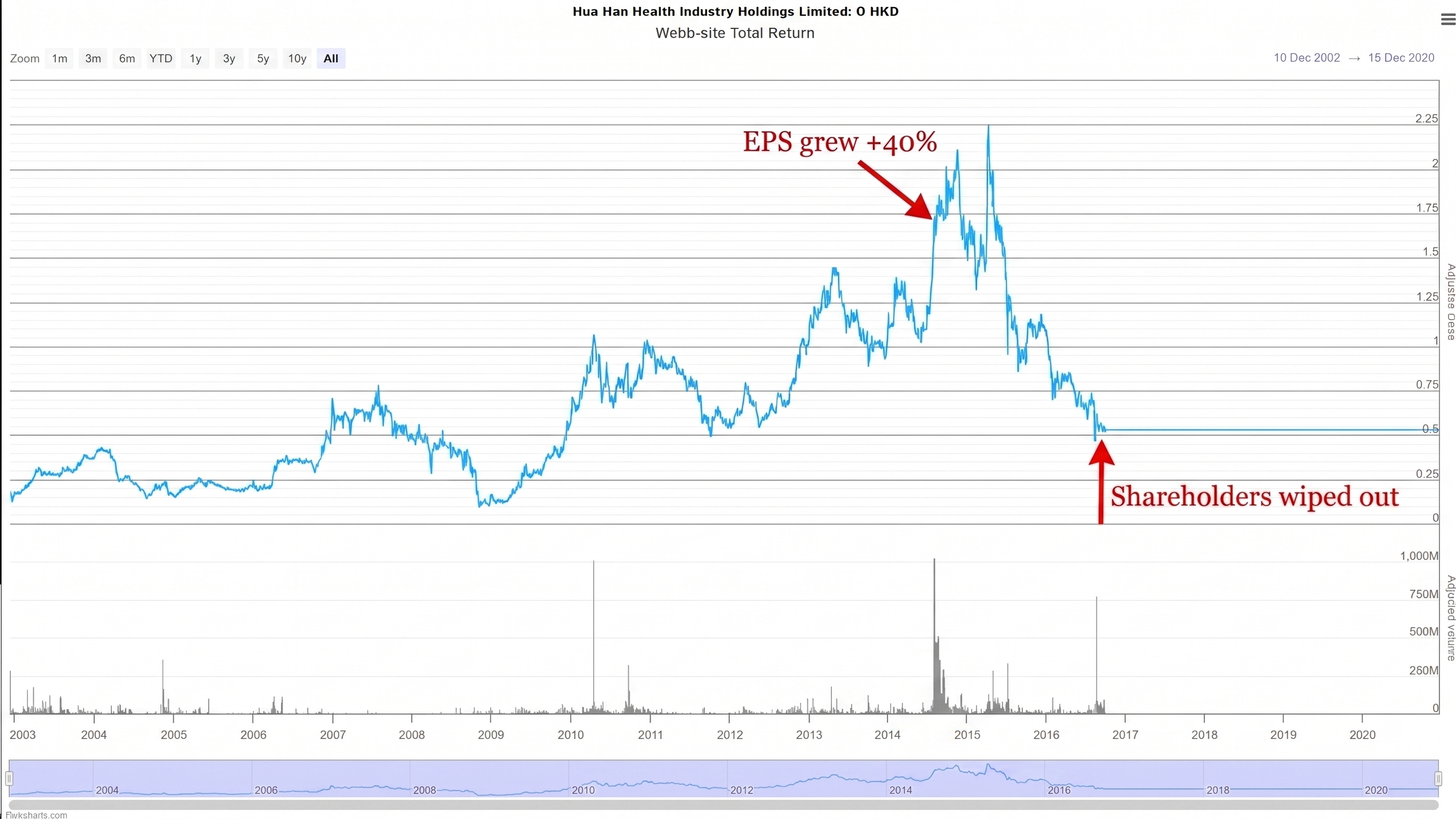
Source: Webb-Site (2026)
Turns out, Hua Han faked its EPS.
What were the red flags?
Many. I want to focus on the biggest: unusually high construction-in-progress (CIP).
CIP refers to the portion of property, plant and equipment (PPE) that is still under construction. Think of half-built factories and hospitals.
In the chart below, I plotted the % of PPE that is still under construction. Blue for Hua Han, orange for China TCM, its peer.
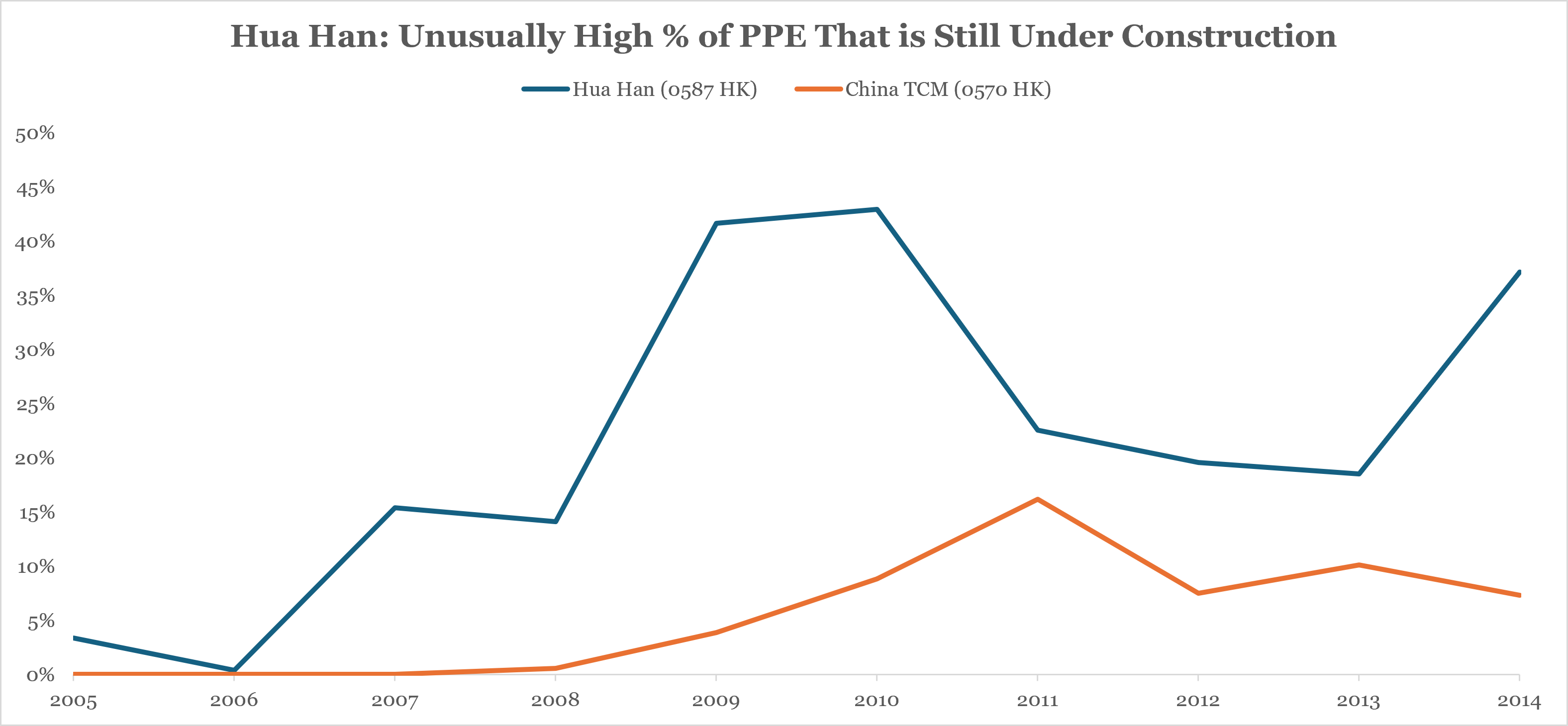
Source: Company annual reports
Imagine you were looking at this chart on 29 September 2014, after Hua Han reported its stellar earnings. What questions should you ask?
First, why is the % of PPE under construction so high?
Over the past 10 years, it significantly exceeded its peer, China TCM.
The % reached as high as 40% in 2009 and 2010. This is unusually high. For context, even in the midst of a big semiconductor boom, Samsung Electronics’ CIP reached only 28% of total PPE in Q1’26.
In 2014, why did Hua Han construct more PPE? China TCM reduced their % of PPE under construction.
Given that both operate in the same industry, they face similar demand. Their capacity expansion plans should not differ too much.
Hide the fake profits in construction-in-progress
In September 2016, Zhongkui Research published a short report on Hua Han:
“We have found that Hua Han has significantly inflated their capex to balance the cash fabricated from their inflated revenue…”1
Hua Han faked its EPS by inflating revenue.
When you inflate revenue, you also inflate receivables. There are few things that attract more attention from auditors and investors than surging receivables.
When I was an auditor, my audit partner always asked the same thing before he signs off on a financial statement: “Has the company collected all receivables after the year-end?”
So, when you fake revenue, you need to get rid of the resulting receivables.
How about faking the collection of these receivables? You’ll collect fake cash. That’s also difficult to get past the auditors.
Auditors almost always get direct confirmation of your cash balance from your bank. During my audit training, I was specifically instructed to never allow the audit client to pass me the bank confirmation, lest they tamper with it.
How about construction-in-progress?
Ah, that’s one of the best places to park fake cash. Inflate revenue, collect the fake receivables, use the fake cash to buy equipment, building materials, etc. at inflated prices. How will the poor auditor know that this equipment is worth HKD 10 mn, not HKD 50 mn?
That’s what Hua Han did.
There’s a better way to do this.
After you inflate revenue, set up a company. Use the fake cash to acquire the company at an inflated price. The fake cash goes into goodwill.
After that, cook up some reasons like '“industry slow down”. Impair the fake goodwill.
Much cleaner. Harder to catch because goodwill is intangible and involves a lot of subjective judgement.
Best of all, investors ignore goodwill impairment because it is ‘non-cash’ and ‘non-recurring’.
I hope I’m not giving you ideas…
Afterword
“Accounting is useless”
That’s the common thinking among investors. I can understand the sentiment.
After all, accounting is public information. Everyone opens the same annual report and sees the same things. There’s no edge.
I hope this Hua Han case study shows otherwise.
If this is not convincing enough, I’ve saved my best argument for the end:
Everyone knows how to get fit:
Eat less, run more.
But why isn’t everyone fit?
Coming up next
Next week, I’ll be back with 2 to 3 more interesting ideas.
I’ll then analyse the most voted idea from my last post.
Right now, that’s Genting Malaysia Berhad (GENM MK). Tuas Limited (TUA AU) is the runner up.
Haven’t voted yet? Check out my last post: 3 more interesting opportunities
Thanks for reading! If you found this helpful, hit the “like” button.
If you’re not already a subscriber, sign up for weekly analysis on global SMID equities.
Disclaimer
This publication is for informational, educational, and entertainment purposes only and does not constitute financial, investment, legal, or tax advice. The content herein is a record of my personal research and investment process, and all analysis, forecasts, and opinions expressed are solely my own.
I make no representation or warranty, express or implied, as to the accuracy, completeness, or timeliness of the information provided. The stock market is highly volatile, and my forecasts, estimates, and assumptions may prove incorrect.
I am not acting as your financial advisor or fiduciary. You should not rely on any information in this publication to make investment decisions. Under no circumstances will I be held liable for any direct, indirect, or consequential losses or damages arising from your reliance on the content of this publication.
At the time of publication, I do not hold any positions in the companies mentioned in this article, either long or short. I may change my views, predictions, or personal portfolio positioning at any time without notice.
Great article!