

[Shortlist] ENN Energy Holdings Limited (2688 HK)
The parent, ENN Natural Gas, tried to privatise ENN Energy. They offered HKD 80 per share.
But the privatisation failed last month. Investors dumped so much shares. Today, the shares trade at only HKD 46.
Why did it fail? Will the parent try again? Why do you think the shares are now attractive?
The privatisation failed because the Chinese regulators did not give clearance on time.
Even though they did not explain why, I believe there are two main reasons:
Complex privatisation structure
Regulatory concerns
The privatisation failed
Ok. Start with the structure of the privatisation.
ENN Natural Gas Co., Ltd. (600803 CH) owns ~35% of ENN Energy.
It offered HKD 80 per share for the remaining 65%:
HKD 24.50 cash
2.9427 newly issued H-shares of ENN Natural Gas
ENN Natural Gas does not have H-shares yet. To facilitate the equity portion of its offer, ENN Natural Gas concurrently applied for a listing on the Hong Kong Stock Exchange (HKEX).
That’s what makes this privatisation complex.
But this is not the main reason why the privatisation failed?
That’s what I believe.
Haier used the same structure to privatise its Hong Kong-listed subsidiary in 2020. No issues.
What’s the problem then?
The State Administration for Market Regulation (SAMR) is the competition watchdog in China.
I believe the SAMR is reluctant to approve the privatisation because it would create a single, highly integrated entity with strong market power across upstream LNG procurement, midstream terminal storage, and downstream pipeline distribution.
The SAMR has been stepping up its scrutiny over vertical integration.
In 2025, it published a prohibition decision on a vertical acquisition in the pharmaceutical industry. The SAMR believed the deal created a vertically integrated and dominant business that was able to foreclose competition in the downstream market.1
Does that mean there is no chance at all for another deal?
There is still a chance.
The desire to privatise is still there. ENN Natural Gas said that even though it dropped the privatisation plan, it still intends to gradually increase its stake in ENN Energy through on-market purchases.
To allay the regulators’ concern, ENN Natural Gas can offer remedies like divesting certain assets or committing to specific price and service levels.
Under Hong Kong's Takeovers Code, ENN Natural Gas is barred from making another formal privatisation offer for ENN Energy for 12 months from Jun 2026.
This puts the earliest possible re-bid around Jun 2027.
Shares sold off so much. Looks attractive now
Interesting enough. Even without privatisation, the shares now look attractive. Why do you say this?
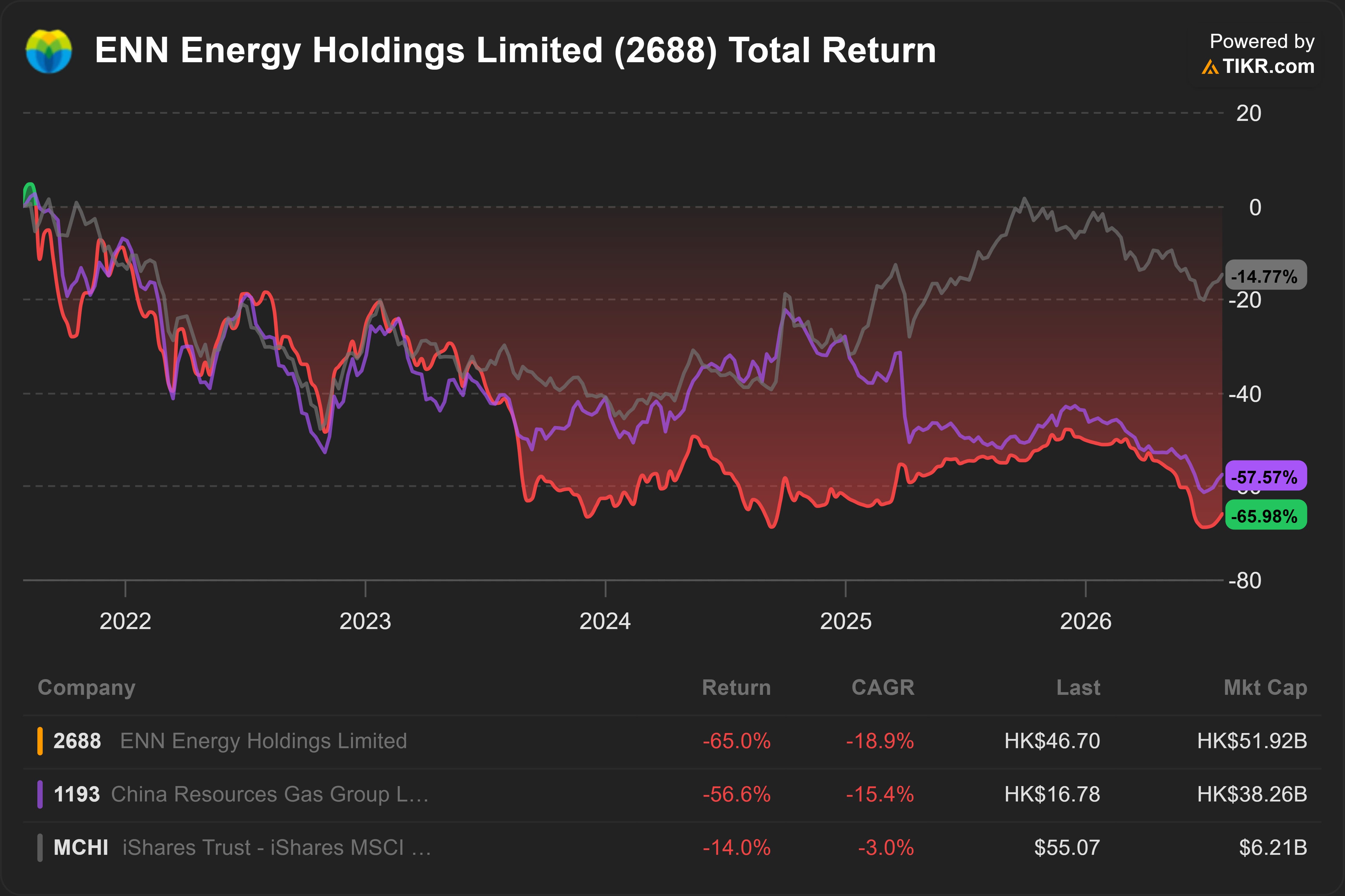
After the privatisation failed, the shares dropped almost -45%. Investors betting on the privatisation were dumping the shares.
But they are ignoring the attractive business fundamentals:
Under-recognised growth
Capital returns
Before you begin, are the shares liquid enough? Give me the basic stats first.
29 Jul 2026
Share price: HKD 46.70
Market capitalisation: HKD 52 bn (USD 7 bn)
Enterprise value (EV): HKD 73 bn (USD 9 bn)
Average daily volume (ADV): HKD 226 mn (USD 29 mn)
NTM P/E: 7x
Under-recognised growth
Ok. What do you mean by under-recognised growth?
ENN Energy buys gas from domestic suppliers like CNOOC, lays down gas pipelines and sells the gas to both commercial & industrial (C&I) and residential customers.
Residential customers make up only ~22% of retail sales volume but contribute significantly to high-margin construction and installation fees.
Since the property crisis started around 2021, these lucrative fees have fallen almost -60%. Fewer houses built meant fewer connection fees.
That’s one of the main reasons why many investors believe ENN Energy is a dying business. Over the next 3 years, sell-side consensus forecasts only low-single-digit EPS growth.
They are, however, ignoring the growth potential in cross-selling.
During the same period, ENN Energy doubled its revenue from cross-selling gas alarms, smoke sensors and kitchen appliances under its own brand, Gratle (格瑞泰). The company calls this segment, “Smart Home”.
Despite the tremendous growth, this opportunity remains under-penetrated. ~63% of new customers buy from Smart Home while the same number for existing customers is only ~4%.
Sounds interesting. But I can’t shake off my concern. Isn’t natural gas consumption declining?
Residential and commercial natural gas consumption in China has grown every year since 2014, as more customers switched from coal to natural gas for home heating.
In the electric power sector, additional economic activity and new natural gas-fired capacity increased consumption.2
Natural gas is generally cheaper for heating, cooking, etc.
In electricity production, natural gas is cleaner than coal, and allows power plants to ramp up and down quickly. That’s an important advantage.
How about the future?
China’s gas consumption is expected to grow by ~6% p.a. through 2030, mainly driven by the same factors.
More than 10 years ago, only ~49% of connectable households were connected to ENN Energy’s gas pipes. Today, that’s around 67%. Even so, there’s a lot of room to grow. The penetration rate in mature areas can reach up to 90%.
The housing market is cyclical. When the cycle eventually turns and more homes are built, ENN Energy will benefit from higher connection fees.
That’s the cherry on top of the cake.
Interesting. How about margins? Operating profit margins (OPM) declined from 11% in 2020 to 7% in 2025.
Two main reasons:
Higher gas prices squeezed margins.
Construction and installation fees, which carry higher margins, declined from 9% of total revenue to only 3%.
I will be surprised if OPM continues to decline.
First, the regulator (NDRC) has been pushing a price linkage mechanism that allows city gas distributors to pass upstream cost increases down to end-users.
As of Dec 2025, ENN achieved a ~72% completion rate for residential price adjustments.
Second, the Smart Home segment has become material. In 2025, it contributed 4% to group revenue, higher than the 3% from construction and installation fees. This segment carries 67% gross profit margin, higher than the 49% offered by construction and installation fees.
Attractive capital returns
What’s the cash coming out of the business?
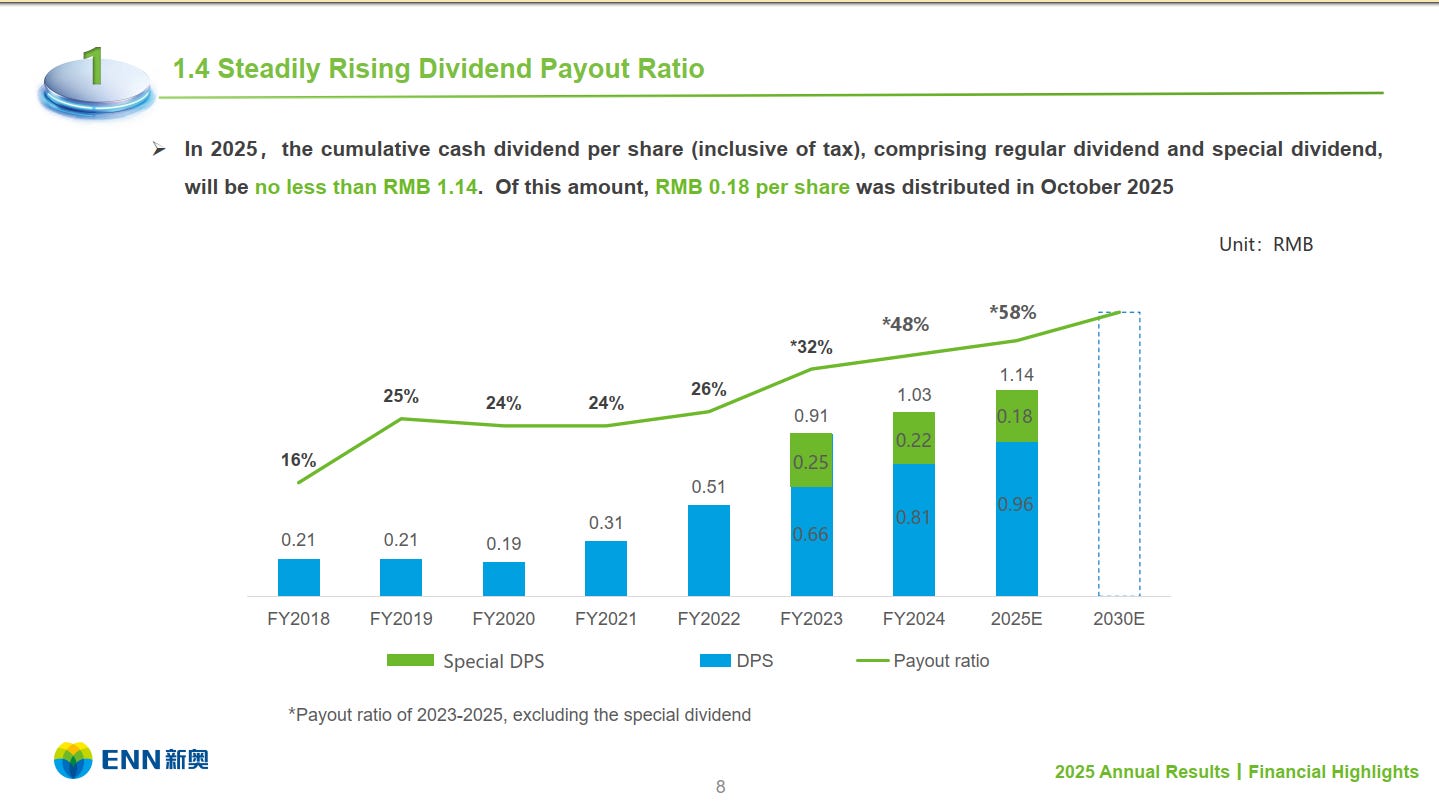
Since 2019, ENN Energy increased its dividends every year.
It committed to a dividend payout ratio of at least 50% through 2028. This seems sustainable. Dividends are covered by its free cash flow. Financial leverage is reasonable (BBB+ from Fitch).
Dividend yield is now ~7%. Attractive, given 1.7% China 10y government bond yield.
Great. Go ahead to develop the full thesis for this.
Give me a sense of the competitive landscape. Compare ENN Energy to its peers like China Gas Holdings Ltd (384 HK) and China Resources Gas Group Ltd (1193 HK).
Help me understand the regulatory landscape better. The key factor in utility companies is regulation. If regulators are unhappy with their price and service level, they can allow more new entrants. That’s how a lot of utility companies get blown out of the water.
That’s interesting. Have you seen something like that before?
In Singapore, the regulator wanted lower prices for customers. They allowed M1 and then StarHub to enter and break Singtel’s monopoly. Still not satisfied, the regulator allowed a fourth operator, SIMBA to enter in 2016.
Good for customers. Mobile plans in Singapore are now among the cheapest in the world.
Very bad for shareholders. Starhub’s share price is now down almost -75% from its peak in 2015.
Very fascinating story. But that’s for another time.
Coming up next
In 2019, China Evergrande was flying high. Less than 5 years later, it wiped out all shareholders.
Warning signs hidden in its financial statements. What were they? How can we look for these warning signs in other industries?
That’s what I will explore in my next analysis.
Subscribe for free to be notified immediately when I publish.
Subscribe for 2 to 3 analyses of global SMID equities every week.
Discover overlooked ideas and rethink familiar names.
Published by Andrew Wong, ACA, CFA
Disclaimer
This publication is for informational, educational, and entertainment purposes only and does not constitute financial, investment, legal, or tax advice. The content herein is a record of my personal research and investment process, and all analysis, forecasts, and opinions expressed are solely my own.
I make no representation or warranty, express or implied, as to the accuracy, completeness, or timeliness of the information provided. The stock market is highly volatile, and my forecasts, estimates, and assumptions may prove incorrect.
I am not acting as your financial advisor or fiduciary. You should not rely on any information in this publication to make investment decisions. Under no circumstances will I be held liable for any direct, indirect, or consequential losses or damages arising from your reliance on the content of this publication.
At the time of publication, I do not hold any positions in 2688, either long or short. I may change my views, predictions, or personal portfolio positioning at any time without notice.
Thanks mate for write up. Are you long this name right now?