

[Shortlist] Elan Corporation (6099 JP)
Last week, you highlighted a potential opportunity in Elan.
Liquidity?
1 Sep 2026
Share price: JPY 746
Market capitalisation: JPY 45,123 mn (USD 282 mn)
Enterprise value (EV): JPY 38,892 mn (USD 243 mn)
Average daily volume (ADV): JPY 67 mn (USD 0.4 mn)
NTM P/E: 13.5x
My initial estimate suggests ~9% free cash flow yield on enterprise value. ~6% premium over the Japan 10y government bond yield. Looks attractive.
FCF yield looks attractive, but this will be more suitable for a personal account. Liquidity is on the low side.
That’s probably why this opportunity exists. No serious investors are looking.
Normally, I look for opportunities > USD 1 mn daily trading volume. USD 0.5 mn minimum.
I came across this by chance. It looks too attractive to ignore.
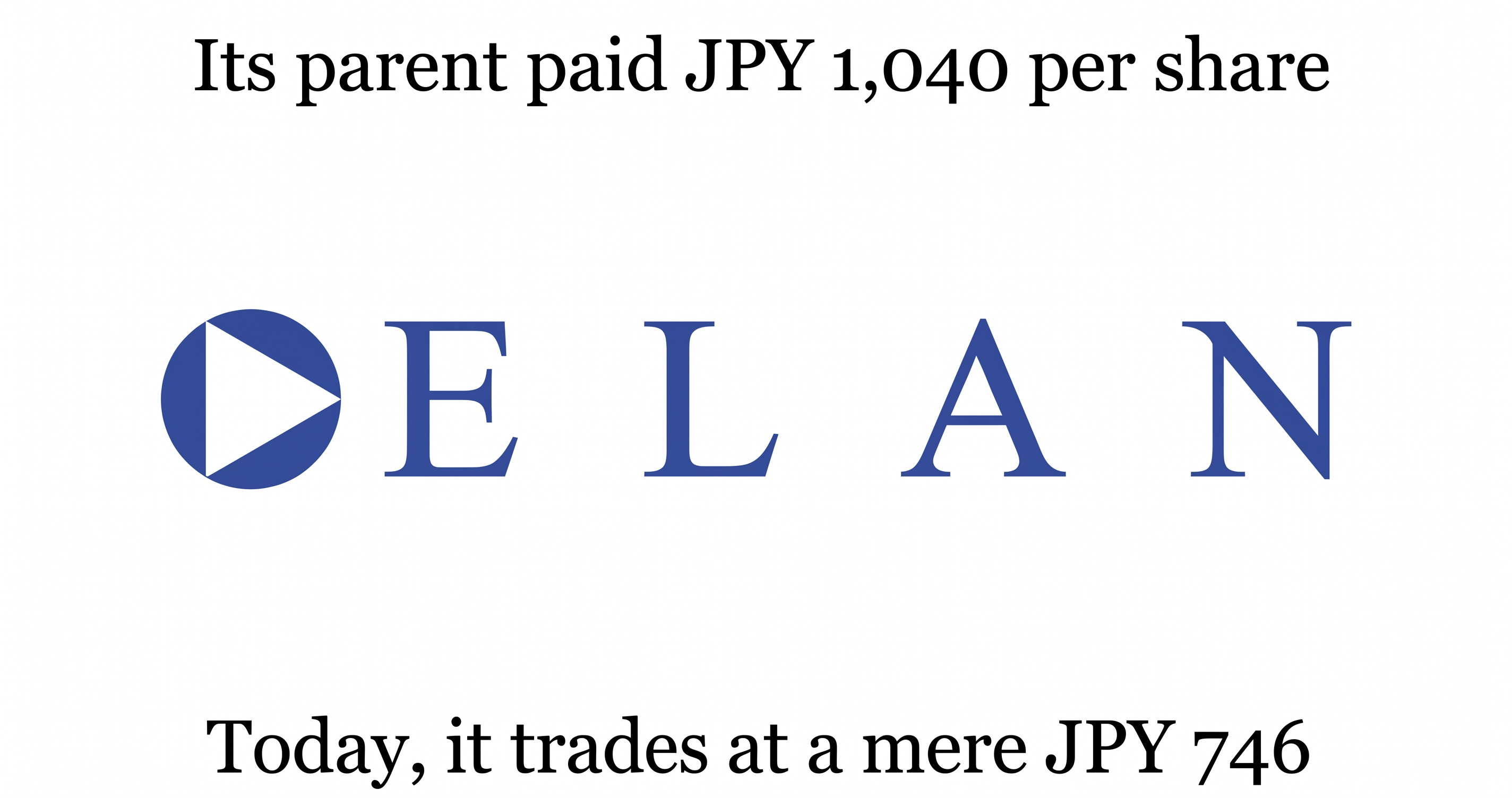
Less than two years ago, M3, Inc. (2413 JP) paid JPY 1,040 per share. Today’s share price is only JPY 746.
Interesting. What does Elan do?
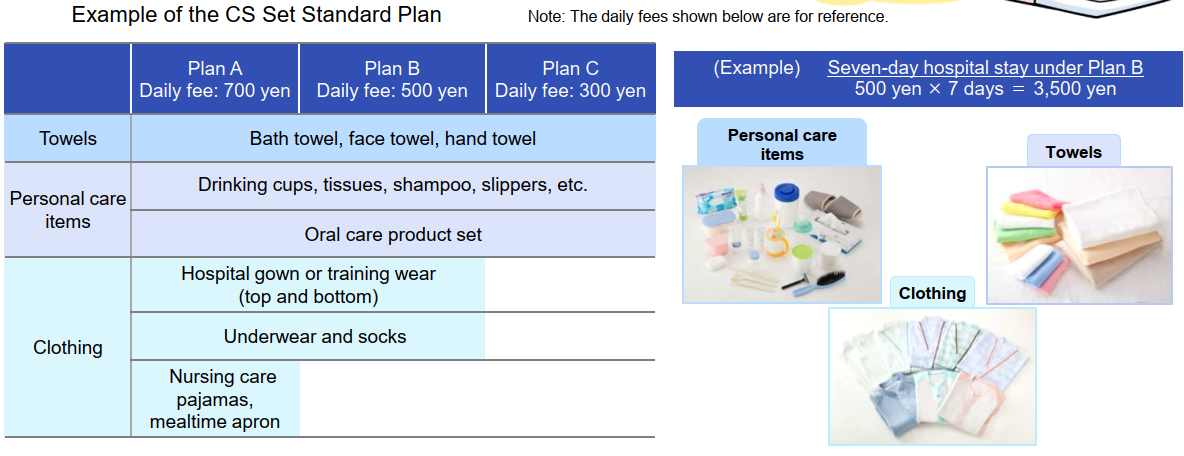
Elan rents out personal care kits to patients staying in hospitals. The kits include hospital gowns, toiletries, diapers, etc.
They call this the “CS Set”.
Source: Elan (2026)
In 2025, it served 2,830 healthcare facilities (+10% YoY). Mostly hospitals, but a growing proportion of nursing care facilities. Average annual revenue per facility is ~ JPY 19 mn (+2% YoY).
491,000 active monthly users (+7% YoY) and JPY 9,000 average monthly revenue per user (ARPU) (+5% YoY).
Almost all revenue is earned in Japan. Customers are individual patients.
Why did the shares’ total return peak between 2020 and 2021?
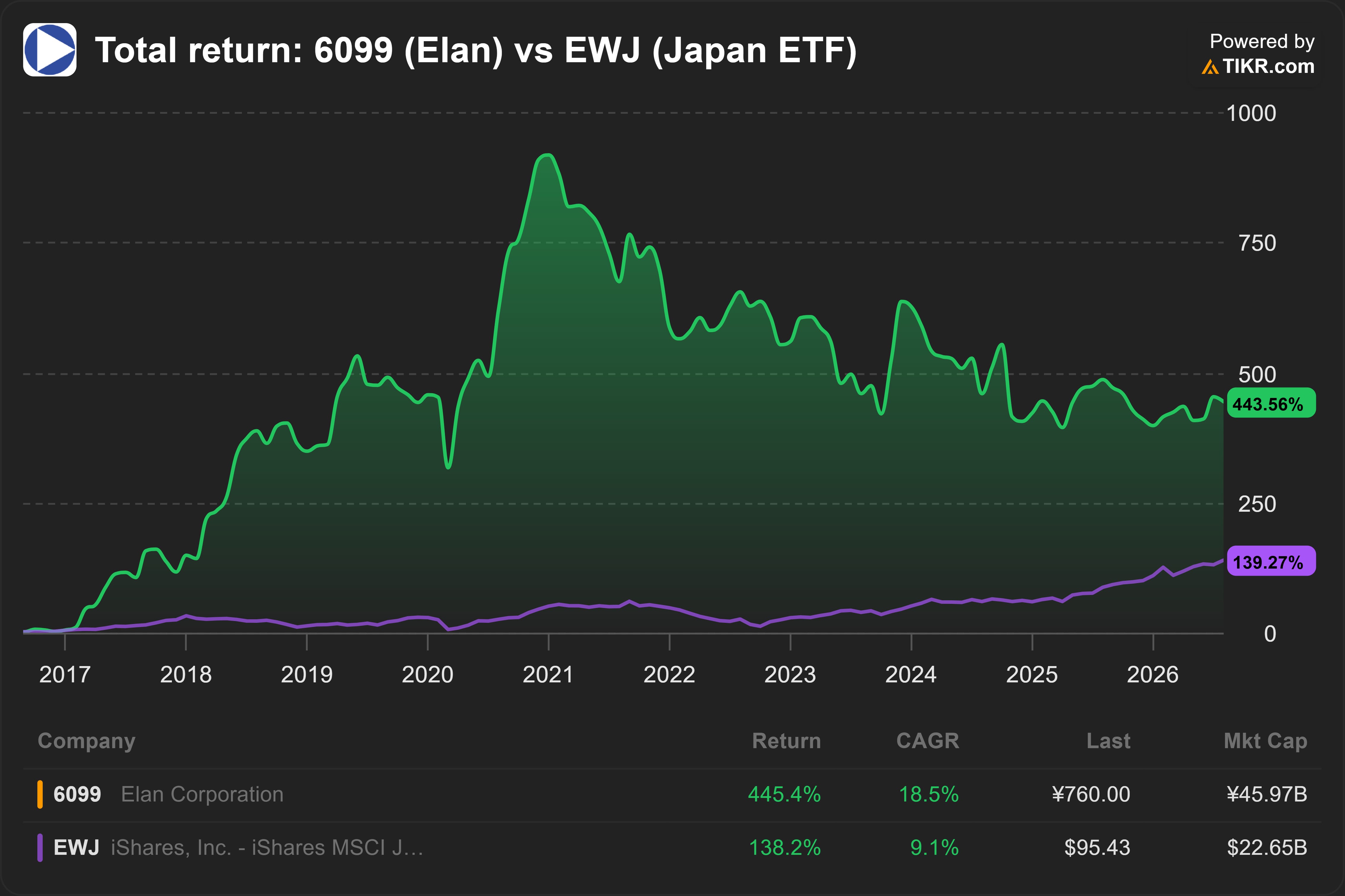
Between 2017 and 2020, Elan’s shares surged on the back of high growth. Its service was under-penetrated among the large hospitals and nursing homes.
COVID-19 lockdowns turbocharged growth. More patients signed up because their families could not deliver laundry and personal care kits.
After lockdowns ended, growth normalised.
Good business, temporary headwinds
How is this a good business?
Look, gross profit margin (GPM) declined so much in the past 2 years! We only invest in compounders that can grow their margins.
This is a temporary accounting headwind.
GPM declined because Elan expensed upfront its new product, lifte. As these are premium hospital garments for rent, it will be more appropriate to depreciate them over their useful lives.
Elan realised this. In H1’26, they moved to depreciation over three years. GPM increased by 1.4 percentage points to 22.6%.
Global peer Johnson Service Group plc (JSG LN) also depreciates their linen over two to three years.
Good point.
I was surprised they had such high return on assets (ROA). ~ 12%. Their competitor TOKAI Corp. (9729 JP) achieved only ~ 5%. Why?
TOKAI owns its laundry plants. Elan outsources the laundry and focuses on assembling the kits, managing relationships, customer service and billing.
Capital-light. Good business.
Their free cash flow conversion is good. They should trade at more than 14x NTM P/E.
In fact, their true NTM P/E is slightly lower: 13.5x
Why?
Elan amortises goodwill. JPY 131.5 mn per year. That’s JPY 2.2 per share.
Management forecasts earnings per share (EPS) at JPY 52.81 in 2026. Add back the goodwill amortisation, you’ll get JPY 55 EPS per share.
NTM P/E drops to 13.5x
Under-recognised growth
Elan targets +15% p.a. revenue growth over the next 2 years. 10% organic growth. The rest from M&A.
If they can achieve that, 13.5x P/E looks very attractive.
Can they?
10% organic growth looks reasonable. The product remains underpenetrated in Japan.
By my estimates, the top 5 players hold ~ 62% market share by number of contracted facilities. Elan is the second largest player with 16% market share.
The remaining 38% is either held by small-scale players or unpenetrated.
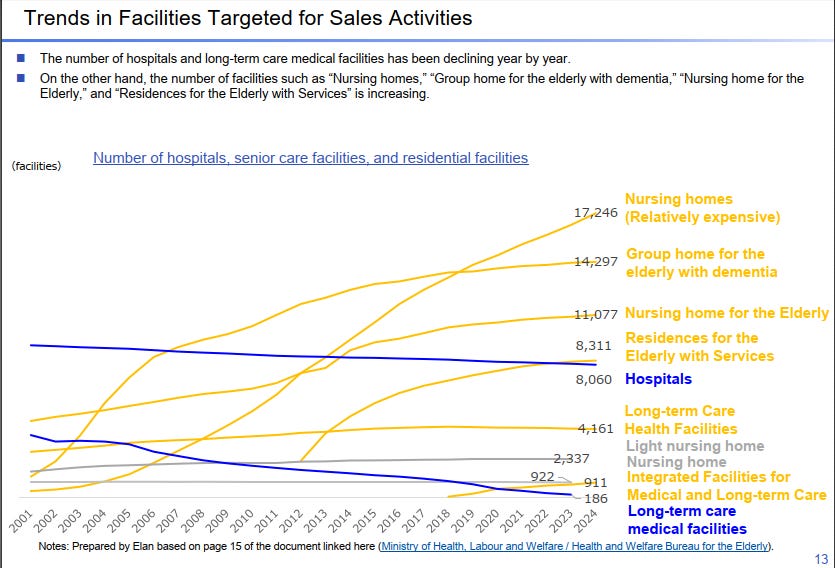
I am skeptical. Aren’t a lot of hospitals closing down in Japan?1
Yes.
But the market continues to grow because small-scale care facilities are growing, especially premium nursing homes.
Source: Elan (2026)
Historically, Elan focused on mass market large-scale hospitals and nursing homes, with 50 beds or more.
From 2024, Elan started expanding into these growing small-scale nursing homes. The company has grown its penetration rate to ~2%. But there remains a lot of room to grow.
I’ve updated my estimates of market share and penetration rate to include these growing small-scale nursing homes:

Source: Respective company websites, Ministry of Health, Labor and Welfare, Angsana Anderson estimates
Instead of 38% of the market held by small-scale players or unpenetrated, we now have 83%.
This vast under-penetration provides strong growth potential.
Yet, the market doesn’t seem to fully recognise this. It is pricing Elan at only 13.5x NTM P/E.
Potential sale
In October 2024, M3, Inc. (2413 JP) acquired 55% of Elan. It paid JPY 1,040 per share. Today, Elan is trading at ~28% discount to the acquisition price.
In August 2026, Oasis Management raised its shareholding in M3 to 6.26%.2
The activist investor demanded M3:
Transfer, acquisition or suspension of part of the business
Significant change to dividend policy
Given the pressure, M3 may sell Elan to fund special dividends to its shareholders.
The synergy is not obvious. It’s almost 2 years after the acquisition. Yet, the company only got 116 contracts through M3’s distribution network. Elan has a total of 2,942 contracts.
Furthermore, Elan is not material. Its operating profits are only 6% of M3’s.
Interesting. Might be worth shortlisting for further research.
You haven’t talked much about their expansion into Vietnam through M&A.
Capex jumped in 2024 and 2025. Elan’s Vietnam subsidiary seems to be buying more equipment. Yet, in H1’26, Vietnam revenue declined -7% YoY.
I know Vietnam is only 3% of group revenue. But is there a risk that Elan continues throwing good money after bad?
Elan is capital-light. It outsources the laundry and other capital-intensive work, whereas its Vietnam subsidiary is capital-intensive.
If capex continues to increase and eats up a lot of free cash flow, 13.5x NTM P/E may not be that much of a bargain.
Please look into this.
Ok.
Coming up next
Stop following rules.
“Invest only in companies without debt. Low risk.”
“Never invest in companies with negative equity. Too risky.”
Rules like these will get you into trouble.
I will explain why in my next post.
Subscribe for free to be notified immediately when I publish.
Subscribe for 2 to 3 analyses of global SMID equities every week.
Discover overlooked ideas and rethink familiar names.
Published by Andrew Wong, ACA, CFA
Disclaimer
This publication is for informational, educational, and entertainment purposes only and does not constitute financial, investment, legal, or tax advice. The content herein is a record of my personal research and investment process, and all analysis, forecasts, and opinions expressed are solely my own.
I make no representation or warranty, express or implied, as to the accuracy, completeness, or timeliness of the information provided. The stock market is highly volatile, and my forecasts, estimates, and assumptions may prove incorrect.
I am not acting as your financial advisor or fiduciary. You should not rely on any information in this publication to make investment decisions. Under no circumstances will I be held liable for any direct, indirect, or consequential losses or damages arising from your reliance on the content of this publication.
At the time of publication, I do not hold any positions in 6099 JP, either long or short. I may change my views, predictions, or personal portfolio positioning at any time without notice.