

About (22 Apr 2026)
Share price: USD 10.60
Market capitalisation: USD 1,969 mn
Enterprise value (EV): USD 1,046 mn
Average daily volume (ADV): USD 5 mn
NTM P/E: 7x
My Decision
Pass (previous: pass)
Background
Chagee: Profits attract competition, competition destroys profits
At only 7x NTM P/E, Chagee looks attractive.
However, I decided to pass.
Chagee’s latest earnings show an industry that remains too competitive. Company-owned stores nearly doubled from a year ago. However, this is likely the result of Chagee taking over unprofitable stores from franchisees.
Does Chagee’s opportunity lie overseas? Unlikely.
In Q4’25, overseas same-store sales growth continued to deteriorate. I found out why after visiting Chagee’s flagship store in Singapore.
Consumer tastes are rapidly changing, yet Chagee became slow to respond.
In this Substack post, I will discuss these concerns in detail.
Business model
Breakdown of 2025 revenue (RMB 12.9 bn, +4% YoY):
88% from franchised stores (−2% YoY)
12% from company-owned stores (+93% YoY)
CHA earns revenue from franchised stores by selling products and services to franchisees.
Out of the 88% revenue from franchised stores, 75 ppt is earned from sale of raw materials, 7 ppt from store equipment and other supplies and the remaining 6 ppt is earned from franchising and other services.
Revenue from company-owned stores is generated from the sale of freshly made tea drinks directly to customers.
As of 2025, CHA has 7,453 stores. 7,108 stores are in mainland China and HK. The remaining 345 stores are located overseas, mainly in Malaysia (217 stores).
6,838 stores are franchised while the remaining 615 stores are directly owned by CHA.
Relevant public comparables include Nayuki Holdings Limited (2150 HK), Auntea Jenny (Shanghai) Industrial Co., Ltd. (2589 HK), and Sichuan Baicha Baidao Industrial Co., Ltd. (2555 HK).
My reasons
Industry is oversaturated and too competitive
Franchisees quitting. At first glance, CHA seems to be doing well. Overall same-store gross merchandise value (GMV) growth improved from -28% in Q3’25 to -26% in Q4’25. CHA even increased its store count by 115 in Q4’25.
However, a closer examination reveals the market remains oversaturated, business is getting worse and likely to continue deteriorating.
The increase in store count is mainly driven by company-owned stores in China. In Q4’25, company-owned stores increased by 168. At the same time, CHA closed 136 franchises stores in China.
“So what? Maybe Chagee wants to operate more stores themselves for quality control.”
I interpret this differently. I believe the oversaturation in the market is pushing many franchisees into losses.
According to 曹阳 (Cao Yang), a franchisee from the Beijing-Tianjin-Hebei region, CHA currently offers 2 solutions for underperforming franchised stores: optimisation or closure.1
Optimisation allows franchisees to find stores with lower rents and relocate, while closure means CHA directly acquires the stores and converts the franchised store into a company-owned store.
The fact that company-owned stores increased significantly just when franchised stores started closing en masse suggests that many franchisees are exiting because of significant losses. This could also explain why CHA slipped into operating losses in Q4’25.
It also suggests a bleak outlook. Put yourself in the shoes of a franchisee. If there are any signs that business will improve very soon, you would likely have held on and continued operating.
Working capital trends support this view. Contract liabilities, which primarily comprise upfront fees and advance payments from franchisees, declined 8% in 2025. This is the first drop since the company began disclosing this metric.
Second-hand equipment piling up. According to Mr. Liu, a dealer of second-hand equipment in China, “At this time last year, you had to fight to get a set of Chagee equipment.
Now? I have more than a dozen sets piled up in my warehouse.
Many franchisees have been listing their equipment for half a year but haven’t been able to sell it. In the end, they can only sell it as second-hand equipment at scrap metal prices.”2
He added that many franchisees who have listed their equipment still have very new store decorations.
“Some have been open for less than a year.”
Low barriers to entry
The grass is greener on the other side? The bulls argue that international markets will come to CHA’s rescue. After all, overseas store count increased +32% QoQ in Q4’25. Chagee will be the Starbucks of tea!
I am less optimistic.
Overseas same-store GMV growth deteriorated from -23% in Q3’25 to -26% in Q4’25. I believe it will deteriorate further, and the consensus is likely too optimistic.
During a Saturday in Apr 2026, I visited Orchard, Singapore’s busiest shopping district.
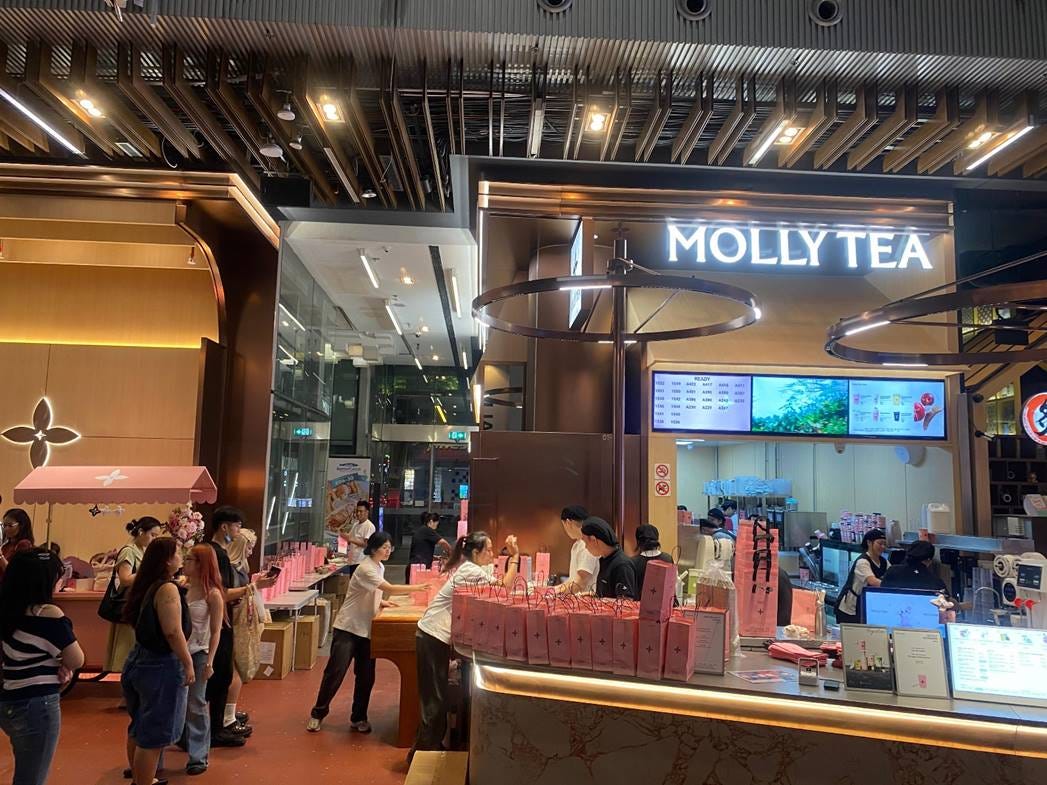
Orchard is where Chagee opened its Singapore flagship store in Aug 2024. It is also where Molly Tea, a rival, opened its flagship store in Mar 2026.
Let’s look at the newcomer first.
Source: Angsana Anderson
I was immediately struck by how busy it was. This was the scene at around 9pm on a Saturday. Look at how packed the counter is. Everyone is busy.
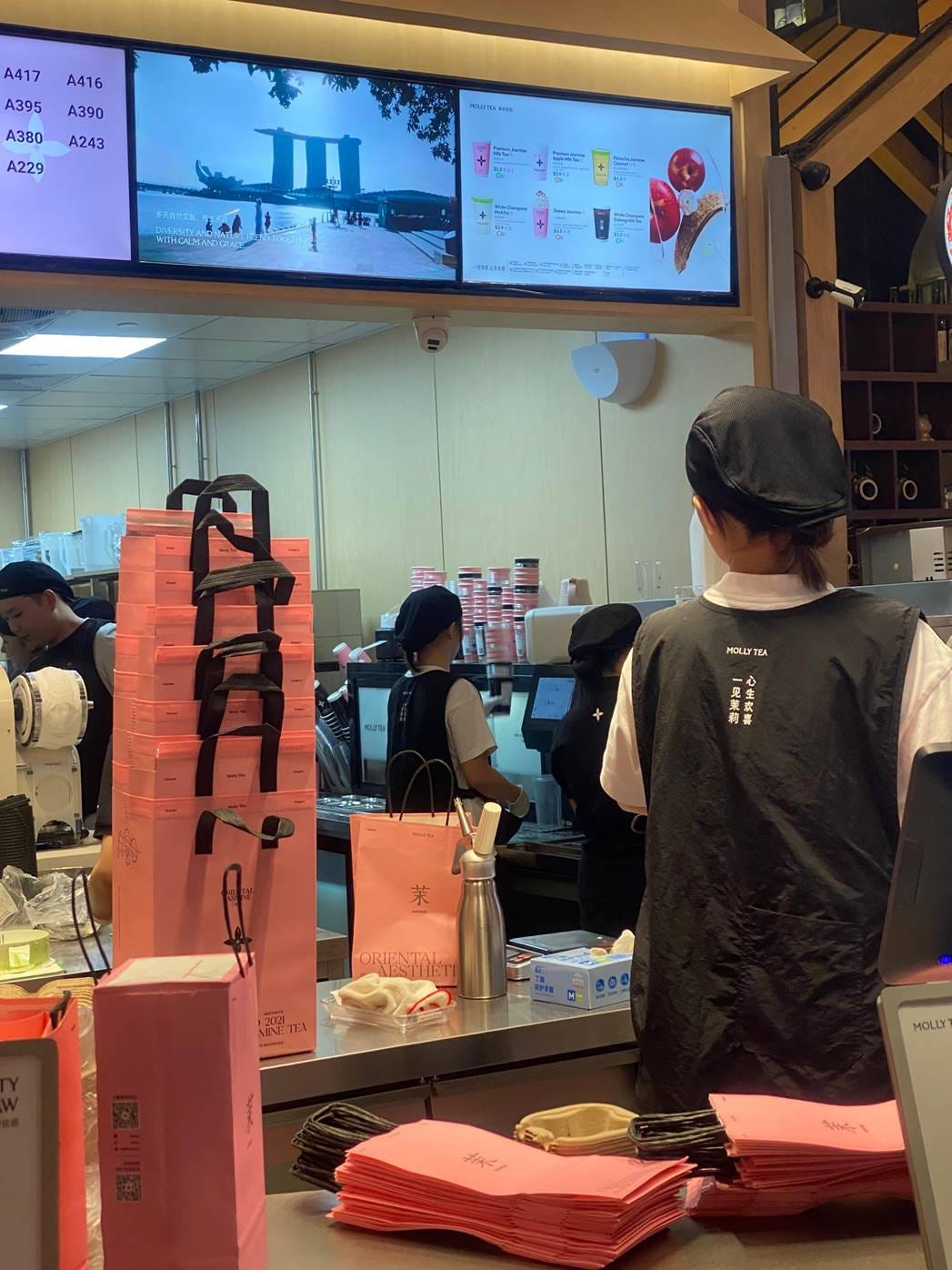
Look at the far-right corner: the mountain of cups stacked together. Each cup represents an unfulfilled order.
Here’s a close-up:
Source: Angsana Anderson
Besides the mountain of teacups, I want to highlight the automated tea-making machine.
Part of the bull case for CHA is its automated tea-making machines. CHA wrote in its prospectus: “we have developed automated tea-making machines that significantly enhance the efficiency of store staff, reduce consumer wait times, and elevate the overall consumer experience.”
CHA continues: “By incorporating our self-developed tea drinks recipe parameters into these machines, we enable our store staff to craft each cup of tea drinks [sic] in consistent high quality at approximately 8 seconds, eliminating the need for memorizing intricate operational protocols.”3
Sadly, a competitive advantage is not much of an advantage if competitors can easily copy it. Automated tea-making machines are now even available through third-party suppliers.4
At Molly Tea, I watched a staff prepare tea using an automated tea-making machine. The machine functions like the one in CHA’s stores. Based on the crowd, I reckon the taste is just as good or better than CHA’s.
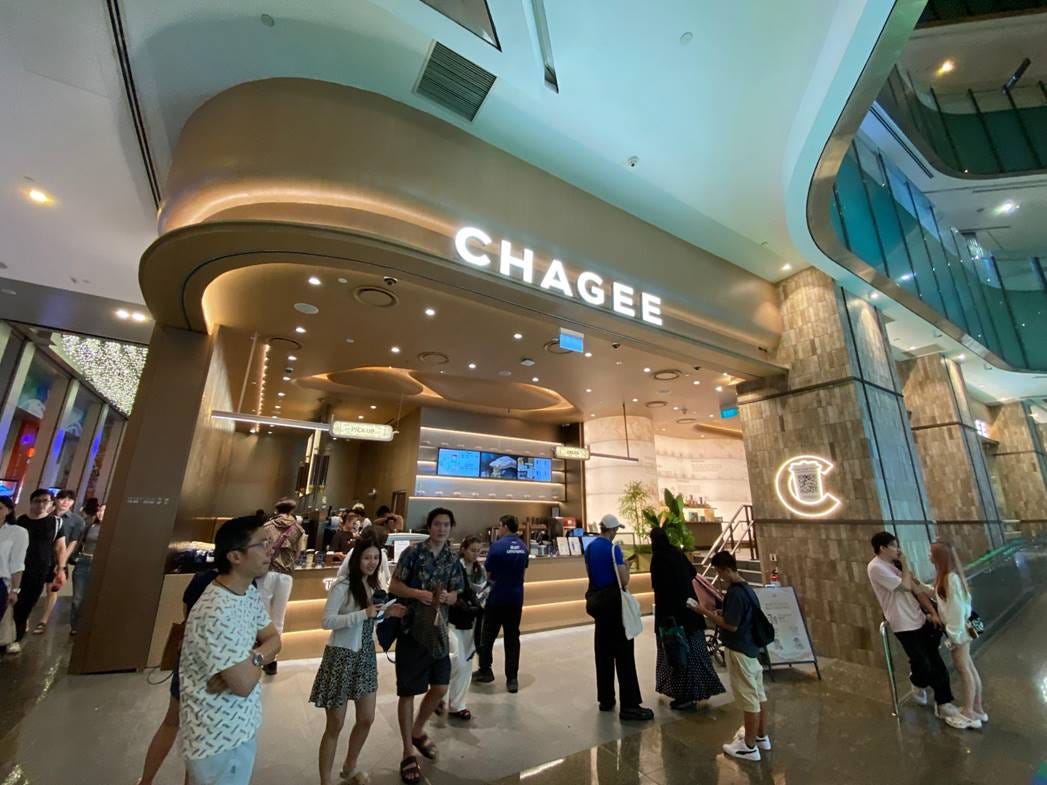
Let’s move on to CHA’s flagship store in Orchard. It’s less than 5 minutes’ walk.
Source: Angsana Anderson
This is the best photo I could take without attracting attention, so I will have to lean more on my written observations. I have two observations.
First, CHA’s store looks much less busy than Molly Tea.
Second, I saw at least two staff idling. Excess staff suggests demand is weaker than expected. Store managers prepare staffing roster based on their expectation of demand.
Rapidly shifting consumer tastes.
Active customers likely declined. One of my favourite techniques is to compare the latest earnings release with the prior one.
Management usually drafts the new release by rolling forward the previous quarter’s document. If I notice a subtle shift from positive to more neutral language, it often points to a weaker outlook. Most importantly, I pay close attention to any KPIs that are redefined, deprioritised, or quietly removed.
In Q4’25, CHA removed ‘active members’ from its key operating data disclosure table.
CHA explained that it had expanded its definition of active members to include “traceable member activity across other third-party online delivery and social networking platforms.”5 As a result, its active members finally broke its declining trend:

Source: CHA
CHA did not provide a like‑for‑like active member number under the previous definition. If it had not expanded its definition, I believe active members would likely have shown a significant decline.
What is driving the declining trend?
“You’re hot and you’re cold” I believe the answer lies in the rapid change in consumer tastes, and CHA’s failure to respond quickly.
According to Cao Yang, “Boya Juexian used to account for more than 50% of the store’s sales, making it a solid pillar of sales. But in the past two years, Boya Juexian has become increasingly difficult to sell…”6 Boya Juexian is Chagee’s bestselling drink, a jasmine milk tea.
The franchisee added: “New tea drinks lack the addictive qualities of coffee products, making it easy for consumers to experience taste fatigue. On social media platforms, many consumers are saying they’re tired of Boya Juexian and don’t want to drink it again after a few tries…”
CHA is struggling to keep up with the rapid shift in consumer tastes.
From Jan to early Dec 2025, CHA launched just 8 new products, and only 4 after Jun, 2 of which were iterations of Boya Juexian. Between 2022 and 2024, rivals launched many more new products than CHA.

Source: 蓝鲸新闻 (2026)
CHA seems to have recognized this problem. During the Q4’25 earnings call, CEO Zhang admitted: “Honestly, we took some detours in new product launch rhythm and marketing execution, and we did not fully keep pace with how fast the market was moving.”
Factors that could lead to a re-assessment of my decision
Strong evidence that the industry is not as saturated and competitive as I believed (e.g. sustained recovery in same-store GMV growth).
New entrants stop entering, existing competitors start exiting.
CHA demonstrates consistent ability to follow consumer tastes.
According to CEO Zhang, CHA’s new “Signature Pu-Erh Tea” launched in Dec 2025 drove a 16% week-over-week GMV uplift, significantly exceeding the historical average for all new products.
If CHA’s new “Signature Pu-Erh Tea” and future new products continue to perform well, this will warrant a re-assessment.
Coming up next
Micro-Mechanics: After a +90% rally, is it still cheap?
At the start of the year, Micro-Mechanics was an unloved orphan. The consensus? "A lousy cyclical business with no liquidity."
Today, the narrative has flipped. After surging +90% year-to-date, there is palpable excitement surrounding Micro-Mechanics (Holdings) Ltd. (5DD; MMH SP).
In my next post, I’ll break down why I bought shares in 5DD on 28 Jan 2026. I will also try to make sense of the sudden rally that even surprised me.
Finally, I will tackle the most important question: Is it still cheap?
Subscribers get my analysis first. Free to join.
Subscribe for 2 to 3 analyses of global SMID equities every week. Discover overlooked ideas and rethink familiar names. Published by Andrew Wong, ACA, CFA
Disclaimer
This is a record of my investment decisions, not financial advice. I may change my decisions without notice. Use this only for education and entertainment. All analysis and opinions expressed are solely my own, and CHA has not reviewed or endorsed this post. Do not rely on this for your investment decisions. I do not hold any positions, long or short, in CHA.
Solid work, love the in-person DD. Might be shortable if it ever gets a bounce.
I was reading Mauboussin’s Expectations Investing and his case study on Domino’s Pizza had me sniffing around Mixue Bingcheng for a bit. But involution in China’s really intimidating. ^^;;