

Every Monday, I share my first take on 2 to 3 attractive ideas.
As usual, if you want me to dig deeper into an idea, vote for it. Use the poll at the end of this email.

Riverstone Holdings Limited (AP4; RSTON SP)
Peers like Top Glove are already recovering, but RSTON still sold off. I suspect investors are overlooking RSTON because it is listed in Singapore, despite operating in Malaysia.
Investors are also overestimating competition from China and underestimating RSTON’s growth potential.
RSTON earns most of its profits from cleanroom gloves. These are less commodity-like because of higher technical requirements and customisations.
About (16 Oct 2026)
Share price: SGD 0.74
Market capitalisation: SGD 1,089 mn (USD 851 mn)
Enterprise value (EV): SGD 907 mn (USD 709 mn)
Average daily volume (ADV): SGD 2 mn (USD 1 mn)
NTM P/E: 15x
My initial estimate suggests ~ 8% long-term free cash flow yield on enterprise value, ~4% premium over the Malaysia 10-year government bond. Looks attractive.
RSTON makes gloves.
It allocates roughly 80% of production capacity to healthcare gloves and 20% to cleanroom gloves, but the cleanroom segment contributes around 70% of the group's gross profit.1
Cyclical inflection?
RSTON’s shares (green) trade in line with peers like Top Glove Corporation Bhd. (TOPGLOV; TOPG MK) (purple).
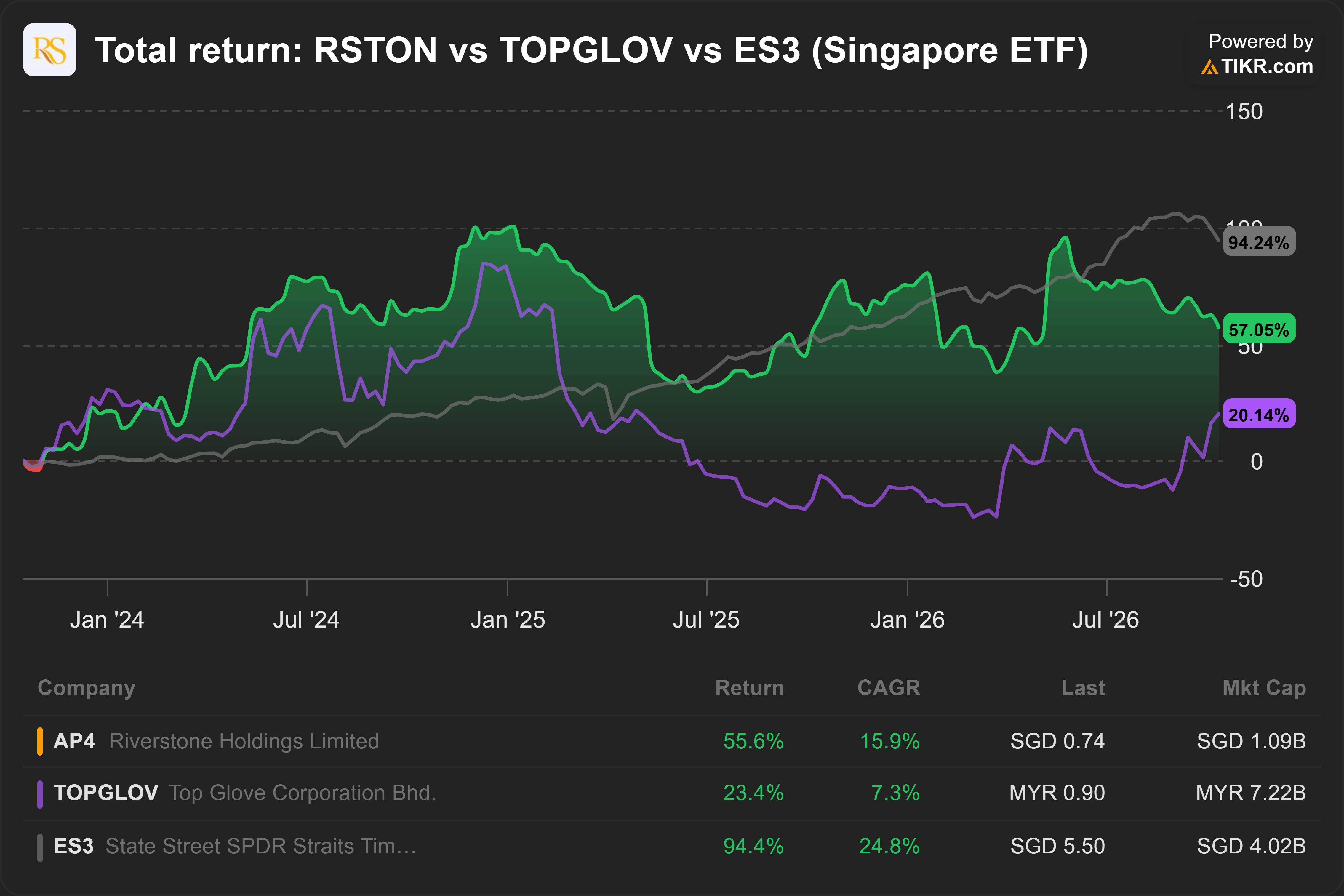
TOPG shares (purple) started recovering in Sep 2026. Profits came in better than expected. Last week, TOPG reported demand outpaced supply growth.2
During the same period, RSTON’s shares continued falling. I suspect the fall is mainly driven by the sell-off in Singapore equities (grey).
Investors may be overlooking the industry read-through and the fact that, despite being listed in Singapore, RSTON operates from Malaysia.
Under-recognised growth?
Investors view RSTON as a commodity glove producer, vulnerable to competition from China.
However, they are likely overestimating competition and under-estimating RSTON’s growth potential.
70% of its gross profits come from cleanroom gloves. These are used in manufacturing semiconductors and require high levels of customisation.
CEO Wong Teek Son explains:3
For instance, a single customer operating facilities across different countries might have different requirements at each site. Riverstone would then have to develop a distinct product for each.
Because the qualification process is so rigorous, switching suppliers is costly and disruptive. Once Riverstone’s glove is qualified at a facility, it tends to stay.
As a result, cleanroom gloves are less commodity-like.
CGS International, a broker, estimates RSTON’s cleanroom gloves yield ~ 46% gross profit margin (GPM), almost 3x the GPM achieved by healthcare gloves.4
Semiconductor makers are rushing to open new fabs. When they come online, RSTON’s revenue growth should accelerate.
Capital returns?
8% next twelve months dividend yield looks attractive.
But is it sustainable?
At first glance, likely yes.
Right now, Riverstone plans to continue its approach of paying out approximately 100% of earnings plus a special dividend roughly equal to annual depreciation.
It is a practice that has been consistent for years, aligned with Wong’s intent for capital to flow back to shareholders.5
High net cash balance (~60% of revenue) supports continued high dividend payout ratio.
Factors to focus on
Where are we in the glove cycle?
Try to quantify the revenue growth when new semiconductor fabs open